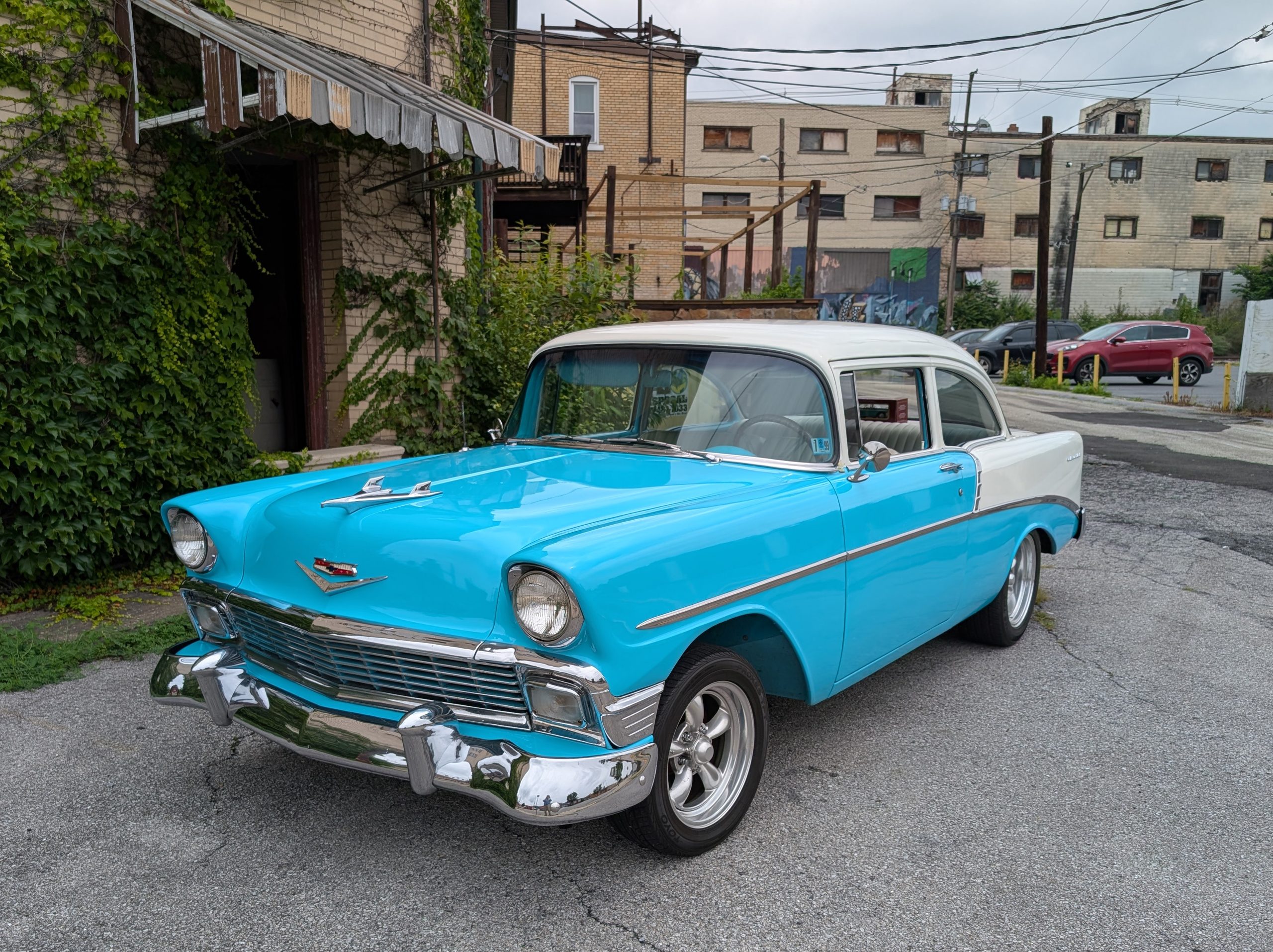
Somebody parked a sixty-nine-year-old Chevrolet against an ivy-choked brick wall in a small Pennsylvania coal town, and the turquoise on it is brighter than anything else on the block, including the dumpster.
It’s a 1956 Chevrolet Two-Ten two-door sedan. Chevrolet sold three trim levels that year, the bare-bones One-Fifty, the Two-Ten in the middle, and the Bel Air on top, and this one is the middle child. The name came from the factory paperwork: the series was coded 2100, and Chevrolet trimmed a digit to ride the 1950s fashion for numbered model names.
How to read it from the curb
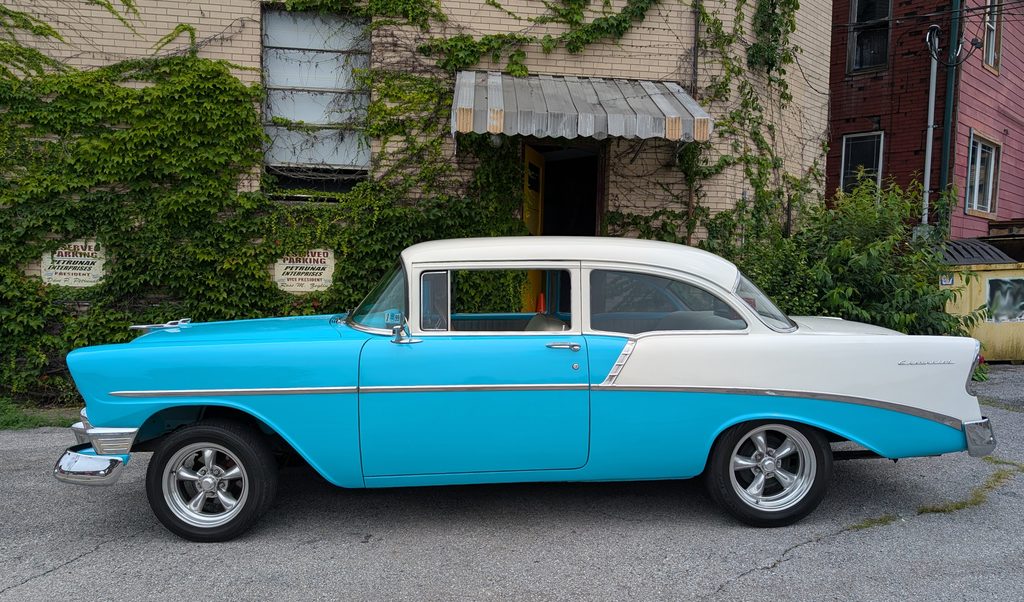
The side trim gives it away. A Bel Air wore two parallel chrome spears with the wedge between them filled in by an aluminum panel. The Two-Ten got a single spear that dips ahead of the rear wheel, and with the two-tone option the wedge was painted in the roof color, with “Chevrolet” in script inside it. That’s the ivory sweep on this car’s quarter panel.
The year shows up front. The 1955 grille was a small egg-crate in a narrow opening; for 1956 the grille runs the full width of the nose and wraps the rectangular parking lamps into its ends. The 1957 would bring the bigger bumper and the tall fins.
And the gold V tucked under the crest on the hood and trunk lid told the 1956 buyer, and tells you, that this car left the plant with a V8.
How it’s built
Underneath the paint, this car is two machines bolted together. A steel ladder frame carries the engine, transmission, suspension, and the loads from all of them. The body sits on top on rubber mounts. Think of the frame as the skeleton and the body as the skin and coat: the body has to hold its own shape, but the frame does the heavy lifting.
The center post between the door glass and the rear side window matters here. Chevrolet sold a pillarless hardtop alongside this sedan, and the hardtop looked sleeker with the windows down. Take that post away, though, and the roof has nothing tying it down at the middle, so the rockers and floor have to absorb the twisting loads the post would have carried. With the post in place, roof, pillar, and rocker form a closed ring, like a picture frame with a brace across it. That made the post sedan stiffer, lighter, and cheaper, which is one reason hot rodders and drag racers went looking for them.
The front suspension was new for the Tri-Five generation. Chevrolet dropped the old kingpin setup for ball joints, which let each front wheel steer and travel up and down on two pivot points, the way your hip lets your leg swing in more than one direction. Out back, the 1955 redesign also retired the torque tube, a rigid enclosed driveshaft that shoved the car forward through a single mounting point. In its place came an open driveshaft and leaf springs that did two jobs at once: hold the rear axle in place and take the twisting reaction from the axle as the engine pushes against it.
The engine that gold V advertised was the 265-cubic-inch small-block, introduced for 1955. It was designed light. Thin-wall castings kept the weight down, and each rocker arm pivoted on its own stamped-steel ball stud instead of riding a shared heavy shaft, which cut weight from the valvetrain and let the engine rev. The base version made 162 horsepower with a two-barrel carburetor. For 1956 Chevrolet offered a four-barrel “Super Turbo-Fire” at 205, and a dual-four-barrel version at 225.
Chevrolet also moved the whole car to a 12-volt electrical system in 1955, ahead of its rivals in the low-price field, which made cold starts on a high-compression V8 a lot less of a gamble.
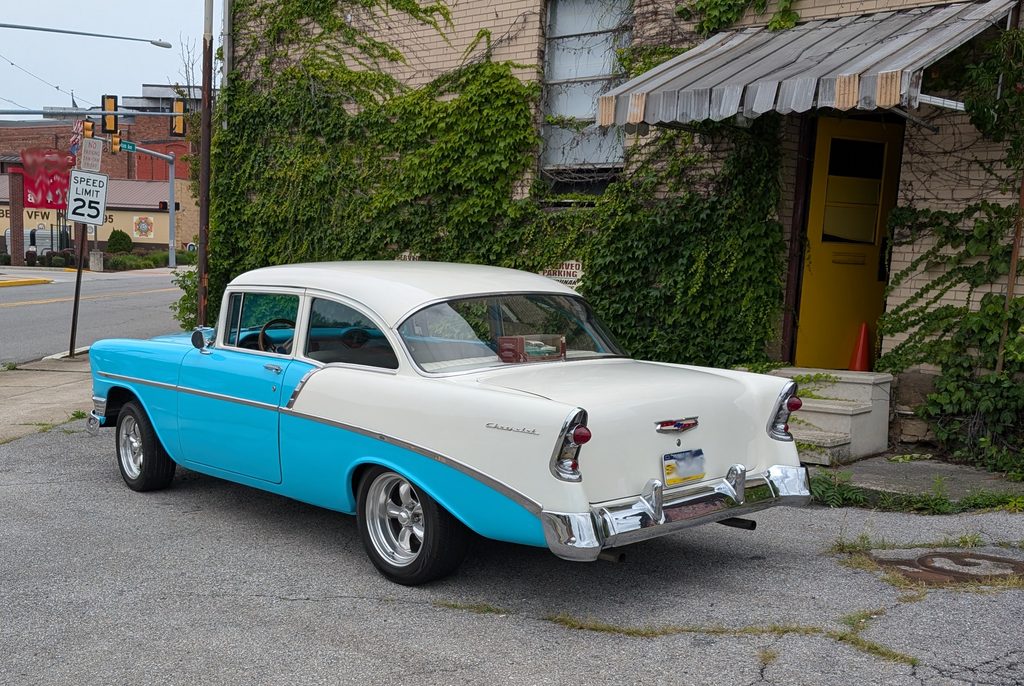
Then there’s the party trick. Look at the left rear of this car and you won’t find a gas cap. For 1956 Chevrolet hid the filler behind the driver’s side taillight, which swings down on a hinge. Cadillac had done it first, and putting a Cadillac trick on a Chevrolet was the whole sales pitch of the decade in one hinge.
This one has been set up for the road it drives on now: a slight drop in stance, polished five-spoke mags, and modern radial tires where bias-plies and hubcaps once sat.
How it got here
Before 1955 a Chevrolet meant a six-cylinder, the “Stovebolt,” while Ford had been selling flathead V8s since 1932. Chevrolet’s previous V8 dated to the Series D of 1917, built for two years before the company joined General Motors. The 265 changed the arithmetic. Paired with the optional Powerglide automatic, it earned the 1955 Chevrolet its nickname, “The Hot One.”
The 1956 facelift came from the dealers. They felt the ‘55 looked plain beside the competition, so the styling department under Harley Earl added chrome, widened the grille, and reworked the rear lighting into one cluster. Chevrolet spent that year proving the engine as much as selling the styling: a 1956 Chevrolet won the Pikes Peak hill climb, and Smokey Yunick drove one to a 24-hour average-speed record for American production cars of 101.58 mph, beating Chrysler’s previous mark by close to 12 mph.
The middle child carried the family. Chevrolet built 205,545 Two-Ten two-door sedans for 1956, priced from $1,910, and the Two-Ten series as a whole ran past 737,000 cars, about 47 percent of the company’s output that year. After 1957 the Two-Ten name was retired in favor of the Biscayne.
The reason so many of these survive and keep running traces back to that 1955 engine. The 265 grew into the 283, then the 327, the 350, and onward, and the family kept enough of the same bones that a later small-block bolts into a Tri-Five without much argument. What’s under this hood today, only the owner knows. The V on the hood tells you what Chevrolet put there, and the family resemblance tells you why it’s still on the road to argue about.
Sources
- Wikipedia, “Chevrolet 210” — en.wikipedia.org/wiki/Chevrolet_210
- Wikipedia, “Tri-Five” — en.wikipedia.org/wiki/Tri-Five
- Conceptcarz, 1956 Chevrolet Two-Ten production and pricing — conceptcarz.com/vehicle/z14559/supercars.aspx
- Hagerty Marketplace, 1956 Chevrolet 210 Two-Door Sedan listing — hagerty.com/marketplace/auction/1956-Chevrolet-210/f1bda65e-04f1-4c07-b0e3-a66be800ecec
- Classic Auto Mall, 1957 Chevrolet 210 description of Two-Ten side trim — classicautomall.com/vehicles/568/1957-chevrolet-210-2-door-sedan
- RM Sotheby’s, 1956 Chevrolet Bel Air Sport Coupe lot notes — rmsothebys.com/auctions/mo21/lots/r0152-1956-chevrolet-bel-air-sport-coupe
- The Daily Record (Dunn, NC), Nov. 2, 1955, p. 6, Chevrolet 1956 announcement — newspapers.digitalnc.org/lccn/sn88063132/1955-11-02/ed-1/seq-6/
- Martin Auto Museum, 1955 Chevrolet 210 entry — martinautomuseum.org/collection/1955-chevrolet-210-2nd-gen-2-door-sedan