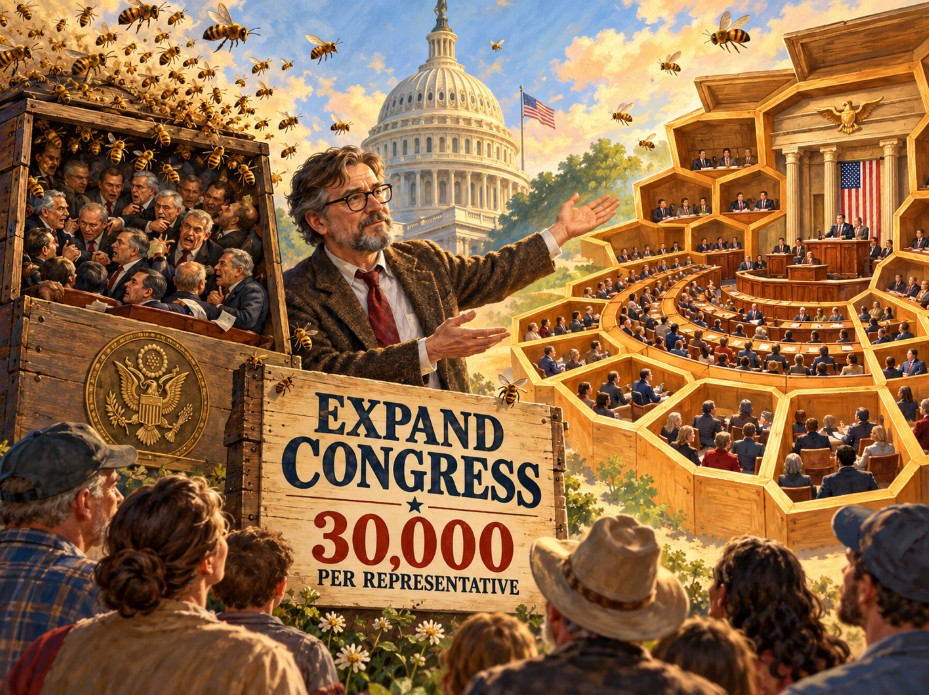
In June I added a third box to the hive down by the river. Bees build until they run out of room, and a colony that runs out of room doesn’t shrink to fit. It swarms. Half the household lifts off with the old queen to find a hollow tree, and the keeper is left with a box of empty comb and a lot less honey than he planned on. The fix costs about forty dollars and ten minutes: give them space before they need it. A beekeeper who won’t add boxes on principle does end up with a smaller hive; he gets there by losing half of it.
I thought about that box this week while turning over an old motto: “That government is best which governs least.” I have liked that line since I was a boy. Grammina had her own version, which she claimed came from Jefferson and which came, as usual, from Grammina: “Govern light, Nate, but don’t govern blind.” Jefferson never wrote the original either. It started as a magazine motto in 1837, and Thoreau borrowed it to argue for no government at all. I’m a small-government man and have been for thirty years; I’m not about to apologize for it now. But I’ve come to think we’ve been reading the motto with one eye shut.
A government governs least when its laws are written close to the people they bind, by representatives those people can find. Ours has drifted a long way from that, and the drift is a matter of plain arithmetic.
Madison understood it. Defending the Constitution, he wrote that “the representative ought to be acquainted with the interests and circumstances of his constituents,” and he promised skeptics that the number of representatives would be augmented from time to time as the country grew. He meant it. The first amendment he sent to the states in 1789, ahead of the ones we now call the Bill of Rights, set rules for how the House would grow. It fell short of ratification, and it still sits, technically, before the states. For more than a century afterward Congress kept the promise anyway. Census after census, the House grew with the nation, from 59 members in 1789 to 435 by 1913.
Then in 1929 Congress froze it. At 435 seats, each member then spoke for about 280,000 people. After the 2020 census the figure was about 761,000, and it’s on pace to reach a million within a generation. The Constitution sets a floor of 30,000 people per representative and no ceiling. The cap at 435 is an ordinary statute, passed by an ordinary Congress, and an ordinary Congress could undo it.
Here is what happens inside a box that’s too small. Four hundred thirty-five people can’t write detailed law for 330 million, so they write broad law and hand the details to agencies. The agencies write the rules Congress lacks the hands to write, and citizens end up governed by officials they didn’t elect and can’t remove. Meanwhile, each district stretches. Campaigns cover more ground and cost more money, and a candidate without a fortune or a patron gets priced out before the first yard sign goes up. A seat that expensive belongs, in practice, to whoever can afford to fill it. Nobody had to scheme for this to happen. We simply left the hive without room.
My friends on the right want fewer rules, leaner agencies, and a federal government that stays in its lane. So do I. The frozen House works against all three. It’s the very thing that feeds the administrative state we complain about, because a legislature without enough legislators has to delegate or do nothing. If we want Congress to do its own job, we have to give it enough people to do the job. A larger House could write its own laws, read its own bills, and answer its own mail. It could also be reached by a citizen with a grievance and a free Tuesday afternoon.
I’ll confess something. At seventeen I won a county debate trophy arguing that Congress should be cut in half. Fewer politicians, I said, means less politics. The judges loved it. I was wrong, and it took me about thirty-five years and one swarm of bees to work out why. Fewer representatives don’t mean less government; they mean government that answers to fewer people.
So here is where I stand, and where I’ll stay: I want a smaller government, and the road to one runs through more elected representatives. Self-government is a living thing. Hold it in a box it outgrew a century ago and it doesn’t stay small and obedient; it goes looking for a hollow tree, and whoever owns the tree decides what becomes of it.
Grammina kept bees too, before me. She said it plainer than I can:
“Give ’em room, Nate, or they’ll find somebody else’s.”
Sources
- James Madison, Federalist No. 56, and Madison’s ratification-era assurances on House growth (via Independent Institute)
- Monticello, “That government is best which governs least (Spurious Quotation)”
- FEE, “Who Said ‘The Best Government Is That Which Governs Least’?”
- American Academy of Arts & Sciences, “The Case for Enlarging the House of Representatives”
- eScholarship, “The House of Representatives Needs to Expand”
- Congressional Apportionment Amendment (proposed 1789, still pending before the states)