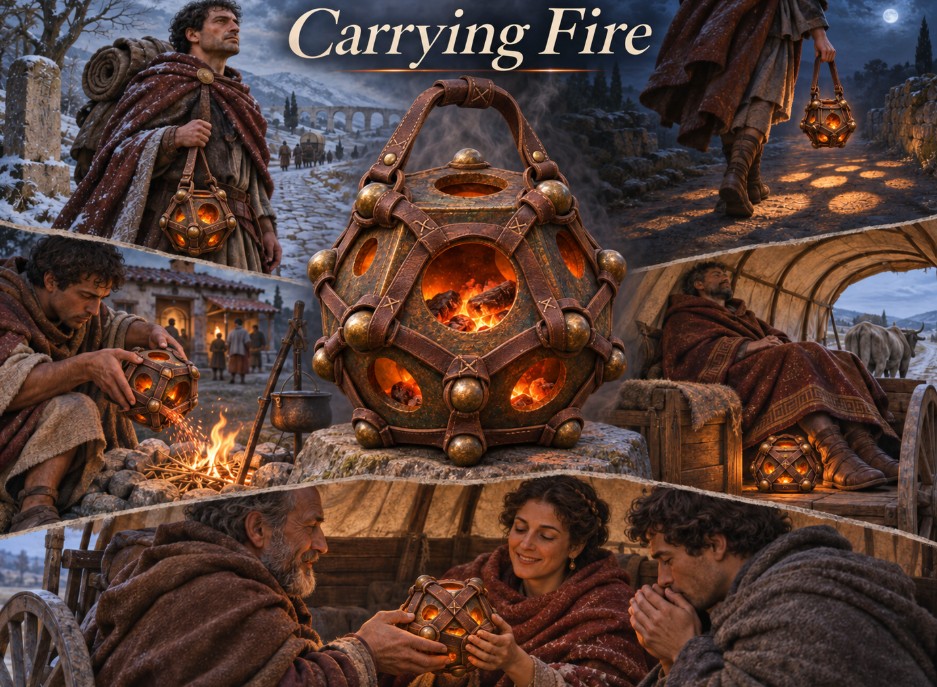
The Roman Dodecahedron as a Traveler’s Hearth
A Bright Meadow Group thought piece
Observe
In 1991 hikers in the Ötztal Alps came across a man who had died up there around 3300 BC. Ötzi had a full kit on him, and two pieces of it matter here. Near the body sat a pair of birch-bark canisters, each cut from a single sheet of bark and stitched with lime bast. One was blackened inside and held charcoal fragments with freshly picked Norway maple leaves. The working explanation is that he wrapped live embers in the leaves and carried them in the canister, which kept the fire alive for hours and let him fan up a blaze in seconds at the next stop. He also carried tinder fungus with flint and pyrite, a backup kit for the days the ember died.
That was the baseline for thousands of years before the friction match showed up in the 1820s. Fire was something you kept going, the way a baker keeps a sourdough starter alive instead of buying yeast each week. Striking sparks onto tinder took skill and patience, and on a wet or freezing day it could fail you. Carrying an ember was the easier road, and travelers took it.
Now set that next to one of archaeology’s stubborn puzzles. About 130 hollow bronze dodecahedra have turned up in the northwestern Roman provinces, dated to the 2nd through 4th centuries AD. Each has twelve pentagonal faces with a round hole through each face, the holes ranging from about 6 to 40 mm on the same piece, and a small knob at each of the twenty corners. No Roman writer describes one, no painting or carving shows one in use, and scholars have floated around fifty theories since the first was recorded in 1739.
BMG doesn’t claim to have solved it. We came at it through a different door, and the door is about the method.
The Question Behind the Question
The usual approach to a mystery object is to ask what it was for. That question carries a hidden handicap: we answer it from inside our own lives, and our lives have dropped whole categories of need.
So we asked a different one. What did people of the period need, day after day, that we don’t think about anymore because we don’t need it anymore?
A modern traveler flips a switch for light, turns a dial for heat, and thumbs a lighter for flame. Those three chores have vanished into wiring, ductwork, and a plastic lighter by the gas station register. Because they’re invisible to us, an object built to handle them looks like a riddle.
The buttonhook makes a good example. To us it’s a strange bent wire on a handle. To anyone living in the Victorian era, it was how you got your boots on in the morning, as plain as a shoehorn. The need went away with button boots, and the tool turned into a curiosity. Give it a few more centuries with no written record, and somebody will propose it was a surgical instrument or a ritual pointer.
Apply that to a Roman-era traveler on a cold road between dusk and dawn. The list of needs is short and urgent: keep fire alive, see in the dark, stay warm. Then set the dodecahedron on the table and ask whether it answers them. It answers each one.
Design
Read as fire gear, the features line up.
The hollow, perforated shell is an ember cage. Bronze holds coals without the risk of burning through, a risk a bark canister faces whenever the leaves dry out.
The mismatched holes work as a draft control. Set it down with a large hole underneath and air feeds the coals from below. Roll it onto a small hole and the burn slows. It’s a stove damper you adjust by turning the stove.
The same holes make it a lantern. Glowing coals throw spots of light through the openings, big and small. Swing it or blow into it and the coals brighten, the way a censer flares on the upswing, so you get more light right when you need it on a dark road.
The knobs are standoffs and handholds. Resting on a few small points, the hot body sits up off a table or a wagon bed instead of scorching it. The knobs run cooler than the walls, give you something to pinch or hook with a forked stick, and add surface to shed heat, the way fins do on an engine block.
The bronze mass makes it a heater. Metal soaks up heat and gives it back. Carriage and church foot warmers from the 1700s and 1800s worked on the same principle: perforated metal boxes of hot coals set on the floor under a lap robe. A small bronze one tucked under a cloak or set in a wagon on a cold ride would earn its keep.
It sits steady on any face. At night in camp it’s a light. In the morning the coals start the cook fire.
Line up the possible uses and the case builds on itself:
- Ember carrier, keeping fire alive between stops
- Fire starter at the inn or camp, coals ready on arrival
- Road lantern, swung or blown on for a brighter glow
- Camp light, set on any face for the night
- Foot warmer on a wagon floor, raised on its knobs
- Cabin heater for a covered carriage
- Hand warmer, strapped in leather and passed down the bench
Then look at where they turn up. The finds scatter across Britain, France, Germany, the Low Countries, Switzerland, Austria, and Hungary, with one as far southeast as Serbia. Where the context is known, it’s often a military site or a grave, sometimes a bath complex. They don’t cluster around one workshop or one road. That spread fits something portable that moved with its owner.
And there aren’t many. About 130 survivors across three centuries in a populous region means this was no standard issue for the man on the road. Ötzi’s canister cost him an afternoon with a birch tree. A cast bronze dodecahedron took a skilled metalworker and a fair amount of metal. The difference is the gap between a paper matchbook and an engraved brass lighter. Both carry fire; one says something about the person carrying it.
Picture the owner. A merchant moving goods between Gaul and the Rhine frontier rides in a carruca, the covered four-wheeled wagon well-off Romans traveled in, some fitted out for sleeping. At his feet sits a bronze ball of coals. It takes the chill off the cabin, throws enough light after sundown to see his ledger, and rolls with the ride on its knobs without tipping. Wrapped in a leather strap wound between the knobs, it passes from hand to hand down the bench, each rider warming his fingers before handing it on, the way a flask makes the rounds on a cold night. At the inn or the roadside camp, his servant carries it in by the knobs and there’s fire for the evening before anyone strikes a spark. It’s a fancy lantern, heater, and fire tote in one, the luxury version of the clay pot of coals a poorer traveler made do with.
Intervene
The objects themselves can answer this. Live coals leave evidence: heat tint on bronze, carbon or soot inside, scorch residue around the holes. Some observers report that the surfaces show little wear, and a fire carrier in steady use should show some. A survey of interiors under magnification, with residue testing, across the examples held in museums would go a long way toward settling it.
The second test is to build one. Cast a replica at the common size of 6 to 8 cm, load it the way Ötzi loaded his canister with charcoal and maple leaves or with tinder fungus, and log the results: burn time with each face down, temperature at the knobs against the walls, how much light it throws, and how long it keeps a wagon seat warm. The museums holding originals, such as the Gallo-Roman Museum in Tongeren, the Rheinisches Landesmuseum in Bonn, and the Hunt Museum in Limerick, along with the volunteer group that dug up the Norton Disney example in 2023, are natural partners. A foundry and a weekend in the field cover the rest.
Whatever the Gallo-Romans called it, the dodecahedron answers needs a Roman traveler felt in his bones and we’ve forgotten we had. When an old object won’t give up its purpose, the first place to look may be the chores we no longer do.
Sources
- South Tyrol Museum of Archaeology, Ötzi’s equipment: https://www.iceman.it/en/equipment/
- Wikipedia, Roman dodecahedron: https://en.wikipedia.org/wiki/Roman_dodecahedron
- Imperium Romanum, “Twelve faces, zero answers”: https://imperiumromanum.pl/en/curiosities/twelve-faces-zero-answers-the-greatest-mystery-in-roman-archaeology/
- Nunc, “Gallo-Roman dodecahedron: twelve faces, zero answers”: https://nunc.ch/en/gallo-roman-dodecahedron-twelve-faces-zero-answers/
- Geograph, Norton Disney Dodecahedron: https://www.geograph.ie/snippet/24229
- Guggenberger, M. and Leach, S., “The Gallo-Roman Dodecahedron and the Receptacle of All Becoming,” The Antiquaries Journal, vol. 105, 2025, pp. 31–54