Twenty pieces, one design for repairing the republic
Earlier this year, in “Democratic Drift,” Nathaniel Leery described a bend in an old river where the bank gives up a few inches each spring. Nobody notices any single season. After enough of them, the river has a different shape. His point was that the American republic changed the same way. A cap on the House in 1929, direct election of senators in 1913, and the slow conversion of the presidency into a prize each moved the structure, and the structure moved the behavior.
Since then this site has published twenty pieces on government structure, in five voices. They were written one at a time, but they describe a single machine. This piece lays them out in the order a repair crew would work: first what’s broken, then each part, then where to begin.
What is broken
The politicians are the part of the failure everyone can see. In “The Politicians Are the Visible Failure,” the example was the Stop Insider Trading Act. It was a popular stock-trading ban with ninety-three cosponsors. Before the floor vote, leaders attached a federal photo ID requirement that reached mail-in ballots. Two Democrats who had cosponsored the original bill found their proposition had become a different object, and they had to vote on the object. The argument assigned the deeper blame to a press that reports the scoreboard and to voters who stop at the headline. It also admitted the limit of that blame. Bundling unrelated ideas into one vote breaks no rule, and a vigilant public would have to fight it case by case, forever.
“Box Score Citizenship” offered the hopeful half of the same observation. A fan in a Johnstown bar can walk you through how a pitching staff got ruined, with causes, incentives, and front-office blame in the right order. That is the reasoning a republic needs, aimed at the wrong field.
The pieces below treat the structure as the thing to fix.
The unit of law
“One Line, One Vote” starts with the smallest part. A modern public law holds hundreds of separate propositions and passes on one recorded vote, so the record shows a member’s position on the package and on none of the propositions inside it. The proposal changes the unit of enactment. The code becomes the law, and legislation becomes an edit to it at a specific address: insert this line, strike that one. A line states one operative proposition, meaning one actor, one action, one set of conditions, and one consequence. Each edit carries its sponsor, its vote, and its history.
Coalitions survive this. A member who will support a mine cleanup only if a severance tax passes can still make that trade, as a recorded condition at a public address. Emergencies can move as a package under narrowly defined triggers, but each line inside gets its own recorded vote within sixty days or expires. Because each bill carries one proposition, a president vetoing a bill vetoes one line. That delivers the line-item veto without the defect that sank it in Clinton v. City of New York.
“Forty-Three Failures Do Not Settle the Question” answers the obvious objection that the states already tried this. Forty-three state constitutions carry a single-subject rule, and courts have failed to enforce it consistently because “subject” stretches to fit whatever a legislature calls it. Those rules governed the container and left the provisions bundled inside it. They also arrived through litigation, after the damage was done. A line-addressed system defines the unit by its structure and checks it at drafting, before anyone votes.
“Government Secrets?” supplies the standard for the record itself. The Speech and Debate Clause protects legislators from executive retaliation, and it presumes the public can hear what they say. Under that standard, legislative work happens on a timestamped, searchable, permanent public record, and secrecy is a logged exception.
The vote is the job
A system built on recorded votes fails if members can skip them. “The Empty Chair” sets the threshold at ten percent. A member who fails to enter a yea or nay on more than one recorded decision in ten has stopped doing the one part of the office that can’t be delegated. “Present” counts as no vote.
The piece drew its cases from both directions. Kay Granger stopped voting in 2024, and her district finished the term represented by a name because the Constitution has no category for a seat that is occupied and inert. A forty-year attendance record didn’t keep Mitch McConnell’s seat from going dark for six weeks during votes decided by one.
The mechanism comes in two stages. Under current law, a chamber rule can make crossing the threshold trigger a privileged expulsion motion with a recorded vote, so protecting an empty chair becomes a public act. The durable version is an amendment defining sustained nonperformance as a vacancy. The piece also offered this as an alternative to term limits, which remove the diligent member and the absent one on the same timer.
The size of the House and the Presidential Vote
In “Letter on the Size of the House,” Leery argued that a smaller government needs more representatives. At 435 seats, each member now speaks for about 761,000 people. A legislature that small writes broad law and hands the details to agencies, so citizens end up governed by officials they didn’t elect. The cap is an ordinary 1929 statute, and an ordinary Congress could repeal it.
“The Distributed House” worked out the mechanics. At the constitutional floor of one representative per 30,000 people, the House would seat about 11,300 members. Each state builds a delegation hall in its capital, sized for growth. Members deliberate on a secure congressional network with a public read-only mirror and vote in synchronized sessions across all fifty halls. In Washington, each state is seated by two senior members, one from each major party. They certify the votes already cast at home, and each checks the other’s count. A 2025 Fifth Circuit ruling that the quorum clause doesn’t require physical presence opens the legal door.
Robert Smith’s “Electoral College Reform” carries the same arithmetic into the presidential vote. Each state’s electors equal its House seats plus its two Senate seats. That makes the presidential vote a blend: a people’s share that tracks population, plus a fixed states’ share of 100 electors. The framers expected the states’ share to shrink in relative weight as the House grew. The 1929 freeze capped the people’s share instead, so a Wyoming resident’s presidential vote now counts about 3.6 times a Californian’s. At one representative per 30,000 people, the Electoral College grows to roughly 11,400 electors and the gap falls to about 1.1 to 1. Repealing the cap updates the House, the Electoral College, and the District of Columbia’s electors together, with no amendment. States would still decide how to award their electors, and a deadlocked election would still go to the House with one vote per state delegation.
The Senate and the ballot
“Letter on the Manner of Choosing Senators” aims to restore the states’ voice inside the federal government, which they lost when the Seventeenth Amendment made the Senate a second popular chamber. The proposal gives each state two senators by two roads: one appointed by the governor and one chosen by the legislature, with staggered terms. Voters still hold the reins through the statehouse elections they already vote in.
“The Third Shelf” moves to the ballot. Winner-take-all, single-seat districts gather Madison’s many factions into two ropes, a pattern political scientists call Duverger’s law. Ranked choice voting removes the penalty for supporting a third option. Australia has used it for its House since 1918. There the two big blocs endure, but they function as coalitions that bargain for second-place rankings in the open. Maine and Alaska show modest early results. The piece treats ranked choice as an on-ramp, with multi-member proportional districts further down the road.
The courts
“The Judicial Loop” takes on gap-filling. When a statute doesn’t answer the case in front of a judge, the judge has to decide anyway. Today the answer lives at a reporter citation with no address and no vote, and legislative silence gets called consent. Under the loop, the deciding judge writes the missing provision as a proposed code line at a specific address and files it with the ruling. The line carries only the weight that court’s decisions already carry.
Each line enters a public repository and must receive a recorded vote in both chambers within ninety days, as its own bill. The legislature can ratify, amend, replace, or reject it, but a rejection has to enact something at that address. The loop covers statutory gaps only. Constitutional holdings and common law stay outside it. Both halves of the machinery already exist: the American Law Institute has distilled case law into numbered propositions since 1923, and the Rules Enabling Act has sent judicially drafted rules to Congress since 1934.
“Fixing SCOTUS” rebuilds the judiciary as a career. The president and Senate admit attorneys to federal service, and each entrant begins at a trial or administrative bench. Judges build public career files and are scored under rules Congress writes. Errors fall into three categories: craft failure, values revision, and contested first impression. Only craft failure draws a mark, and avoiding an obvious gap counts as a craft failure.
The Supreme Court administers promotion, education, reassignment, and removal through the Judicial Conference and the circuit councils that already exist. Presidents nominate justices only from seasoned upper-circuit judges. The Court itself answers only constitutional questions certified by three-judge district panels, a restored and generalized version of a mechanism the country used for most of the twentieth century.
The piece names its own weakest point, which it calls the Brown objection. A disciplined career judiciary may not produce the next Brown v. Board. The answer it offers is a stated bet: a legislature forced to vote on an identified injustice, with seats on the line, will act where an unforced one wouldn’t. The bet holds only if the forced vote and the empty-chair rule arrive together with the judicial reforms.
“The Man Without a Lawyer,” told through Mr. Wright’s forty years as a steward, carries the courts down to the person standing in front of them. Self-represented plaintiffs in federal district courts won final judgment about three percent of the time. Wright reads that as the price of knowing the route, more than as a measure of who was right. A 1982 statute already lets federal courts transfer a misfiled case and keep its original filing date. Extending that rule to the gap between courts and agencies would shift the routing burden onto the government, which knows its own hallways. A code whose lines carry their own routes would finish the job.
The floor
Two pieces set the economic ground the rest stands on. “The Line” draws a fence between desire and necessity. Markets should run free on luxuries. Necessities that law or infrastructure make impossible to refuse would be provided at cost by public utilities, or through markets with standardized billing, capped margins, and real oversight.
“Usufruct” goes further. It starts from Jefferson’s view that the earth belongs to the living and stretches his nineteen-year cycle to fifty. Inheritance above a human-scale threshold would be capped. Only living people could hold title to land. Intellectual monopoly would be retired. Corporations would return to purpose-limited, time-limited charters. Infrastructure that has to outlast a lifetime would be owned fractionally by citizens. The piece makes this case as a capitalist one: restoring competition among living people on their own merits.
“What Is Government For, If Not People?” asks the plainest version of the question from a café table. Should every person stand on the same floor, with civil rights, healthcare, housing, and a living wage built into it?
Where it starts
“Pennsylvania First” answers the question of where any of this could begin. The Commonwealth has already moved three municipal codes into its consolidated statutes and is moving a fourth. In the township code project, the Local Government Commission kept policy changes out of the recodification so members could see what they were voting on. That separation is the principle behind the whole series, already practiced by a Pennsylvania agency.
Pennsylvania pays 253 full-time legislators who meet around fifty session days a year, so it has the capacity. The pilot would start with the Municipalities Planning Code and the Construction Code Act, where ordinary permits and projects grind daily. The judicial loop and repair docket would run on existing authority. The constitutional amendments, including the functional-vacancy rule, would follow once the pilot has produced evidence.
“Knock It Off the Table” provides the reason to start at all. People move toward a picture of what they want, and a list of things to stop gives them nothing to picture. Washington doesn’t have to approve the picture first. Pennsylvania can build it, and the country can watch it run.
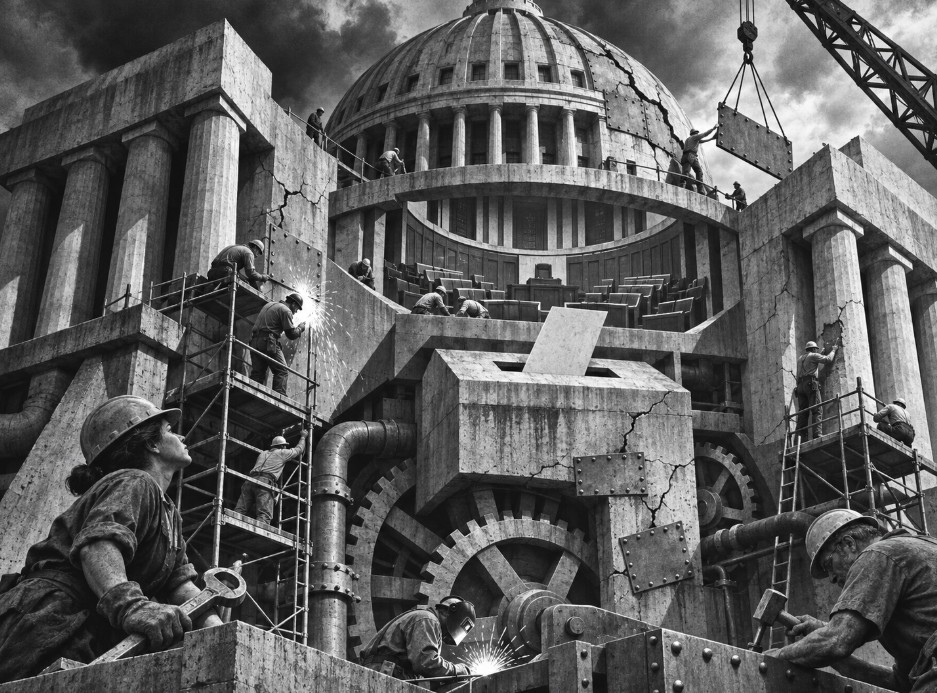
Taken together, the pieces describe one maintenance plan. Make each line of law readable, addressed, and voted on. Make each member cast those votes in public. Give the House enough members to do the work, the people their full share of the presidential vote, and the states a voice in the Senate. Let voters rank their choices. Let judges find the gaps, make legislators fill them, and build the judiciary as a profession with open books. Set a floor beneath each citizen. Start in one state.
Grammina said the man who built the fence knew where the gate was. Most of these repairs reopen gates the builders left. Pennsylvania first. The republic after.
Sources
- Democratic Drift — https://blueribbonteam.com/blog/2026/02/27/democratic-drift/
- Government Secrets? — https://blueribbonteam.com/blog/2026/02/01/government-secrets/
- The Line — https://blueribbonteam.com/blog/2026/02/09/the-line/
- Knock It Off the Table — https://blueribbonteam.com/blog/2026/05/02/knock-it-off-the-table/
- What Is Government For, If Not People? — https://blueribbonteam.com/blog/2026/05/06/what-is-government-for-if-not-people/
- Box Score Citizenship — https://blueribbonteam.com/blog/2026/05/10/box-score-citizenship/
- Usufruct — https://blueribbonteam.com/blog/2026/05/17/usufruct/
- Letter on the Manner of Choosing Senators — https://blueribbonteam.com/blog/2026/07/14/letter-on-the-manner-of-choosing-senators/
- One Line, One Vote — https://blueribbonteam.com/blog/2026/07/24/one-line-one-vote/
- The Politicians Are the Visible Failure — https://blueribbonteam.com/blog/2026/07/24/the-politicians-are-the-visible-failure/
- The Judicial Loop — https://blueribbonteam.com/blog/2026/07/24/the-judicial-loop/
- The Empty Chair — https://blueribbonteam.com/blog/2026/07/24/the-empty-chair/
- Pennsylvania First — https://blueribbonteam.com/blog/2026/07/25/pennsylvania-first/
- The Man Without a Lawyer — https://blueribbonteam.com/blog/2026/07/25/the-man-without-a-lawyer/
- Forty-Three Failures Do Not Settle the Question — https://blueribbonteam.com/blog/2026/07/25/forty-three-failures-do-not-settle-the-question/
- Fixing SCOTUS — https://blueribbonteam.com/blog/2026/07/25/fixing-scotus/
- Letter on the Size of the House — https://blueribbonteam.com/blog/2026/10/24/letter-on-the-size-of-the-house/
- The Third Shelf — https://blueribbonteam.com/blog/2026/10/30/the-third-shelf/
- The Distributed House — https://blueribbonteam.com/blog/2026/10/30/the-distributed-house/
- Electoral College Reform — https://blueribbonteam.com/blog/2026/11/01/electoral-college-reform/