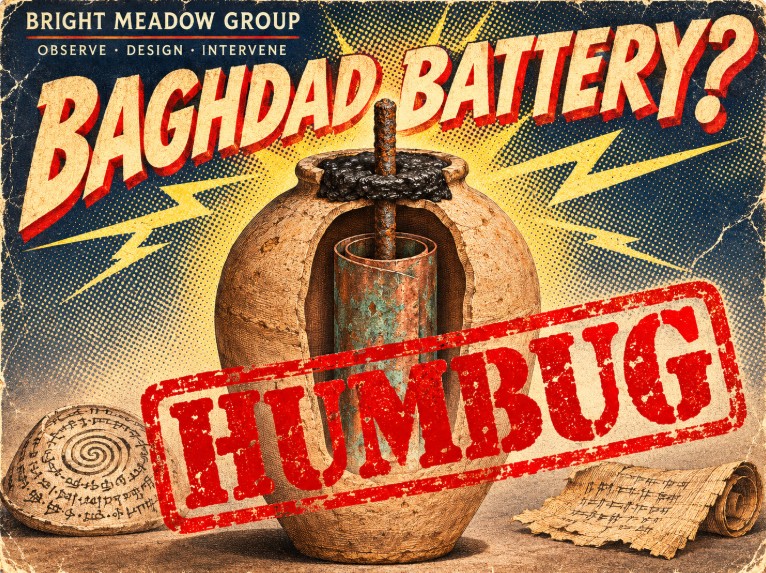
A Bright Meadow Group ODI thought experiment on the “Baghdad Battery”
Our earlier mystery pieces argued for what an object was. This one runs the method in reverse. Here’s an object the world already knows the answer to, or thinks it does, and we’re going to take that answer apart.
In 1936, a dig at Khujut Rabu, just outside Baghdad, turned up a clay jar about five inches tall. Inside sat a cylinder of rolled copper sheet, sealed at the bottom with a copper disc and bitumen. Down the middle of the cylinder hung an iron rod, held in place by a bitumen plug. The rod was corroded.
Two years later Wilhelm König, a painter then working at the Iraq Museum, published a two-page note in a Berlin journal. Copper around iron, room for a liquid between them: he saw a galvanic cell. He proposed the ancients used it to electroplate gold onto silver jewelry. The “Baghdad Battery” was born, and for ninety years it has powered documentaries, paperbacks, and late-night radio.
Let’s see what it actually ran on.
Observe
The jar itself. Its excavation was poorly recorded. The pottery style is Sasanian, putting it somewhere from the 200s to the 600s AD. Only one part reaches the outside: the iron rod pokes through the bitumen plug while the copper cylinder stays sealed inside. No wires, no conductors, and no plated objects turned up with it. The jar was looted from the National Museum in 2003, and nobody has seen it since.
Its cousins. The Khujut Rabu jar has relatives, and they’re better documented.
- At Seleucia in 1930, a University of Michigan team found four similar jars. Three were sealed with bitumen and held sealed bronze cylinders with rolled papyrus inside, decayed past reading. Three lay on their sides, staked into the ground with metal rods, one iron and the rest bronze.
- At Ctesiphon in 1931, a German-American team found six more. Some held sealed bronze rolls with rotted plant fiber inside. One held lead plates crusted with lead carbonate. Another held ten heavily corroded iron nails, wrapped in fiber.
- The excavator at Ctesiphon described them in 1932 as containers for conjurations and blessings.
The neighborhood. The Seleucia jars were found near incantation bowls, clay bowls inscribed with spells and buried upside down to trap demons. The Khujut Rabu jar was found with magic bowls too. Sasanian Mesopotamia is famous for these bowls; museums hold hundreds of them.
Design
Ask what the object was built to do, and test the battery claim against its own construction.
The circuit. A battery earns its keep by pushing current through something outside itself. That takes two terminals. This jar has one. With the copper sealed away, whatever happened in that jar stayed in that jar. A flashlight with one wire is a paperweight.
The plating. Suppose someone had rigged a wire anyway. Plating needs the donor metal dissolved into the liquid first. Copper dissolves slowly in vinegar or fruit juice, and copper onto iron needs no battery at all; drop an iron nail into a copper solution and it comes out coated in minutes. Silver barely notices vinegar. Gold needs aqua regia or cyanide, which nobody in that region had in that era. The jewelry König pointed to turned out to be fire-gilded with mercury, an old and well-documented method.
The corrosion. The rod’s rust gets cited as proof that someone filled the jar with acid. Rotting papyrus does that job on its own. Cellulose breaks down into weak organic acids, mainly acetic and formic, the same chemistry that yellows old newspaper. Papyrus decays faster than plain paper. Seal a scroll in a damp buried jar and you’ve made a weak vinegar bath without pouring anything in. The lead carbonate crust on the Ctesiphon plates fits the same picture; it’s what lead grows when it sits in acetic vapor, which is why museums keep lead objects out of oak cabinets.
The real design. Put the pieces back in their neighborhood and the jar reads as a spell container. A text goes in, sealed in metal and bitumen. Iron pins it down. The vessel goes into the ground near the demon bowls, staked in place. Copper and bitumen amulet cases from the same era sit in museum collections. Lead sheets inscribed with protective spells and rolled up are a practice with a long life in the region; Iraq’s Mandaeans have kept that tradition going.
Here’s the thought experiment. If the jar was built to seal a spell away for good, then the scroll rotting inside counted as success. Curse tablets in the Greek and Roman world went into the ground to deliver their message below, and nobody planned to read them again. A container that slowly eats its own contents might have been doing exactly what its maker wanted. Or it might have been a document safe that destroyed every document it was built to protect, which would put its maker in good company. Plenty of security measures ruin what they guard.
A second idea for the bench: a shorted copper-iron cell sitting in an acidic, decaying mix shifts the chemistry of whatever ferments inside it. Modern researchers run small currents through fermentation on purpose to change what the microbes produce. Ancient people noticed results without knowing causes. If anything in those jars was fermenting by design, the metals had a hand in it, whether the makers knew it or not.
Intervene
Here’s where the humbug comes from, and it has two layers.
The ancient layer. A scribe or magician sold protection. He sealed a spell in copper and bitumen, pinned it with iron, and buried it beside the demon bowls. He made a weak battery by accident, the same way a kid makes one by sticking a nail and a penny in a lemon.
The modern layer. König had a reason for his idea. He’d watched Baghdad silversmiths electroplating with a clay pot and assumed he was seeing an ancient secret. Chemist Gerhard Eggert later showed the smiths’ method matched a process John Wright invented in Birmingham, England, in 1839, using a flowerpot. König watched a Victorian English trick in a Baghdad workshop and called it Parthian.
From there the story fed itself. Replicas produce half a volt to a volt or two when filled with vinegar or grape juice, which proves the materials can make a current, the same way a potato can. MythBusters strung ten replica jars together in 2005 and got about four volts. A 2026 paper argued the clay jar adds a second cell and pushes output past 1.4 volts. Each experiment shows the jar could make electricity. None shows anyone used it to. Elizabeth Stone, an expert on Iraqi archaeology, has said she doesn’t know a single archaeologist who thinks the jars were batteries.
The BMG question for a mystery object is what it did for the person holding it. For the man who buried it, the jar kept a spell sealed in the ground. For the man who named it, the jar delivered ninety years of fame. The only electricity anyone can prove came from the TV crews.
Sources
- König, Wilhelm. “Ein galvanisches Element aus der Partherzeit?” Forschungen und Fortschritte 14 (1938).
- Eggert, Gerhard. “The Enigmatic ‘Battery of Baghdad.’” Skeptical Inquirer 20, no. 3 (1996).
- Eggert, Gerhard. “On the origin of a gilding method of the Baghdad silversmiths.” Gold Bulletin 28, no. 1 (1995).
- Keyser, Paul T. “The Purpose of the Parthian Galvanic Cells: A First-Century A.D. Electric Battery Used for Analgesia.” Journal of Near Eastern Studies 52, no. 2 (1993).
- Frood, Arran. “Riddle of ‘Baghdad’s batteries.’” BBC News, February 27, 2003.
- The Metropolitan Museum of Art. Incantation bowl with Mandaic inscription, Ctesiphon, ca. 5th–6th century CE.
- “Baghdad Battery.” Wikipedia.
- Felton, James. “Infamous ‘Baghdad Battery’ Was Capable Of Producing More Power Than We Thought, Controversial Study Suggests.” IFLScience, January 28, 2026.