On kings, ministers, and what the grown-ups owe their grandchildren
There is a coin in my grandmother’s button tin that has no business being there. It is a copper halfpenny, worn as smooth as a creek stone, and if you tilt it toward the window you can still make out the profile of George III. Grammina bought it for a nickel at an estate sale in the sixties and kept it among the buttons for forty years. When I asked her why, she told me a king belongs with the loose things in a house, where he can finally be of use to somebody.
I took the coin out this week and set it beside my coffee, and I have spent more time looking at it than a grown man ought to spend on a halfpenny.
Since Tuesday’s election, President Trump has answered the voters’ rebuke by drawing his circle tighter. He has named Stephen Miller his chief of staff. Mr. Miller has been the architect, and in many cases the beating heart, of the harshest practices this administration has pursued. Promoting him after a defeat is a little like answering a flooded basement by putting the man who dug the trench toward the house in charge of repairs. Meanwhile the president’s rants grow more pointed toward his opposition by the week, and his calls for actions the law and the Constitution plainly forbid come with less disguise each time.
I have tried to give this president the respect his office carries, more of it than some of my friends thought he had coming. I would like to keep giving it. He is making that harder than a man of my temperament can comfortably bear.
We remember George III as the mad king, and in his last years he was lost to himself: blind, confined at Windsor, talking for hours to people who were not there. That madness came late in his reign. The colonists knew a different George, lucid and diligent, a king who believed with his whole heart that he was defending lawful order against ingrates and agitators.
Read the Declaration again and notice how little of it concerns his temperament. It reads like a bill of particulars. “He has obstructed the Administration of Justice.” “He has made Judges dependent on his Will alone.” “He has dissolved Representative Houses repeatedly, for opposing with manly firmness his invasions on the rights of the people.” Those are the complaints of people watching a government treat opposition as a crime and the courts as an instrument. They describe the madness of power that has stopped hearing the word no, and it can afflict a perfectly sane man, provided the people around him stop saying it.
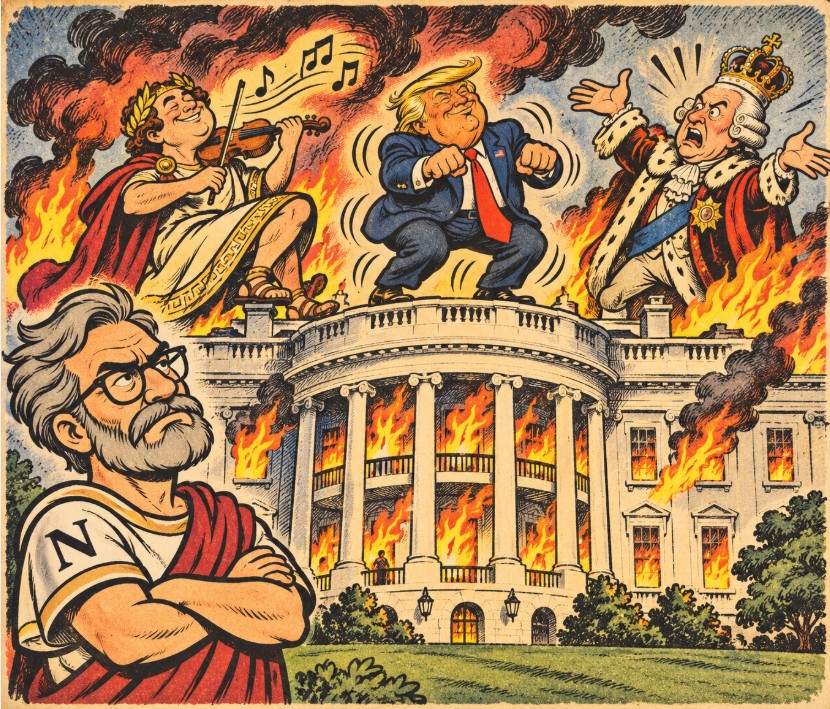
Here is the part of the story I keep returning to. The King’s first minister through the worst of the American war was Lord North, a capable and humane man who came to doubt the war he was running. North asked to be relieved more than once. The King refused, and North stayed on out of loyalty and habit and a sense that someone steady ought to be at the desk, administering a policy he no longer believed in until it was lost at Yorktown. He was the grown-up in the room, and the room burned anyway.
Few Americans recall that George III was still king when British troops set fire to the Capitol and the President’s House in August of 1814. By then he was blind and beyond reason, and his son ruled as regent. Our republic was born resisting one king’s will, and in its youth it watched its capital burn in that same king’s name.
That is the thought that has kept me up these past few nights, with the coin on the table and the coffee going cold. A nation born from the actions of one mad king could end in flames because of another. I keep bees and distrust hysteria, and I would very much like to be wrong about this. So far, the people best placed to tell me so have chosen to say very little.
Madison told us plainly what he was building. “If men were angels, no government would be necessary,” he wrote, and so he arranged for ambition to counteract ambition. He built it for the day we would elect a man who mistook the office for a crown, because he assumed that day would come. What he could not build was the willingness of the people inside the machinery to turn their own gears. A levee is only as good as the men who walk it in high water.
So I would like to speak directly to the grown-ups in the Republican Party: the Senate leaders and committee chairmen, the cabinet secretaries, the governors, the party elders, and the senior staff who still answer the phones at two in the morning. You know who you are. I suspect you have known for some time.
What do you want for your grandchildren?
Picture one of them at a kitchen table forty years from now, working on a history assignment about these years. Picture her looking up from the page and asking what you did when the president called for things the Constitution forbids, and when he pointed the machinery of government at people whose only offense was opposing him.
Then picture the country she lives in. The powers you excuse this winter will not retire when this president does. Precedent is a tool left in the barn, and whoever owns the farm next will pick it up for whatever work he has in mind. Your grandchildren will inherit that tool on whichever side of the barrel the politics of their day happens to place them.
The oath you swore has the Constitution in it and no one’s name. No line of it asks you to protect a man from the consequences of his own ambition, and the founders took some care to make sure of that.
What I am asking for is well within your reach. Speak in the meeting. Put your name to the objection. Decline the unlawful order and let the record show you declined it. Let Congress conduct its oversight without threat of prosecution for doing its job. Tell the president no, in a way the country can hear. Lord North’s lesson is that the steady hand counts for very little if it signs the order anyway.
When I was a boy, Grammina made me read the story of the woman outside Independence Hall who asked Franklin what sort of government the delegates had made. “Franklin told her we had a republic if we could hang onto it,” Grammina said, in her own fashion. “He didn’t say who ‘we’ was, Nate. That means whoever happens to be standing closest when it starts to slip.”
Some of you are standing very close.
I put the coin back among the buttons this morning, where a king can finally be of use to somebody. Our ancestors put him there at considerable cost. Whether our grandchildren find him there is up to the grown-ups now.