The Automaker’s Case for High-Speed Rail
A Bright Meadow Group look at the industrial build-out behind a national rail network.
The Keystone Network, The Lone Star Junction and The Continental Spine drew the lines on the map. This piece is about who builds the trains that run on them, and why Detroit should want the job.
OBSERVE
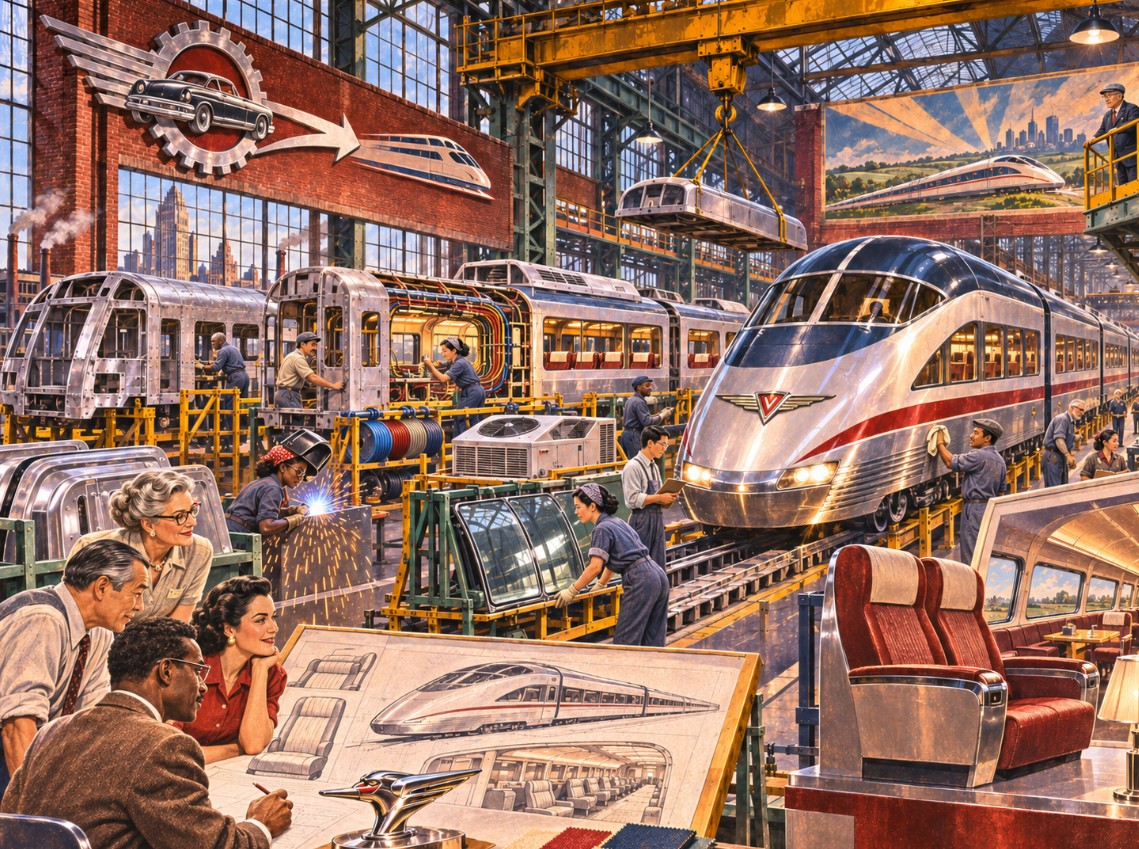
A trainset is a car with more seats. Strip a high-speed trainset down to its parts list and it reads like an electric car stretched to the length of a football field. Traction motors. Inverters. Regenerative braking. Climate control, seating, glazing, door actuators, wiring harnesses, crash structures, passenger displays. American automakers are spending billions to learn how to build those parts at scale for EVs. A rail car uses the same toolkit on a bigger frame.
The industry has done this before. The Budd Company in Philadelphia stamped steel bodies for Detroit and built stainless passenger cars on the side, including the Metroliners that ran the Northeast Corridor. General Motors built locomotives through its Electro-Motive Division for decades. Rail and auto grew from the same trunk.
Automakers know the passenger. For a century, car companies have studied the person in the seat. They’ve worked out seat foam density, lumbar support, and cabin noise at highway speed. They know where a cupholder lands under a hand, how a door should sound when it closes, and which dash lighting reads calm at night. Luxury brands sell on that work. Minivan makers built whole product lines around a parent wrangling three kids for six hours.
Rail builders design for durability and capacity first, and the cabins often show it: rows of seats, a luggage rack, a bathroom at the end of the car. A rider picks the train over the car when the train feels better than the drive. The people who know how to make a long drive feel good work on the auto side.
Where the miles go. Trips of 75 miles or more are a small slice of the trips Americans take. One University of Texas analysis puts them at close to half of person-miles traveled. Federal survey data from 2001 showed round trips of 200 to 999 miles carrying a little over half the miles driven on long-distance car trips.
That band, the four-to-eight-hour drive between cities, is the range high-speed rail is built for. The grocery run, the commute and the trip out to the job site stay in the car. The train takes the long haul down the interstate, the part of driving that wears out pavement and people.
DESIGN
The retooling is moderate. Much of the production line already exists. Carbody work on modern trainsets runs on welded aluminum extrusions and steel structures, the same family of joining, painting and sealing an auto plant runs daily. Interiors, harnesses, HVAC, motors and power electronics come from suppliers who already sell to automakers. The new capital goes into bogies, couplers, pantographs and rail safety certification. Call it a new wing on an old house.
Design the cabin from the auto side. Hand the interior to the teams who design premium cars, and the train becomes something people choose to ride. That could look like:
- Seats engineered like a luxury car’s, adjustable and built for four hours instead of forty minutes.
- Acoustics tuned the way automakers tune a sedan, so a phone call at 200 mph needs no raised voice.
- Car classes built like trim levels: a work car with desks and power, a family car with room to spread out, and a lounge or sleeper car for the long legs.
- A cockpit designed by people who have spent decades on driver ergonomics, displays and fatigue.
- A name on the side. A Ford-built or GM-built trainset carries a badge riders already know, and the carmaker’s reputation rides along with it.
The economics from the manufacturer’s side. A rail order book runs in decades. Trainsets stay in service thirty years or more with scheduled overhauls, and a fleet contract carries maintenance, refurbishment and parts revenue long after delivery. Automakers have chased recurring service revenue for years through subscriptions and software. A rail maintenance depot is that idea in steel.
Rail work also steadies the workforce through the EV transition. Electric drivetrains carry fewer parts than combustion ones, and labor hours per vehicle are expected to shrink. Rail gives skilled plant workers somewhere to go that uses what they know.
It routes batteries where they fit, too. A train on overhead wire draws power straight from the grid and carries no battery pack. Cells kept out of intercity travel stay available for the cars doing local work.
The risk sits on the automaker’s own ledger. Fewer highway miles means cars wear out slower and replacement cycles stretch. The rail book hedges that. An automaker that builds both sells to the commuter and to the corridor.
INTERVENE
- Partner first. Siemens builds passenger trains in Sacramento, Alstom builds car bodies in Hornell, New York, and Stadler assembles trains in Salt Lake City. Each needs domestic content to meet Buy America rules. An automaker with an underused plant can take carbody, interior and electrical subassembly work under contract, and learn the trade on someone else’s design.
- Lead with the interior. The first contract an automaker goes after should be the cabin. That’s where its edge sits, and where riders feel the difference on day one.
- Tie the first order to one corridor. The Continental Spine starts with the Texas triangle. A plant tooling up for a defined run on a defined line knows what it’s building and when.
- Build the depot beside the plant. That way the workforce that builds the cars also keeps them running.
The pitch fits on an index card. The long trip is leaving the highway one way or another, and the company that builds the train keeps the customer.
Sources
- Kockelman et al., “Americans’ Long-Distance Domestic Travel Choices,” University of Texas at Austin: caee.utexas.edu/prof/kockelman/public_html/TRB24LDAVDomesticTrip.pdf
- Bureau of Transportation Statistics, Table 1-39, Long-Distance Travel in the United States, 2001: bts.gov/archive/publications/national_transportation_statistics/2010/table_01_39
- Railway News, “Amtrak, Siemens Deploy 8 Airo Trains for U.S. Cascades” (March 2026): railwaynews.net/?p=256512
- Alstom, “Alstom opens new state-of-the-art Plant 4 facility in Hornell, NY” (June 2025): alstom.com/press-releases-news/2025/6/alstom-opens-new-state-art-plant-4-facility-hornell-ny-boosting-us-rail-manufacturing
- Deseret News, Stadler Salt Lake City facility tour (June 2026): deseret.com/business/2026/06/21/stadler-rail-switzerland-salt-lake-city-uta-trax-atlanta-marta-apprenticeship-program-light-rail-hydrogen-fuel-cell-battery-electric-transit-systems/