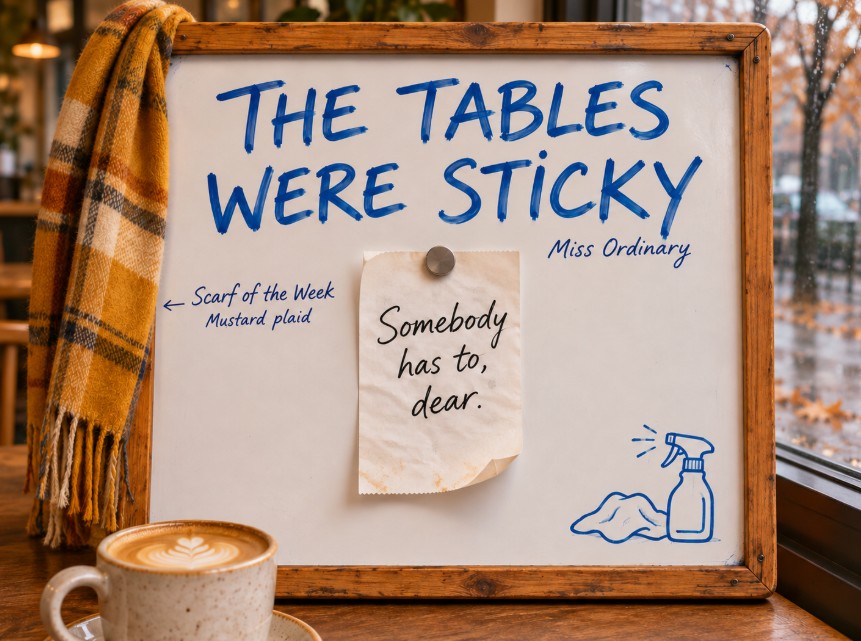
I was on my second latte, wrapped in the mustard plaid scarf my aunt gave me, when the woman two tables over got up and asked to speak to the manager.
She was maybe in her sixties. Short silver hair, a canvas tote bag, reading glasses pushed up on her head. She didn’t raise her voice. She said, “I’m sorry to bother you, but the tables by the window are sticky, and the one in the corner has a bit of a crumb situation.” Then she thanked him and went back to her seat.
I should admit something. I was sitting at one of those window tables. For 20 minutes I’d been holding my mug about an inch off the surface, because every time I set it down it made that little suction sound. I had noticed. I just hadn’t said anything, because I don’t say things. That’s sort of my whole personality.
The manager sent one of the teenagers out with a spray bottle and a rag. He was maybe seventeen, a sweet-looking kid with a mop of hair. He wiped down the window tables, mine included (I lifted my mug and said thank you), and on his way back behind the counter he leaned over to the girl at the register and said, “Karen strikes again.”
She laughed. I sat there with my nice clean table and felt strange about it.
The lady was right. The tables were dirty. She said so politely, to the person whose job it was to fix it, and it got fixed. That’s what’s supposed to happen. Her reward was a nickname muttered behind the espresso machine.
I know there’s another kind of Karen. We’ve all met her. She’s on her phone about the neighbor’s trampoline, which is behind the neighbor’s fence and on the neighbor’s grass. She calls the township about the family down the street over and over until they get the hint and move. That’s meanness in a nice cardigan, and I’m not here to defend it.
The silver-haired lady wasn’t that. She was what I’ve started calling a keeping-things-working Karen. She noticed something broken in a shared space, said so kindly to the right person, and went back to her coffee. If anything, she was doing the kid’s manager a favor.
Here’s the part that’s been bothering me since. I make lists on receipts. Grocery lists, to-do lists, little lists of nice things that happened that day. Some of those lists, if I’m honest, are things I wanted to say to someone and didn’t. The neighbor whose car alarm goes off at 2 a.m. The coworker who microwaves fish. The landlord who said he’d look at the sink.
Those receipts don’t go away when I throw them out. The feeling stays and stacks up, a little like the slow drip under my kitchen sink that I ignored for three months until the cabinet floor went soft. Holding it in doesn’t make it disappear. It just puts it somewhere I can’t see it.
Now picture two people who’ve both been doing that for a month. They meet in a grocery store parking lot over who saw the spot first, and suddenly there’s yelling. The parking spot isn’t the real fight. It’s just the place where two people who were already full finally spilled over onto each other. Everyone watching decides those two must be awful people, and they go home a little more tense themselves, a little more determined to keep their heads down. So it keeps going.
The more I thought about the kid with the rag, the more it looked like how a lot of things work right now. People are frustrated that so much doesn’t work right: phone trees that loop back to the start, potholes that eat tires, offices that lose paperwork, even courts and government offices that move slower than anyone can stand. But the person who points out the problem gets the eye-roll. The employee who flags a safety issue gets moved to the night shift. The neighbor who goes to the township meeting about the drainage ditch becomes “that guy.” The person who reports a problem inside an agency gets treated as the problem.
We keep punishing the messenger and keeping the mess. Then we wonder why people stop speaking up.
The British have a gift here. “I’m terribly sorry, but I think you may be in my seat” is about the gentlest sentence in the language, and it works. It gives the other person room to fix things without anybody losing face. The silver-haired lady had that gift. “I’m sorry to bother you” did all the heavy lifting, and the tables got wiped.
So here’s my small confession. I think I’d like to grow up to be her.
On my way out I stopped at her table and told her thank you, the tables were sticky and I’d been too shy to say anything. She smiled and said, “Somebody has to, dear.” I’m going to write that on a receipt and keep it.
Small joys are big deals. So are clean tables, and so is the person who asks for them.
Stay clean, stay kind, stay caffeinated.
— Heather