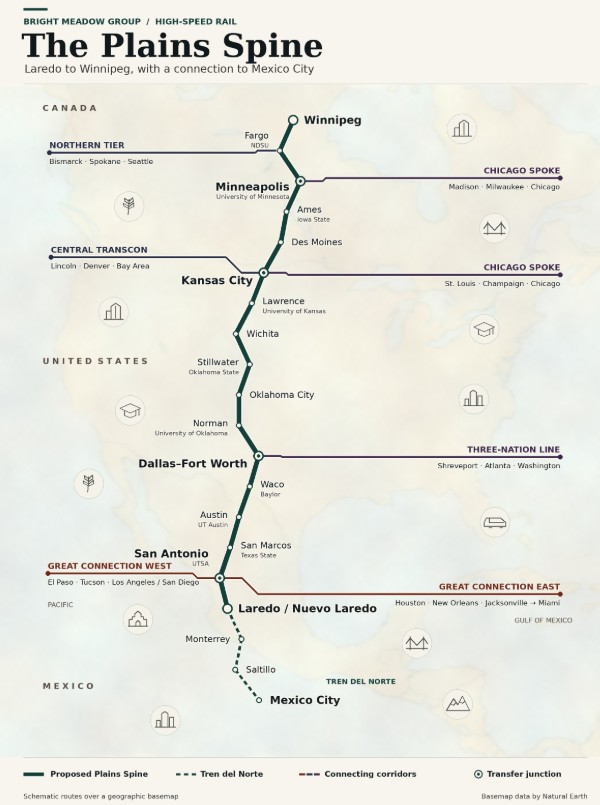
A Bright Meadow Group look at the Plains Spine, Laredo to Winnipeg, the north–south backbone of a hemispheric rail network
This entry comes late in the series. The Lone Star Junction set the hub in Texas. The Continental Spine sketched the network. The line pieces since then worked outward along the coasts and through Chicago, and they kept pointing back to this one. The Plains Spine runs from Laredo on the Mexican border through the Texas triangle, across Oklahoma and Kansas to Kansas City, north through Iowa to Minneapolis, and on to Winnipeg. The Great Connection crosses it at San Antonio. The Three-Nation Line ends on it at Dallas-Fort Worth. Both Chicago spokes end on it, one at Kansas City and one at Minneapolis. Take it off the map and the Texas hub, the Chicago hub and the northern lines lose their link to one another. Leave it in and Mexico City and Winnipeg share a line, with the country’s trunk lines hung from it like ribs.
OBSERVE
The corridor already carries the country’s north–south trade. Interstate 35 runs from Laredo through San Antonio, Austin, Dallas-Fort Worth, Oklahoma City, Wichita, Kansas City and Des Moines to Minneapolis. Laredo is the busiest crossing for American trade with Mexico, and a steady line of trucks carries that trade north on I-35. BNSF runs freight over much of the same ground. The goods already travel this way. The people make the trip by car, or by a connecting flight through Dallas.
The land is flat and open. The Plains give a 200 mph train long, straight stretches where it can hold its speed for hundreds of miles, and I-35 has a wide median through much of Oklahoma and Kansas. The Continental Spine named that median as the first place to lay track.
The cities along it are growing. Austin, San Antonio and Dallas-Fort Worth rank among the fastest-growing metro areas in the country. Oklahoma City, Kansas City, Des Moines and Minneapolis anchor their regions. Between them sit the universities: UTSA, Texas State, UT Austin, Baylor, Oklahoma, Oklahoma State, Kansas, Iowa State, Minnesota and North Dakota State.
The neighbors are already building toward the line. Mexico broke ground in September 2025 on the Saltillo to Nuevo Laredo section of the Tren del Norte, a 1,200 km passenger line from Mexico City to the border at Nuevo Laredo, designed for 160 to 200 km/h. When it opens, Monterrey will be a little under two hours from the Rio Grande. At the other end, Winnipeg sits about seventy miles north of the border at the head of the Red River valley, the gateway to the Canadian prairies.
DESIGN
The route.
Laredo – San Antonio (UTSA) – San Marcos (Texas State) – Austin (UT) – Waco (Baylor) – Dallas-Fort Worth – Norman (OU) – Oklahoma City – Stillwater (Oklahoma State) – Wichita – Lawrence (KU) – Kansas City – Ames (Iowa State) – Des Moines – Minneapolis (Minnesota)
North: Minneapolis – Fargo (NDSU) – Winnipeg
Alignment. Wherever I-35 runs straight and flat, the line rides its median, and that covers much of Oklahoma and Kansas. Where BNSF has the better ground, the line runs beside it on its own pair of tracks. It needs new alignment only for the approaches into city centers.
The vertebrae. The Plains Spine earns its name at its junctions, where the trunk lines branch off it like ribs.
Laredo. The southern gate. Here the line meets the Tren del Norte and runs on to Monterrey, Saltillo and Mexico City. Beyond that, the corridor laid out in The Lone Star Junction continues south through Central America toward the Darién.
The Texas triangle. San Antonio is the corner where the border meets both coasts. The Great Connection runs west from there through El Paso, Tucson and Tempe to Los Angeles and San Diego. Through Houston it runs east to Baton Rouge, New Orleans, Mobile, Tallahassee and Jacksonville, where Brightline carries riders on to Orlando and Miami. At Dallas-Fort Worth the Three-Nation Line heads east through Shreveport, Jackson, Birmingham, Atlanta, Charlotte, the Research Triangle and Richmond to Washington.
Kansas City. The center of the continent. The Central Transcon heads west through Lincoln, Denver, Salt Lake City and Reno to Sacramento and the Bay Area. The Chicago spoke heads east through St. Louis and Champaign to the hub. From there the Keystone-Lakes Line runs east through Pittsburgh to Philadelphia, and the Crossroads Line runs south through Indianapolis, Louisville and Nashville to Mobile.
Minneapolis. The northern junction. The Northern Tier heads west through Fargo, Bismarck, Billings, Bozeman, Missoula and Spokane to Seattle. The second Chicago spoke heads east through Madison and Milwaukee. The line north continues to Winnipeg.
Winnipeg. The northern gate. The line reaches the Canadian prairies. Manitoba is home to a large First Nations population, and the Spine connects those nations and the rest of Canada to the hemisphere’s network.
The hemisphere. Ride the Spine end to end and you go from Mexico City to Winnipeg. Continue south along the Lone Star Junction corridor and you are headed for South America. A rider on the Plains Spine needs one change of trains to reach Los Angeles, Miami, Washington, Chicago, Denver, the Bay Area or Seattle. The coastal lines connect cities. The Spine connects the lines.
The campuses. Ten universities sit on the Spine and its northern spur. A researcher in Austin sits in on a seminar in Lawrence and is home for dinner. A student in Norman spends a Saturday in a Minneapolis lab. A soil scientist at Iowa State visits a colleague at Oklahoma State without a connecting flight through Dallas. For a century the Plains research schools have done their work side by side, each on its own. The Spine puts them on one line.
The people. The trade corridor becomes a people corridor. A family in Monterrey rides north to San Antonio for a weekend. A machinist in Wichita takes a job in Kansas City and keeps his house. A nurse from Winnipeg works a contract in Minneapolis. A Kansas City business covers Dallas and Minneapolis by train in the same week.
INTERVENE
Name the Plains Spine as the backbone of the National High-Speed Rail Act, and build each crossing trunk to meet it at a shared junction station.
Reserve the I-35 median for rail from Laredo to Minneapolis.
Open the gates at both ends. Binational agreements with Mexico at Laredo and with Canada at Winnipeg cover customs, shared standards and through-ticketing from Mexico City to the Canadian prairies. Mexico has already laid its side of the southern agreement in steel.
Build the junction stations as stations of the first rank. San Antonio, Dallas-Fort Worth, Kansas City and Minneapolis are sized for riders changing lines, with timetables set so trains meet.
Let the corridor’s first proven segment pay for the rest. As The Continental Spine laid out, once the line from San Antonio to Kansas City shows its economic growth, the money lines up behind the remaining trunks.
Sources
Blue Ribbon Team, The Keystone Network: https://blueribbonteam.com/blog/2026/01/14/the-keystone-network/
Blue Ribbon Team, The Lone Star Junction: https://blueribbonteam.com/blog/2026/10/20/the-lone-star-junction/
Blue Ribbon Team, The Continental Spine: https://blueribbonteam.com/blog/2026/10/21/the-continental-spine/
Blue Ribbon Team, Two Lanes to Anchorage: https://blueribbonteam.com/blog/2026/11/05/two-lanes-to-anchorage/
Blue Ribbon Team, Second Shift: https://blueribbonteam.com/blog/2026/11/07/second-shift/
Blue Ribbon Team, The Head Start: https://blueribbonteam.com/blog/2026/11/09/the-head-start/
Blue Ribbon Team, The Great Connection: https://blueribbonteam.com/blog/2026/11/11/the-great-connection/
Blue Ribbon Team, The Three-Nation Line: https://blueribbonteam.com/blog/2026/11/14/the-three-nation-line/
Blue Ribbon Team, The Chicago Hub: https://blueribbonteam.com/blog/2026/11/16/the-chicago-hub/
Railway Pro, Work begins on new Tren del Norte section: https://www.railwaypro.com/wp/work-begins-on-new-tren-del-norte-section/
Mexico Business News, Grupo Carso Wins Contract for Saltillo–Nuevo Laredo Train: https://mexicobusiness.news/infrastructure/news/grupo-carso-wins-contract-saltillo-nuevo-laredo-train
Railway Age, Gulf of Mexico Train Project Construction Begins: https://www.railwayage.com/passenger/intercity/gulf-of-mexico-train-project-construction-begins/