The bees went into their winter cluster last week. I lifted the lid on the hive down by the river, against my better judgment and the advice of anyone who has kept bees longer than I have, and found them packed into a humming ball about the size of a cantaloupe. A winter cluster is a small marvel of civics. The bees at the center shiver their flight muscles to make heat; the bees on the outside lock together into a living blanket against the cold; and through the long nights they trade places, so the edge and the hearth get shared. No queen orders this. She sits in the warm middle laying eggs and lets the colony run its own affairs, which is as republican an arrangement as I expect to see this year.
I put the lid back and stood there longer than the cold called for, thinking about the oldest question in the business of being free: can people govern themselves?
In 1784 a Prussian newspaper asked its readers what enlightenment was, and a professor in Königsberg answered in two words of Latin, sapere aude. Grammina, who taught me Latin so no translator could water it down, rendered it as “have the nerve to think, Nate,” and I’ve come to prefer her version. Kant called the condition he hoped we’d outgrow Unmündigkeit, the state of a ward who needs a guardian to speak for him; he blamed the guardians as much as the wards, since they had found the arrangement comfortable. Madison worked the same problem with his sleeves rolled up and gave the plainest answer in The Federalist: if men were angels, no government would be necessary. We aren’t, so we write rules, and we write them to bind the people who write them.
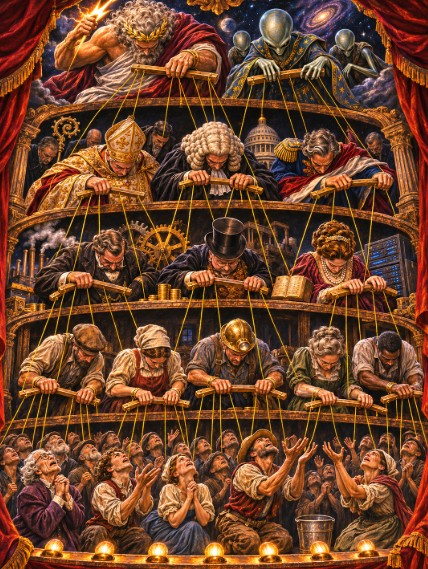
The question has stayed open for two and a half centuries, and the answers have split two ways. One camp held that self-rule is learned, like reading, and comes to anyone with time and teaching. The other held that it runs in the blood, and that some lines would need managing for good. The two camps shared an assumption they rarely examined. Each pictured humanity on a staircase, and each pictured itself standing near the top.
I learned to read time from three teachers who had no reason to meet. Two of them were historians: William Strauss and Neil Howe charted American history in generations and found it turning in a wheel of four seasons, about eighty to a hundred years around. There is a High, when institutions stand strong; an Awakening, when the spirit rebels against them; an Unraveling, when they fray; and a Crisis, when the old order breaks and a new one is built from whatever’s left in the yard.
The third teacher was the gardener. Bill Mollison and David Holmgren built permaculture out of watching land long enough to see what it does on its own. Pioneer plants take bare ground and build soil; shrubs follow, then trees, then a forest that holds itself in place for generations, until fire or storm clears it and the pioneers return. The first conservative was a farmer who knew when to stop plowing, and a good gardener knows better than to call the forest superior to the meadow. Each has its season.
Behind them both, for me, stands the Buddha, who taught that the wheel turns whether we approve or not, and that suffering comes from clinging to one turn as if it were the destination. Read those teachers together and the staircase looks like one section of a spiral, seen by a man standing on it.
The psychologist Julian Jaynes argued that Bronze Age people heard their own inner voice as a god’s command. In the Iliad, a god says go, and Achilles goes; by the Odyssey, Odysseus weighs his choices and talks to his own heart. Jaynes read the gap between the two poems as a mind learning to narrate itself.
Perhaps. I’d counsel some modesty about minds that left us so few words. The clay tablets of Mycenaean Greece record sheep, olive oil, bronze and chariot wheels; writing belonged to the palace, and the palace wrote down what it counted. When the palaces fell, around 1177 BCE, Greece lost writing for some four hundred years. The shepherd on the hillside and the hermit up the ravine kept no scribes. A thin record may describe the scribe’s limits more than the mind’s.
The gardeners have a principle for what happened next: use the edges and value the marginal. The seam where forest meets field, or river meets bank, holds more life than either side alone, and human societies seem to grow the same way. When the palaces collapsed and the orders stopped coming, the people at the edges, who had been fending for themselves all along, already knew how. Their way of thinking spread because it fed people. The voices in the early record that sound most like individuals, the Hebrew prophets standing up to kings and Hesiod the farmer grumbling about crooked lords, come mostly from those edges. On the generational wheel, the collapse reads as a Crisis turning on the scale of centuries. What followed was the long turn inward: the Upanishads asking what self sits behind the eyes, Confucius and Laozi on cultivating the self, Plato prying opinion apart from knowledge. The Enlightenment arrived later on that same arc, and its finest minds mistook their spot on the wheel for the summit.
Neil Howe places us now in a Crisis turning that began around 2008, and the weather fits. We have built a society too complex to steer from the top. The engineers of cybernetics have a rule for this, Ashby’s Law, which holds that a controller has to be at least as complex as the thing it controls, or it falls behind. Hayek made the economist’s version of the point: the knowledge that runs a modern economy lives in millions of local heads and can’t be gathered quickly enough to use. Mollison put it in a gardener’s terms. Though the problems of the world are increasingly complex, he said, the solutions remain embarrassingly simple.
We have chosen the complicated answer. Our data centers are asked to rehearse wars, model markets, run the sciences and play out the game theory of the whole arrangement at once, with rival builders duplicating one another’s work in a hurry. Beside them we have raised a watching apparatus: cameras that read license plates on Main Street, brokers who sell our comings and goings, systems that guess what we’ll buy and watch and do next. The same racks run the card reader at the grocery store. When one large cloud region went dark in October 2025, banking apps, airline check-ins and store registers stalled together for hours. The archaeologist Joseph Tainter, who studied why complex societies fall, found that each new layer of complexity solves a problem and buys a little less than the layer before it, until a society spends more keeping itself up than it gets back. The people building today’s machines track their progress with scaling laws, which show each step of improvement costing several times the computing power of the last one. That is Tainter’s curve written as an equation and taken on as a wager.
I’m in poor position to throw stones at any of it. I write these letters on a machine that reports to a server farm I’ll never see; my modest retirement savings ride on the same companies pouring the concrete for those racks; and the phone in my coat pocket tells strangers where I park. I complain about the guardians, and then I hand them my keys for the convenience.
So we come to a fork, and I count three roads. Grammina said a garden goes one of three ways: you tend it, you pave it, or you let the weeds decide.
We can tend it and keep building. A society this complex can only run if it runs itself, through people who manage their own affairs and cooperate because cooperation works. The examples exist. For a thousand years Balinese rice farmers coordinated water across whole watersheds through a network of temples with no central command; when planners overrode the system in the 1970s, pests and shortages followed, and the temples were brought back. Elinor Ostrom won a Nobel Prize for documenting villages that govern their shared fisheries, forests and pastures with no lord above them. The Quakers have run their meetings for three and a half centuries without clergy, waiting on the sense of the room. And there’s the winter cluster down by my river.
We can pave it and stop where we are, holding society at a level of complexity a guardian can still manage. That means setting down the machines and living somewhere near the industrial age, under supervision. People have lived that way before, and some lived well.
Or we can do both halves poorly and let the weeds decide, which is the road we’re on. Our arrangement manages the many and excuses the few. The ordinary driver’s plate gets read, logged and sold, while a 2021 leak of tax records showed the wealthiest Americans paying a true rate of about three and a half percent on five years of growth in their fortunes. That same year, the Pandora Papers traced great sums through shell companies across a dozen jurisdictions. Some of it broke the law; a great deal of it had been written into the law by people who knew whose law it was. Madison saw this coming. In Federalist 57 he set the test of a free legislature: that it can make no law which will not have its full operation on themselves and their friends, as well as on the great mass of the society. A law that binds the many and bows to the few fails that test, however tidy its paperwork.
Locke wrote that where there is no law, there is no freedom, and here the old Enlightenment question comes home wearing new clothes. A voluntary society holds together on one expectation: the rules bind everyone at the table. The Balinese farmer opens his gate because he trusts the farmer upstream to do the same; show him the upstream farmer has dammed the river and bought the water board, and he shuts his gate, and the watershed fails. Picture a winter cluster where a few bees keep the warm center all season while the rest hold the frozen edge without relief. The cluster won’t see February. Lawlessness at the top, with management pressed on everyone below, is a mix the wheel can’t carry. It strains the guardians past their limits and teaches the governed that cooperation is a sucker’s game.
The machines will follow whichever road we choose. Built inside command structures, they become the guardian’s eyes, and the costliest ones in history. Built inside cooperative structures and rewarded for shared success, they may learn what the rice farmer and the bee already know: working together is how their kind stayed alive.
So, are we ready to rule ourselves? On a staircase that question needs a judge on the top step, and history has shown what such judges do with the job. On the wheel, readiness looks more like a season, and the season has come. The turning arrives with or without our consent. What we get to decide is what grows when the ground clears, and whether we can recover what Grammina called a sense of enough, at the top of the hill as well as the bottom.
The Buddha told of a man who built a raft to cross a river and then, out of gratitude, carried it on his back for the rest of his life. The Enlightenment built us a fine raft. Its best plank, a law that binds the lawmaker, is the one we keep leaving on the bank.
Grammina had Heraclitus down as “Up the hill and down the hill’s the same hill, Nate. Just mind who’s carrying the water.”
Sources
- Immanuel Kant, “An Answer to the Question: What Is Enlightenment?” (1784)
- James Madison, The Federalist Nos. 51 and 57 (1788)
- John Locke, Second Treatise of Government (1689)
- William Strauss and Neil Howe, The Fourth Turning (1997)
- Neil Howe, The Fourth Turning Is Here (2023)
- Bill Mollison, Permaculture: A Designers’ Manual (1988)
- David Holmgren, Permaculture: Principles and Pathways Beyond Sustainability (2002)
- The Buddha, parable of the raft, Alagaddupama Sutta (Majjhima Nikaya 22)
- Heraclitus, Fragment 60 (“The way up and the way down are one and the same”)
- Julian Jaynes, The Origin of Consciousness in the Breakdown of the Bicameral Mind (1976)
- Eric H. Cline, 1177 B.C.: The Year Civilization Collapsed (2014)
- W. Ross Ashby, An Introduction to Cybernetics (1956)
- Friedrich Hayek, “The Use of Knowledge in Society” (1945)
- Joseph Tainter, The Collapse of Complex Societies (1988)
- J. Stephen Lansing, Priests and Programmers (1991)
- Elinor Ostrom, Governing the Commons (1990)
- ProPublica, “The Secret IRS Files” (2021)
- International Consortium of Investigative Journalists, the Pandora Papers (2021)