A Bright Meadow Group look at the Chicago hub, the Keystone-Lakes Line and the Crossroads Line, where the middle of the country joins the international network
The Continental Spine named three switchyards: Texas, Chicago and the Northeast Corridor. The Three-Nation Line tied Washington to Texas and reached for Montreal. This piece takes up the middle switchyard. Chicago is where the lines from both coasts already meet. Run high-speed spokes out from it and the whole middle of the country plugs into the international network, south to Mexico through Dallas-Fort Worth, north to Canada through Winnipeg and Toronto, and east to Washington from a third direction.
The international gates get the headlines. The bigger change happens inside the country. The Midwest, the Ohio Valley and the inland South hold dozens of cities that have spent a century working alone, each with its own industry, its own university and its own airport too small for direct flights. The hub turns them into neighbors.
OBSERVE
Chicago became Chicago because the railroads met there. In the 1800s, lines from the East ended at the lake and lines to the West began there, and the city grew at the joint like a knuckle on a finger. Amtrak still runs its long-distance network out of Chicago Union Station. Illinois runs 110 mph service between Chicago and St. Louis, and Michigan runs trains at that speed on part of the line to Detroit. The hub is there. The speed isn’t.
The middle of the country sits in pieces. Purdue and Ohio State, Penn State and Pitt, Vanderbilt and Louisville have research of their own and a long drive between them. The auto plants of Michigan, Kentucky, Tennessee and Alabama build cars for the same market but sit a day’s drive apart. A worker in Dayton who finds a job in Indianapolis has to sell the house to take it. A family in Nashville wanting a weekend in Chicago spends two days of it in the car. Cities that should work together sit apart like rooms in a house with no hallway.
Air travel doesn’t fix it. A flight from Huntsville to West Lafayette, or from Mobile to Madison, connects through a hub airport and eats the better part of a day. The airlines built their networks for the big cities. The mid-sized cities get the leftovers.
DESIGN
The spokes.
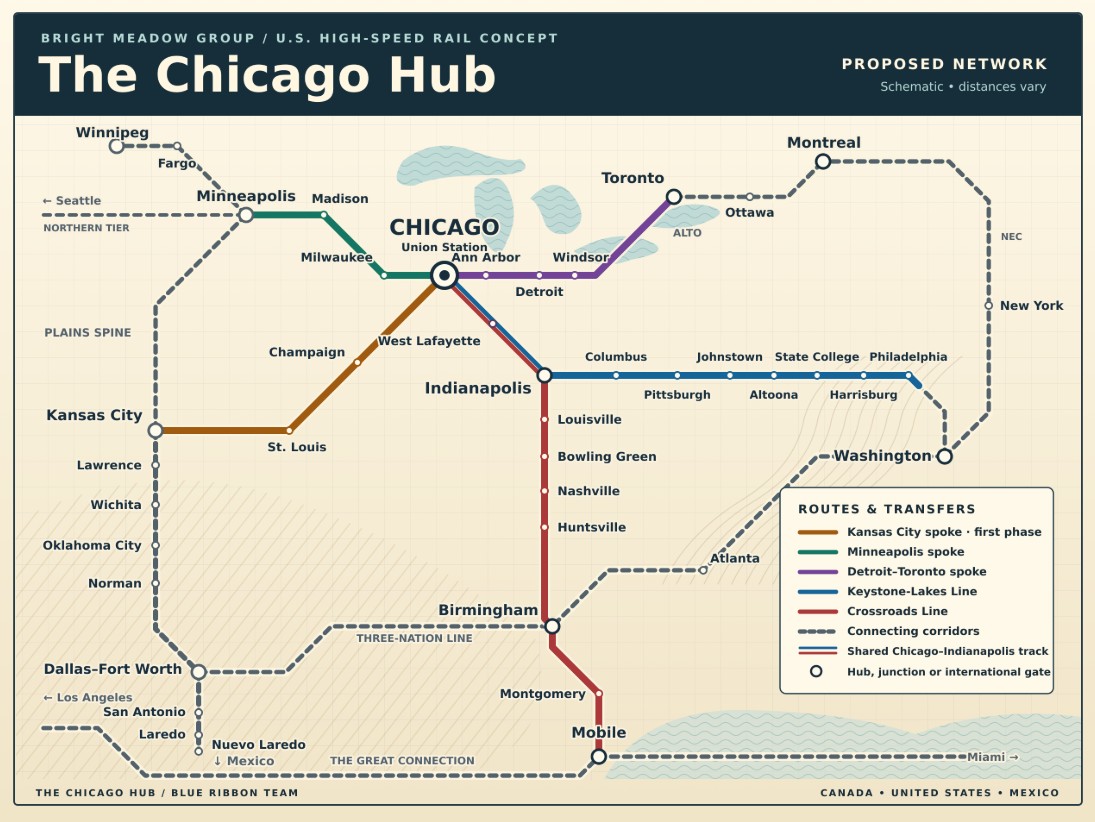
Chicago to Dallas-Fort Worth: Chicago – Champaign (Illinois) – St. Louis (WashU) – Kansas City, joining the Plains Spine at its northern end. The Plains Spine carries the line south through Lawrence, Wichita, Oklahoma City and Norman to Dallas-Fort Worth and the Texas triangle, and on to Laredo and Mexico.
Chicago to Winnipeg: Chicago – Milwaukee – Madison (Wisconsin) – Minneapolis (Minnesota), joining the Plains Spine’s spur north through Fargo (NDSU) to Winnipeg.
Chicago to Montreal: Chicago – Ann Arbor (Michigan) – Detroit – Windsor – Toronto, with Detroit as the American stop before the border. At Toronto the line meets Canada’s planned Alto network, which carries it on through Ottawa to Montreal.
The Keystone-Lakes Line: Philadelphia – Harrisburg – State College (Penn State) – Altoona – Johnstown – Pittsburgh (Carnegie Mellon, Pitt) – Columbus (Ohio State) – Indianapolis – West Lafayette (Purdue) – Chicago.
The Crossroads Line: Chicago – West Lafayette (Purdue) – Indianapolis (IU Indianapolis, with Bloomington close by) – Louisville (UofL) – Bowling Green (Western Kentucky) – Nashville (Vanderbilt) – Huntsville – Birmingham (UAB) – Montgomery – Mobile (South Alabama). It shares the Chicago–Indianapolis stretch with the Keystone-Lakes Line.
The connections. Draw the lines on a map and the cities start talking to each other in pairs and chains.
The Great Lakes auto corridor. Detroit builds cars. Ann Arbor researches what goes into them. Chicago sells them, finances them and ships them. On the Detroit spoke, the three sit within a couple of hours of each other. Down the Crossroads Line, the same industry continues through Bowling Green’s Corvette plant, the auto plants around Nashville, Huntsville’s assembly plant and Montgomery’s. An engineer in Ann Arbor can visit a supplier in Tennessee and a plant in Alabama in the same week and sleep at home most nights. An industry spread over five states becomes one shop floor.
Steel and engineering, east to west. The Keystone-Lakes Line runs through the old steel country. Johnstown and Pittsburgh made the steel. Carnegie Mellon and Pitt now make the robotics and the medicine. Columbus brings Ohio State. West Lafayette brings Purdue’s engineering school. Pittsburgh to Columbus becomes a short hop, and Columbus to Indianapolis another. A robotics lab at Carnegie Mellon and an engineering lab at Purdue end up a morning’s ride apart.
The rail country. Altoona built locomotives for the Pennsylvania Railroad and sits below the Horseshoe Curve. Johnstown sits in the same mountains. The line brings high-speed rail back through the towns that built the old railroad, and puts them half an hour from Pittsburgh and a few hours from Philadelphia and Chicago.
Indianapolis, the double hub. The Keystone-Lakes Line and the Crossroads Line share track from Chicago to Indianapolis and split there, one east toward Pittsburgh and Philadelphia, one south toward Louisville and Nashville. Indianapolis becomes a second junction in the hub’s shadow, the place where the Northeast meets the inland South.
The Ohio Valley chain. Indianapolis, Louisville, Bowling Green and Nashville line up along the Crossroads like beads on a string. Louisville’s medical and shipping economy, Nashville’s music and health care industries and Bowling Green’s university sit within an hour or so of their neighbors. A nurse in Louisville can take a job in Nashville. A musician in Nashville can play Louisville on Friday and Indianapolis on Saturday.
The rocket and research belt. Huntsville builds rockets and runs NASA’s Marshall center and the Army’s Redstone Arsenal. Purdue trains the engineers, and has trained a long list of astronauts. The Crossroads Line puts the two on one track. Birmingham adds UAB’s medical research. Vanderbilt sits in between. The South’s research cities and the Midwest’s engineering schools end up on the same commute.
The upper Midwest. Milwaukee, Madison and Minneapolis line up on the northern spoke. Madison’s university and state capital sit between Milwaukee’s manufacturing and the Twin Cities’ corporate offices. Champaign and St. Louis do the same on the southern spoke, with Illinois’s engineering school and WashU’s medical center a short ride from Chicago and from each other.
The Plains link. At Kansas City the hub joins the Plains Spine. Lawrence, Wichita and Oklahoma City connect to Chicago in one direction and Texas in the other. The farm-and-aircraft country of Kansas sits between the Great Lakes and the Gulf instead of beyond both.
The junctions. A few cities wake up one day connected to everything.
Minneapolis is where the Plains Spine, the Madison spoke from Chicago and the Northern Tier to Seattle meet. It faces Chicago, Winnipeg, the Pacific Northwest and, by way of the Plains Spine, Texas.
Birmingham is where the Crossroads Line crosses the Three-Nation Line between Washington and Dallas-Fort Worth. A rider there can head north to Chicago, south to Mobile, east to Atlanta and Washington, or west to Texas.
Mobile is where the Crossroads Line meets The Great Connection. A Gulf port that has long sat at the end of the road becomes a straight ride from Chicago, from Miami and from Los Angeles.
The gates. The hub reaches all three nations. South through Kansas City and Dallas-Fort Worth to Laredo and Mexico. North through Minneapolis to Winnipeg. Northeast through Detroit and Windsor to Toronto and on to Montreal.
The hub also gives Washington a third approach. The Three-Nation Line reaches the capital from the south, by way of Texas and Mexico. The Northeast Corridor reaches it from the north, by way of New York and Montreal. The Keystone-Lakes Line brings it in from the west, through Pittsburgh and Philadelphia, carrying Chicago, the Great Lakes, Toronto and Winnipeg with it. A delegation from Winnipeg or Toronto can ride to the capital through the American heartland as easily as one from Mexico City rides up through Texas. Washington sits at the meeting point of three lines, and each line leads to a different border.
The people. Labor can move to the work without moving the family. The welder in Johnstown takes the job in Indianapolis and comes home on weekends, or commutes to Pittsburgh daily. A researcher in West Lafayette sits in on a seminar in Ann Arbor and is home for dinner. A Nashville family spends Saturday at the Art Institute and Sunday at home. A sales rep in Louisville covers Chicago, Indianapolis and Nashville in a week without a single flight. A retiree in Mobile visits grandchildren in Minneapolis without a layover. The country’s middle stops being the stretch people fly over and becomes the stretch they ride through.
INTERVENE
- Build Kansas City to Chicago first among the spokes, as The Continental Spine set out. It joins the Plains Spine to the hub and connects Texas to the Great Lakes.
- Build the Keystone-Lakes and Crossroads lines as one project from Chicago to Indianapolis, where they share track, then split them east and south.
- Open the Windsor gate. A binational agreement with Canada covers customs at the Detroit River crossing and a through-connection to Alto at Toronto.
- Rebuild Chicago Union Station as a junction for high-speed service, with the platforms, transfers and customs space to handle trains bound for three countries.
- Make the junction cities stations of the first rank. Indianapolis, Minneapolis, Birmingham and Mobile get stations sized for transfers between lines, since a large share of their riders will be changing trains.
- Schedule for the connections. Timetables at the junctions are set so trains meet, the way airline hubs bank their flights, and a rider changing lines at Indianapolis or Birmingham waits minutes instead of hours.
Sources
Blue Ribbon Team, The Continental Spine: https://blueribbonteam.com/blog/2026/10/21/the-continental-spine/
Blue Ribbon Team, The Lone Star Junction: https://blueribbonteam.com/blog/2026/10/20/the-lone-star-junction/
Blue Ribbon Team, The Keystone Network: https://blueribbonteam.com/blog/2026/01/14/the-keystone-network/