Name’s Wright. Mister Wright if we’re doing business.
In 1886 a man named Jacob Mikolanda sat in a Chicago jail cell. In an affidavit he swore to later, he said the police came to him with an offer: money, a job, and his freedom if he’d turn state’s witness in the Haymarket case. He told them he didn’t know anything he could testify to. They put him back in the cell.
Picture that conversation from his side of the bars. The men holding the key tell him there’s a paycheck waiting outside. To get out the door, he has to hand them a story they can use to hang somebody.
Here’s how Chicago got there. That May, working people were fighting for an eight-hour day. On the third, police fired on strikers outside the McCormick reaper works. The next night a crowd gathered at Haymarket Square to protest. Police marched in to break it up, and somebody threw a bomb. Officers died. Civilians died. To this day the record doesn’t say who threw it.
The State of Illinois hanged Albert Parsons, August Spies, Adolph Fischer, and George Engel on November 11, 1887. Louis Lingg died in his cell the day before. Six years later Governor John Peter Altgeld pardoned the three men still in prison and published his reasons. Mikolanda’s affidavit is in there, alongside others like it.
You’ll hear folks say a company with enough money can go a county over and buy itself a witness. Chicago didn’t have to go that far. The authorities already had men in custody, and they could offer a man a living and threaten his liberty in the same breath.
When money couldn’t settle a strike, the owners could call on rifles. In April of 1914, at Ludlow, Colorado, coal miners and their families were living in a tent colony after the company put them out of company housing. Colorado National Guardsmen and company guards opened fire on the camp, and the tents burned. Two women and eleven children died in a pit dug under one of those tents, where they’d crawled to get away from the bullets. Louis Tikas, a strike leader, was taken prisoner that day and turned up dead with bullets in his back. Among the miners’ demands: enforce the eight-hour law Colorado already had on its books, and let a man choose his own doctor.
That same year, Utah put Joe Hill on trial.
Hill was a Swedish immigrant who worked with his hands and wrote songs for the Industrial Workers of the World, the Wobblies. He understood that a tune could ride a boxcar from a railroad camp to a dock and carry the union’s argument further than a pamphlet. In January 1914, John Morrison and his son Arling were shot dead in their Salt Lake City grocery. That same night, Hill showed up at a doctor’s office with a bullet hole through his chest. The prosecution said Arling got off a shot before he died. No witness could put Hill’s face in that store with certainty. The bullet that went through Hill wasn’t found there. Hill said he’d been shot in a quarrel over a woman, and he wouldn’t name her or the man who fired, to protect her honor. He carried that silence to the firing squad. Utah shot him on November 19, 1915.
I’ve sat at the steward’s table across from management more times than I can count. I believe in getting the facts down on paper and making the other side answer for them one at a time. A member’s defense deserves to be done right. But Joe Hill has been in the ground a hundred and eleven years. We could spend another hundred and eleven arguing over the angle of that bullet, and tomorrow morning some worker would still walk into a supervisor’s office by himself.
That part we can fix.
In the Army I trained young men for a living. The first thing you teach is that you don’t leave a man alone out there. The second is that the next fella has to know the job, in case the first one goes down. A shop runs on the same two rules.
Find out who works the shift you don’t see. Learn the name of the new hire who keeps drawing the worst assignment. When somebody gets called into the office, make sure they know who can walk in with them. Write down what happened while it’s still fresh in people’s heads. And when the company goes after the one person the whole shop leans on, make sure somebody else already knows how to carry that load.
My father was a Pullman porter. He named me after A. Philip Randolph, the man who built the Brotherhood of Sleeping Car Porters. I think about the porters when I read Hill’s last telegram. A porter could be halfway across the country before the men in his local heard what had happened to him. The Brotherhood had to reach him wherever the railroad sent him. Somebody had to learn his route, earn his trust, and keep in touch after the train pulled out. That was organizing, and hardly any of it made the newspaper. Dad used to say, “We carried other folks’ baggage, son, but never their shame.”
Say the names of the dead, and say them right: Parsons, Spies, Fischer, Engel, Lingg. Tikas. Joe Hill. Then go learn the names of the living people on your shift.
On November 18, 1915, the day before the firing squad, Joe Hill wired Big Bill Haywood. I’ll let him close.
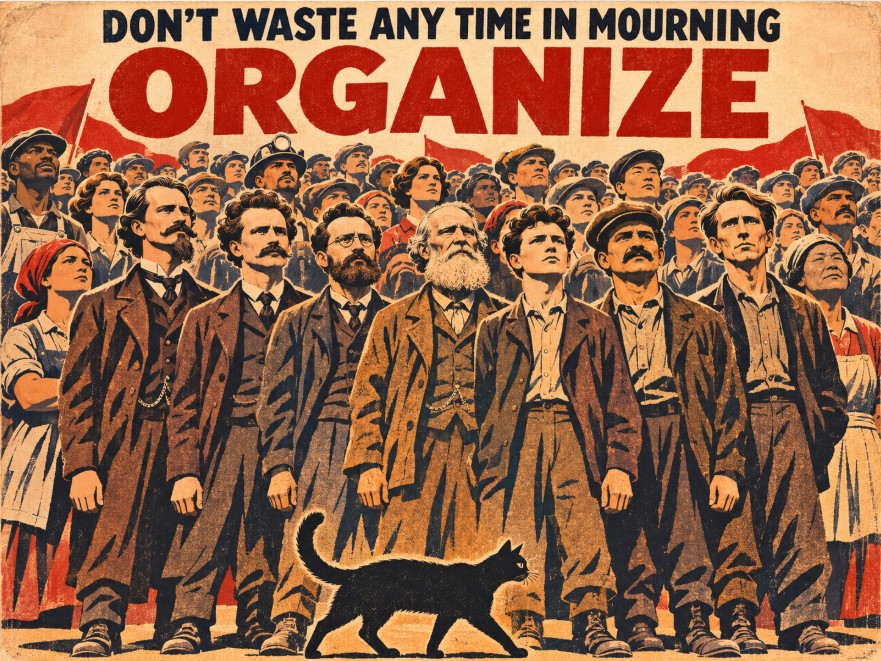
“Don’t waste any time in mourning. Organize.”
Sources
Joe Hill: The Salt Lake Tribune’s reconstruction of the trial record, and the 1915 printing of Hill’s telegram to Haywood
Haymarket: Gov. John Peter Altgeld, “Reasons for Pardoning Fielden, Neebe and Schwab” (1893), including the witness affidavits
Ludlow: U.S. Department of Labor history and the National Park Service account of the Ludlow Massacre