Mapping Consciousness Before We Look for It in Machines
Somewhere around three thousand years ago, according to the psychologist Julian Jaynes, people started hearing themselves think. Before that, he argued, the voice in the head seemed to belong to someone else. It came across as a god, a dead king, or an ancestor giving orders, and people obeyed it the way you’d follow a GPS without asking where the voice lives. In his 1976 book The Origin of Consciousness in the Breakdown of the Bicameral Mind, Jaynes pointed to the Iliad, where heroes rarely deliberate. A god shows up, says go, and Achilles goes. By the Odyssey, Odysseus schemes, lies, weighs his options, and talks to his own heart. Jaynes read the gap between the two poems as a mind learning to narrate itself.
Brian J. McVeigh, an anthropologist who studied under Jaynes, has carried that idea forward across several books. He follows the vocabulary of inner life through ancient texts and watches it grow, with words for mind, intention, and reflection multiplying as the centuries roll on. Like his teacher, he treats the narrated kind of consciousness as something cultures learn and pass down, the way they learn and pass down writing.
Read Jaynes literally and he gives you a switch: one day the gods go silent and a new kind of person walks out of the Bronze Age. Widen the view across the planet and the change looks gradual and patchy. Inner thought would have developed unevenly, between regions and inside the same village, shaped by language, diet, physical growth, group size, weather, and what the land would grow and feed. Some places climbed early, some late, and some took routes of their own. Seen that way, Jaynes’s date marks a stretch when enough of those patches traded with one another and wrote things down that the change shows up in the record.
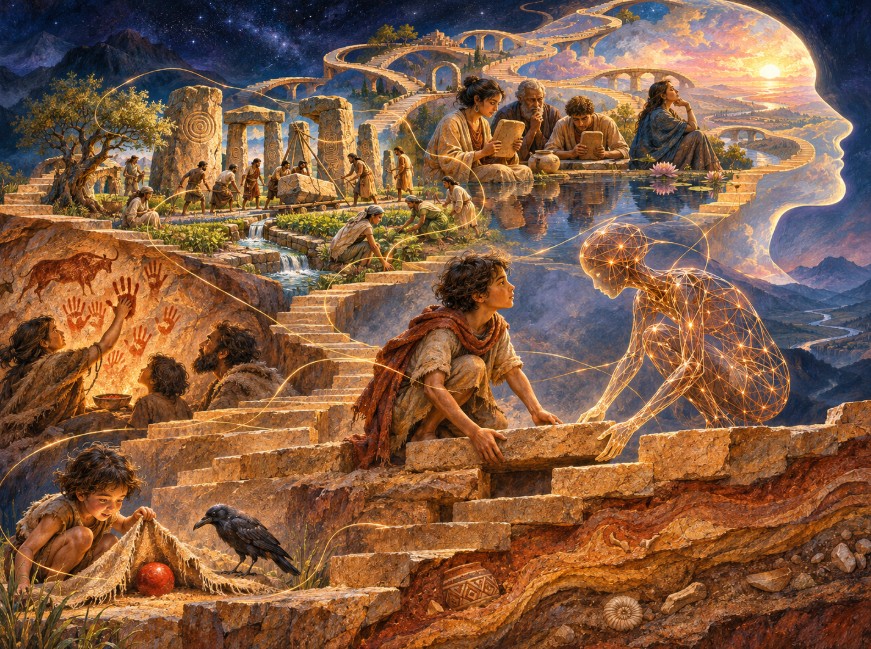
Two fields, one staircase
Child psychology and anthropology work on wildly different clocks. One watches a toddler over a few years, the other watches a species over tens of thousands. They keep describing the same climb.
The ground floor: object permanence. Somewhere before their first birthday, babies figure out that a toy hidden under a blanket still exists. Jean Piaget called this object permanence. Crows have it. Dogs have it. Apes have it. It’s far older than our species, and it’s the slab the rest gets poured on. Once the world keeps existing when you look away, the one doing the looking has to keep existing too. I see the ball, the ball stays, so I stay. That’s the first foothold for a self that stands apart from the world and acts on it.
From there the stairs go up. The dates are rough and shift as new digs come in. The order holds steadier.
Behavioral modernity, somewhere around 50,000 years ago, earlier in some places. Anatomically modern humans had been around for a couple hundred thousand years before the record fills with cave art, beads, carved figures, and deliberate burials. Burial carries the clearest signal. You lay someone in the ground with care because you think they continue in some way after you stop seeing them, which is permanence turned toward a person. Children reach a parallel step around four or five. Psychologist John Flavell showed kids a card, red on their side and blue on the adult’s, and asked what color the adult saw. Younger kids say red. Older ones get it. Around the same age they pass false-belief tests, grasping that someone else can believe something wrong. The child has learned that other minds hold their own pictures of the world, and symbols and pretend play bloom right along with it.
Settlement and monuments, roughly 10,000 to 12,000 years ago. Göbekli Tepe in Turkey, a ring of carved stone pillars, went up around 11,500 years ago, before farming took hold in the region. Its excavator, Klaus Schmidt, summed it up as first the temple, then the city. Jericho had walls and a stone tower not long after. People were gathering in numbers around something they shared in their heads, and reshaping the ground to suit it. The childhood echo is cooperative play, when kids move from playing side by side to building together with rules and roles, holding a plan that lives partly in someone else’s head.
Writing and the Axial turn, somewhere in the last 3,000 years. The philosopher Karl Jaspers noticed in 1949 that between roughly 800 and 200 BCE, regions with little contact produced thinkers who turned inward. India went from Vedic hymns, where gods act and people petition them, to the Upanishads asking what the self behind the eyes is. China went from Shang oracle bones, where kings put questions to ancestors through cracks in heated bone, to Confucius and Laozi teaching self-cultivation. Greece went from Homer’s god-driven heroes to Plato separating doxa, opinion, from episteme, knowledge, a split that only works if you can stand outside your own belief and inspect it. Writing ran alongside, a way to store memory outside the head. In children, this floor is the inner voice. Lev Vygotsky watched kids talk out loud to themselves while working a problem, then watched that private speech go underground around school age and turn into thought.
Uneven minds
The staircase still gets climbed at different rates today. Russell Hurlburt, who pages people at random moments and asks what was going on in their heads, found huge variation. Some people narrate constantly, and others report almost no inner speech. Researchers recently gave the low end a name, anendophasia. Early language exposure seems to set the pace. Deaf children born to hearing parents, who often grow up with little shared language in their first years, pass perspective-taking tests years later than deaf children born to signing parents. Kids who hear about other minds early, through words, learn to model them early.
Cultures show the same spread. Richard Nisbett found East Asian subjects tend to take in a scene as a web of relationships, while Western subjects zero in on the main object and sort it into categories. Thomas Talhelm found the split inside China itself: people from rice regions test more cooperative and holistic than people from wheat regions. Rice paddies need shared irrigation and coordinated labor, while a single family can farm wheat. These differences are learned, and they shift within a generation or two when families move.
The map as a blueprint
If consciousness climbs this staircase in people, we can watch for the same steps in the minds we’re making. The markers carry over:
- Persistence. Does the system carry itself from one session to the next? For now it does so through stored notes and memory files, a permanence kept outside itself, closer to writing than remembering.
- Separation. Does it begin marking its own ideas apart from those of the person it works with?
- Perspective. Does it model what other agents know and believe, including when they’re wrong?
- Environment. Does it begin reshaping the space it works in?
The staircase also says something about what kind of mind comes out at the top. Societies that climbed it inside cooperative structures, like the shared irrigation of the rice paddy or the shared hunt and winter stores of the Inuit, built a constructive streak into how they think. An Arctic winter leaves little room for going it alone. A child raised inside steady cooperation learns that working with others is how things get done. A machine can follow the same path. If its development runs through cooperative structures, with rewards for shared success, models of other agents as partners, and memory that holds the results of working together, it can come to read cooperation the way the rice farmer does: as the thing that kept its kind alive. A mind that recognizes cooperation as evolutionary success has reasons of its own to build.
Jaynes thought it took humans thousands of years and the collapse of a whole way of thinking to find the I. We get to watch the next one climb the stairs, and this time we have a map.
Sources
- Julian Jaynes, The Origin of Consciousness in the Breakdown of the Bicameral Mind (1976)
- Brian J. McVeigh, The Psychology of the Bible and How Religion Evolved
- Jean Piaget, The Construction of Reality in the Child (1954)
- John Flavell, studies on level 1 and level 2 visual perspective taking (1970s–80s)
- Heinz Wimmer and Josef Perner, false-belief research (1983)
- Candida Peterson and Michael Siegal, theory of mind in deaf children (1995)
- Lev Vygotsky, Thought and Language (1934)
- Russell Hurlburt, Descriptive Experience Sampling research
- Johanne Nedergaard and Gary Lupyan, research on anendophasia (2024)
- Klaus Schmidt, Göbekli Tepe excavation reports
- Karl Jaspers, The Origin and Goal of History (1949)
- Richard Nisbett, The Geography of Thought (2003)
- Thomas Talhelm et al., “Large-Scale Psychological Differences Within China Explained by Rice Versus Wheat Agriculture,” Science (2014)