A Bright Meadow Group ODI Theory on Where and When the American and European Eels Breed
A century ago, the Danish oceanographer Johannes Schmidt spent years towing fine nets across the Atlantic and measuring eel larvae. He followed them as they got smaller and smaller, until the smallest ones led him to the southern Sargasso Sea. Ships from Denmark, Germany, the United States, Japan and Britain have gone back many times since. Tagging teams have fixed satellite tags to silver eels and followed them out past the Azores. In 2022 one of those teams tracked adult European eels into the Sargasso itself. No one has yet collected an Atlantic eel egg or a spawning adult there.
What follows is the easy part of this puzzle. We sat at a desk with other people’s data and looked at it with fresh eyes. The hard part belongs to the researchers who did the collecting: weeks at sea, nets going over the side at two in the morning, tags that pop up early or fail to report, and eels that disappear into 800 meters of black water. Their work is the reason a theory like this can be built. If this piece helps one of those crews spend a week of ship time in a better spot, it has done its job.
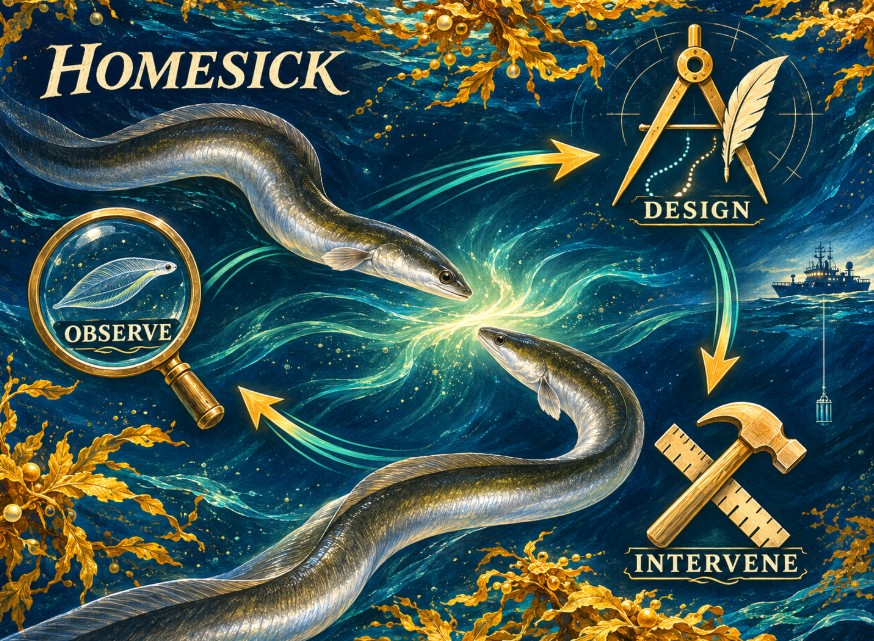
OBSERVE: What the Field Record Shows
Two species, one nursery. The American eel ranges from Greenland to Venezuela and far upstream the Mississippi. The European eel ranges from Iceland and Norway to North Africa. Both spawn in the southern Sargasso Sea. American eels from across the whole range breed as a single population, so an eel from a Minnesota creek and one from a Venezuelan river share one gene pool. The European eel makes the longest spawning trip of any eel, 5,000 to 10,000 kilometers.
Where the youngest larvae turn up. Larvae 12 mm or smaller are less than about 20 days old, so they mark recent spawning. Surveys have found them across a 2,000-kilometer stretch of the Sargasso, from 70°W to 50°W. North to south, though, they stay in a narrow band near temperature fronts of 22 to 24°C. A 2014 Danish–German survey ran 15 crossing transects in March and April and confirmed spawning across that whole east–west span. The fronts set the northern limit of spawning.
The two species overlap but lean apart. American larvae come from a spawning area farther west. They grow faster and change into glass eels at under 70 mm. European larvae mostly come from farther east and can reach almost 90 mm before they change.
When. Ear-bone growth rings in larvae caught in 2011 put hatching in February and March. More American larvae hatched in February and more European larvae in March. A few larvae hatched outside that season, back in November, December and July. The lunar timing of Atlantic spawning hasn’t been worked out.
The trip. Satellite-tagged European eels released in the Azores swam 3 to 12 kilometers a day, and the tags tracked them for 40 to 366 days. Eels leave from rivers across Europe and North Africa. Researchers proposing a Mid-Atlantic Ridge spawning site argued that silver eels converge on the Azores whatever their starting point.
The one solved case is in the Pacific. The Japanese eel spawns along the West Mariana Ridge, a chain of seamounts, just south of a salinity front. Researchers there have collected eggs, newly hatched larvae and spawning adults. The record from that ground shows:
- Spawning in pulses at the new moon.
- Spawning at about 150 to 200 meters deep, with the eggs rising afterward.
- Females spawning two or three times on successive new moons, then dying when their energy runs out.
- Adults fasting for the whole trip of about six months.
- Adults making a daily commute in the water: deep and cold by day, shallower at night, and shallower still on moonless nights.
The trip begins at puberty. Silvering is the change from the yellow, river-dwelling eel to the silver, ocean-going one. Hormone studies classify it as a puberty event. Reproductive hormones switch on early in silvering, and sex steroids and egg-yolk protein rise in the blood. The eel leaves home with this process only begun. The swim seems to carry it forward: swimming kicks off early maturation in females and drives maturation in males, and high water pressure plays a supporting part.
The nose. In a Maine estuary, twelve of seventeen normal silver eels left for the sea within about four days. Of eight eels with blocked noses, two made it out. In Japan, eels with blocked noses also stopped responding to magnetic fields, and the researchers placed a magnetic sensor in or near the nostrils. In rainbow trout, researchers found the magnetic receptor cells inside the nose itself, in a layer of the smell tissue, holding chains of magnetite crystals about one micrometer long. Young European eels have a magnetic map they use to steer into the Gulf Stream.
Eels read each other. Mucus from mature European eels gives a stronger smell response than mucus from immature ones, which points to chemical signaling in reproduction. Behavioral tests on young American eels suggest that glass eels moving inland follow the odor of the previous year’s class.
Seawater carries an address. Oceanographers identify water masses by the rock they’ve touched. Neodymium, a rare metal washed off the continents, carries an isotope ratio that marks where the water picked it up. The international GEOTRACES program has used it to trace North Atlantic water masses from south of Iceland down to the Sargasso Sea.
The nose can be damaged. NOAA researchers found that dissolved copper at levels common in urban stormwater runoff dulls the sense of smell in young salmon in fresh water. In saltier estuary water, the same copper levels had no measurable effect.
A published cousin of the “high point” idea. In 2020, Chang, Feunteun and Miyazawa proposed that Atlantic eels spawn near seamounts on the Mid-Atlantic Ridge, east of the Sargasso. Their argument drew on the Japanese case, larval drift models and the chemistry of larval ear bones. Hanel and colleagues pushed back in 2022. They pointed out that the youngest larvae keep turning up between 70°W and 50°W. They also argued that a volcanic chemical signal from the ridge floor would have to cross more than a kilometer of deep water to reach the larvae. The debate is still open.
The decline. Since the 1980s, the number of young European eels arriving at the coasts has dropped by about 95 percent.
DESIGN: The Theory
1. The eel lives where it lands. A larva drifts where the currents take it and grows up wherever it arrives. Nothing about the river it settles in decides where it will breed. That fits the single American breeding population and the European eel’s spread from the Arctic Circle to North Africa.
2. The nose is a field lab. An eel’s nose works like a sensor bench with two instruments. One reads dissolved chemistry: metals, minerals and organic compounds. The other reads magnetism, from the magnetic sensors in the same tissue. Seawater carries both kinds of signal. Each water mass has a chemical fingerprint from the rock it has touched. Iron-bearing mineral grains and magnetite-building bacteria in the water line up with Earth’s field like tiny compass needles. The brain blends the two readings into one impression, the way temperature and taste blend into one sip of coffee. To the eel, water doesn’t register as so much iron plus so much north. It smells like a place.
3. The reference sample is taken at conception. The egg’s yolk is built from reserves the mother stored in her home river, so the yolk carries her river’s signature. The nursery’s signature enters at fertilization. When a fish egg is fertilized, it swells by drawing in the surrounding water, which fills a space between the outer shell and the embryo. The eel embryo develops bathed in a sealed sample of spawning-ground water until it hatches, then spends its first days as a larva in that same water. Whether the record is written at fertilization, at hatching, or across both, the nursery’s signature stays with the eel for life.
4. Puberty brings a pang. At silvering, a drive switches on that the brain may feel the same way it feels hunger, sexual urge or pain. Like an early teenager, the eel has the urge before the equipment is finished. It stops eating, and the gut shrinks while the eyes grow. Resources shift from feeding to the search. The swim, the pressure and the cold finish the ripening along the way.
5. Currents and each other lead the way home. Water that has passed through the nursery reaches the continents by the same currents that carried the larvae, so the signature arrives at the river mouths. Each migrating eel also leaves its own scent trail. Eels from scattered rivers start on separate branch lines, pick up each other’s trails and merge onto a trunk route, the way rail lines converge on a hub. The convergence toward the Azores fits that picture. Early leavers lay the trail and later leavers follow it, and the trail strengthens as more eels join.
6. Timing comes from arrival and ripening. An eel spawns when it has arrived and its hormones have finished the job. The Pacific record shows new-moon pulses. The Atlantic record can’t yet tell new-moon pulses apart from a spread-out season.
7. Spawning happens at a high point, and the eels spawn until the fuel runs out. At the nursery, eels gather near a high point and broadcast their eggs and sperm into the water. A female spawns again on later nights until her reserves are spent, and then she dies.
8. The decline can feed on itself. If eels follow each other, the strength of the trail depends on how many eels are traveling it. A run reduced to a twentieth of its former size lays a much fainter trail across thousands of kilometers of moving water. A fainter trail means more eels lose their way, fewer arrive, and the next year’s trail is fainter still. Anything that damages the nose before the eel leaves fresh water cuts into the trail at its start.
9. The test that would settle it: conceive eels somewhere else and they will head back there.
INTERVENE: Where and When to Look
The search box
| American eel | European eel | |
|---|---|---|
| Peak season | February | March, running into April |
| Longitude | Western part of the 70°W–50°W band | Central and eastern part of the band |
| Latitude | South of about 30°N, on the warm side of the frontal zone | Same |
| Depth, by the Pacific comparison | About 150–200 m, at night | Same |
| Moon phase | Sample the full lunar cycle; the Pacific record predicts new-moon peaks | Same |
| Landmarks | Seafloor rises within the band; the top of the eels’ nightly climb in the water | Same, with the Mid-Atlantic Ridge flank as the alternative site to check |
Tests, from cheapest to longest
Desk test: the moon. Collect the ear-bone hatch dates already measured from Sargasso larvae and line them up against the moon phase. If they cluster at the new moon the way the Japanese eel’s do, the moon is setting the timing. If they spread evenly through February to April, arrival and ripening set it, as this theory holds. This costs no ship time, because the larvae are already in jars and the rings are already counted.
Desk test: the address. Compare the trace-metal and isotope fingerprint of water in the spawning band with the chemistry locked in the ear-bone cores of the youngest larvae. A match supports the idea that the eel carries its birth water from its earliest days.
Lab test: conception or hatching. Japanese hatcheries already fertilize eel eggs by hand. Fertilize one batch in seawater carrying a distinct, harmless chemical marker and move it to plain seawater before it hatches. Fertilize a second batch in plain seawater and move it into the marked water before it hatches. Raise both batches and test which group’s noses respond to the marker. The result shows whether the reference sample is taken at fertilization, at hatching, or across both.
Lab test: the plume. Collect water from inside the spawning band, from the Gulf Stream, from the Canary Current and from open Atlantic water outside the gyre. Present each sample to the noses of silver eels and record the nerve response with an electro-olfactogram. If silver eels respond more strongly to water from the spawning band than to other ocean water, the nose can tell the nursery’s signature apart.
Lab test: smell or compass. Japanese researchers have already blocked eel noses and lost the magnetic response. The next step is to cut the smell nerve only, leave the nostril tissue intact, and test magnetic response again. A follow-up would release three groups of tagged silver eels from the Azores: normal eels, eels without smell, and eels with the nose intact but the smell nerve cut. Comparing how far each group gets toward the Sargasso would show which sense is steering.
Field test: the trail. During the autumn migration, sample water along the route from the European shelf to the Azores for the compounds eels shed: bile acids and mucus chemistry. If the concentration rises toward the Azores, where the routes converge, the eels are traveling a shared trail.
Field test: magnetic particles. Filter water from the spawning band and from waters outside it, and count magnetic mineral grains and magnetite-building bacteria in each. A distinct magnetic signature in the band would give the nose’s magnetic instrument something to read.
Field test: the high points. Overlay the seafloor map on the band where the youngest larvae turn up. Sample for environmental DNA at 150–200 m on February through April nights, both downstream of seafloor rises and over flat bottom, and compare the eel DNA signal.
Long test: the swap. The Japanese eel’s life cycle was closed in captivity in 2010, and European labs are getting closer to the glass eel stage. Fertilize eggs in water with a distinct, traceable chemical signature, raise them to silver eels, tag them, and see where they head. This is the experiment that would settle the theory either way.
If the trail holds up
Under this theory, each silver eel that reaches the sea does more than add one spawner. It also strengthens the scent trail for the eels traveling behind it. That changes the accounting for dam passage, trap-and-transport programs and river cleanup. A silver eel carried past a dam adds its own spawning and its share of the trail that guides the rest. Keeping copper and other nose-dulling pollutants out of eel rivers protects the instrument the whole trip depends on.
Close
Schmidt narrowed the search down to one sea. The crews who followed him narrowed it to a band, a season and a depth. This theory offers a reason for the trip and a way it might be made: a homesick teenager with a field lab for a nose and no appetite, following the chemistry of its birthplace and the scent of the eels ahead of it. It also comes with a list of places and nights to check. Take whatever is useful and throw out the rest. The sea will settle it, and the people out there sampling it will be the ones who find the answer.
An offer of hands. The author of this theory, Robert “Bert” Smith of The Cernunnos Foundation, is an able-bodied seaman and a former Navy radioman who served aboard USS Nimitz and USS Niagara Falls. He would gladly sign on to a research vessel heading out to sample, tag or track these eels, whether the ship needs a hand on deck or on the radio. He can be reached through blueribbonteam.com.
Bright Meadow Group, a division of The Cernunnos Foundation
Sources
- Wright et al. 2022, First direct evidence of adult European eels migrating to their breeding place in the Sargasso Sea, Scientific Reports. https://pmc.ncbi.nlm.nih.gov/articles/PMC9562336
- Miller et al. 2019, Spawning by the European eel across 2000 km of the Sargasso Sea, Biology Letters. https://pmc.ncbi.nlm.nih.gov/articles/PMC6501356
- Miller et al. 2015, A century of research on the larval distributions of the Atlantic eels, Biological Reviews. https://esploro.umontpellier.fr/esploro/outputs/journalArticle/A-century-of-research-on-the/99152185209311
- Munk et al. 2010, Oceanic fronts in the Sargasso Sea control the early life and drift of Atlantic eels. https://researchonline.jcu.edu.au/27627/
- Kuroki et al. 2017, Hatching time and larval growth of Atlantic eels in the Sargasso Sea, Marine Biology. https://link.springer.com/doi/10.1007/s00227-017-3150-9
- Chang, Feunteun & Miyazawa 2020, New clues on the Atlantic eels spawning behavior and area: the Mid-Atlantic Ridge hypothesis, Scientific Reports. https://www.vliz.be/imisdocs/publications/ocrd/352344.pdf
- Hanel et al. 2022, No new evidence for an Atlantic eels spawning area outside the Sargasso Sea. https://www.ncbi.nlm.nih.gov/pmc/articles/PMC9276751/
- Chang et al. 2022, Reply. https://www.ncbi.nlm.nih.gov/pmc/articles/PMC9276716/
- Tsukamoto et al. 2003, Seamounts, new moon and eel spawning. https://kyushu-u.elsevierpure.com/en/publications/seamounts-new-moon-and-eel-spawning-the-search-for-the-spawning-s/
- Tsukamoto et al. 2011, Oceanic spawning ecology of freshwater eels in the western North Pacific, Nature Communications. https://pmc.ncbi.nlm.nih.gov/articles/PMC3105336
- Shimizu et al. 2021, Histological evidence of multiple spawning in wild female Japanese eel. https://zoolstud.sinica.edu.tw/Journals/60/60-61.pdf
- Chow et al. 2010, Japanese eel do not assimilate nutrition during the oceanic spawning migration. https://int-res.com/articles/meps2010/402/m402p233.pdf
- Higuchi et al. 2018, Tracking Anguilla japonica silver eels along the West Mariana Ridge. https://zoolstud.sinica.edu.tw/issue.php?id=554
- Aroua et al. 2005, Endocrine evidence that silvering is a pubertal rather than a metamorphic event. https://pubmed.ncbi.nlm.nih.gov/16679776
- Palstra et al. 2008, Male silver eels mature by swimming. https://pmc.ncbi.nlm.nih.gov/articles/PMC2474648
- Sébert et al. 2007, Effects of high hydrostatic pressure on the pituitary-gonad axis in the European eel. https://pubmed.ncbi.nlm.nih.gov/17324430
- Barbin et al. 1998, Olfactory clues play a critical role in the estuarine migration of silver-phase American eels. https://doi.org/10.1023/a:1007469232698
- Nishi & Kawamura 2005, Magnetosensitivity in anosmic Japanese eel. https://doi.org/10.1111%2Fj.1444-2906.2005.00936.x
- Diebel et al. 2000, Magnetite defines a vertebrate magnetoreceptor, Nature. https://tethys.pnnl.gov/publications/magnetite-defines-vertebrate-magnetoreceptor
- Naisbett-Jones et al. 2017, A magnetic map leads juvenile European eels to the Gulf Stream. https://repository.library.noaa.gov/view/noaa/17949/noaa_17949_DS1.pdf
- Huertas et al. 2007, Olfactory sensitivity to conspecific bile fluid and skin mucus in the European eel. https://agris.fao.org/search/es/records/679ba40c969e37f4376ed015
- Great Lakes Fishery Commission 2017, American eel bile acids as conspecific cues. https://glfc.org/pubs/pdfs/research/reports/2014_LIW_54043.htm
- GEOTRACES, Water masses traced by neodymium isotopic compositions in the North Atlantic. https://www.geotraces.org/?p=995
- Sandahl et al. 2007, Copper and olfaction in juvenile coho salmon, NOAA Fisheries. https://www.noaa.gov/sites/default/files/legacy/document/2020/Oct/07354626634.pdf
- Estuary News 2015, Copper effects on salmon influenced by salinity. https://www.sfestuary.org/estuary-news-copper-effects-on-salmon-influenced-by-salinity/
- Wageningen University 2025, Eel breeding: from biological mystery towards controlled eel reproduction. https://wur.nl/en/show/eel-breeding-from-biological-mystery-towards-controlled-eel-reproduction.htm
- USFWS, American eel. https://www.fws.gov/northeast/americaneel/