A Bright Meadow Group thought experiment on Atlanta, the Southeast’s hub in waiting, and the arc that finishes it
Atlanta was born as a railroad town. In 1837 surveyors drove a stake in the Georgia woods to mark the end of a new line, and the settlement that grew around it was called Terminus. The city has been where the South’s lines meet ever since. The Three-Nation Line already runs through it on its way from Washington to Dallas-Fort Worth. Add legs to Nashville, Mobile and Jacksonville, and Atlanta becomes the hub of the Southeast on the rail map, the way it already is on every other map.
OBSERVE
Atlanta already runs as a hub. Hartsfield-Jackson handled 106.3 million passengers in 2025, more than any other airport on the planet, and it has held that title for 27 of the last 28 years. Three interstates, I-75, I-85 and I-20, cross downtown. The freight railroads still converge on the city that started as their end of the line. When people in the Southeast travel, they pass through Atlanta.
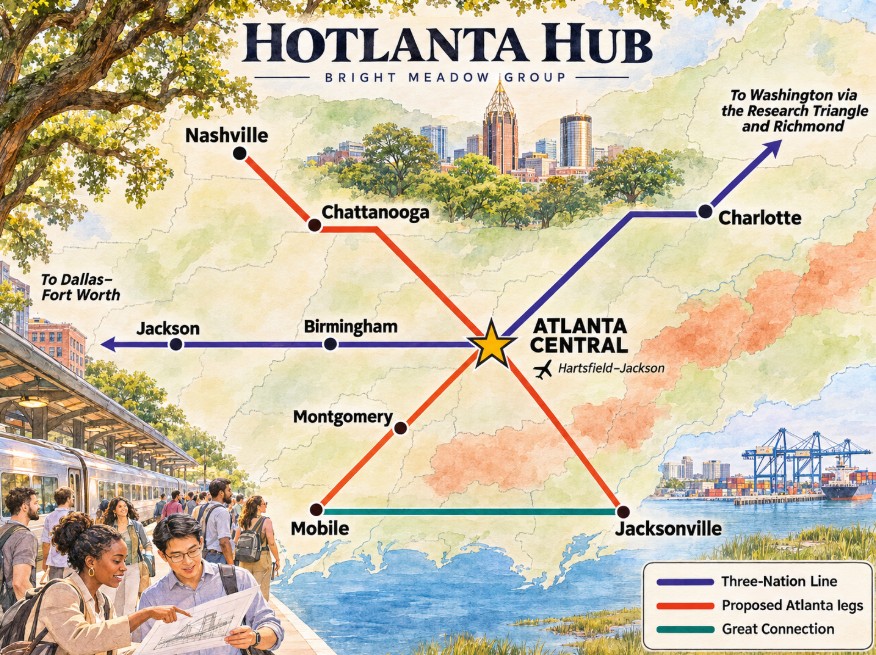
The Continental Network treats Atlanta as a stop. On the first map, the Three-Nation Line passes through between Charlotte and Birmingham and keeps going. Nashville hangs on the Crossroads Line to the west. Mobile and Jacksonville sit on the Great Connection along the Gulf, a long way around from Atlanta.
The cities around it are growing. Nashville has become a capital of music and of the healthcare business. Jacksonville runs a deep-water port and anchors the Navy on Florida’s Atlantic coast. Mobile builds airliners and warships on the Gulf. Each one sits a long half-day’s drive from Atlanta, and the drive gets worse each year. On a weekday evening, Atlanta’s Downtown Connector moves like a church parking lot on Easter Sunday.
DESIGN
The legs. Atlanta Central with five directions out:
- Northeast on the Three-Nation Line: through Charlotte, the Research Triangle and Richmond to Washington, then on to New York and Montreal.
- West on the Three-Nation Line: through Birmingham and Jackson to Dallas-Fort Worth, then on to Laredo and Mexico City.
- Northwest to Nashville: through Chattanooga along I-75 and I-24.
- Southeast to Jacksonville: across south Georgia to the Atlantic coast.
- Southwest to Mobile: down I-85 to Montgomery and I-65 to the Gulf.
Mobile and Jacksonville already share the Gulf leg of the Great Connection. With the new legs, Atlanta, Mobile and Jacksonville form a triangle the size of the Texas triangle, with Nashville hanging off its northern point.
What Atlanta becomes. The front door of the hemisphere’s network on the Atlantic side. The international line already runs through the city. The arc ties four more of the region’s cities into it.
The airport becomes a rail port. A traveler lands at Hartsfield-Jackson from Lagos, São Paulo or Seoul, walks downstairs to a train platform, and reaches Nashville, Jacksonville or Mobile while the next flight is still boarding. The short flights to those cities, which now tie up gates and runway slots, move to the trains. The world’s busiest airport frees up room for longer flights, the ones only an airplane can do.
The region turns into one market. Close to twenty million people live in the metros along the five legs and the triangle. On the arc, Nashville, Jacksonville and Mobile each sit an hour or two from Atlanta. A songwriter in Nashville takes a meeting at a studio in Atlanta and is back on Music Row by supper. A Jacksonville shipping firm opens an office in Midtown and staffs it from home. A Georgia Tech engineer rides to Mobile in the morning to walk the assembly line at the airliner plant.
The Mobile leg runs through the auto belt. The line down I-85 and I-65 passes the Kia plant at West Point and the Hyundai plant in Montgomery on its way to the Gulf. Parts, people and engineers move between the plants, the port and the schools by rail. The trains themselves could come off the same kind of lines that build those cars.
The ports join the hinterland. Mobile on the Gulf and Jacksonville on the Atlantic become Atlanta’s two harbors, an hour or two away by train. Freight keeps its own rails. The people who run the ships, the cranes and the warehouses get a way to work the whole region from wherever they live.
The campuses join the line. Georgia Tech, Emory and the historically Black colleges of the Atlanta University Center connect to Vanderbilt in Nashville, the University of North Florida in Jacksonville and the University of South Alabama in Mobile. The Three-Nation Line carries them on to the Research Triangle and Washington to the northeast, and to the Texas schools to the west.
The heat sells itself. Hotlanta earned its nickname honestly. A train from Nashville drops a family at the aquarium in the morning and brings them home before the afternoon storms. A family from Jacksonville rides up for a ball game and skips four hours of interstate each way.
Atlanta has been the Southeast’s hub since it was a stake in the woods. The Three-Nation Line puts it on the international network, and the arc makes the rest of the region feel it.
INTERVENE
Build the arc with the Three-Nation Line. When the international line reaches Atlanta, open the Nashville, Jacksonville and Mobile legs alongside it, so the hub arrives finished.
Put the station under the airport. Build an Atlanta rail station at Hartsfield-Jackson, tied to the downtown station, so a plane and a train connect in one building.
Reserve the medians now. I-75 and I-24 to Nashville, I-85 and I-65 to Mobile, and the south Georgia corridor to Jacksonville, while the ground is cheap.
Invite the automakers. The Kia and Hyundai plants along the Mobile leg are natural partners for building and maintaining trainsets, and they sit right on the line.
Let the airlines in. Give the hub airline a stake in the short-haul trains that replace its short flights, so the train and the plane sell one ticket.
Hold the national standard. Build gauge, power, signals and trainsets to the federal spec, so Atlanta plugs into the Continental Network on the first day.
Terminus was the end of a line. Atlanta Central is where five lines begin.
Sources
CNN via KRDO, This is the world’s No. 1 busiest airport. Here’s why — https://krdo.com/news/2026/07/18/this-is-the-worlds-no-1-busiest-airport-heres-why/
Blue Ribbon Team, High Speed Rail series — https://blueribbonteam.com/high-speed-rail/
Blue Ribbon Team, The Continental Network — https://blueribbonteam.com/blog/2026/11/23/the-continental-network/
Blue Ribbon Team, The Three-Nation Line — https://blueribbonteam.com/blog/2026/11/14/the-three-nation-line/
Blue Ribbon Team, The Great Connection — https://blueribbonteam.com/blog/2026/11/11/the-great-connection/
Blue Ribbon Team, The Second Wave — https://blueribbonteam.com/blog/2026/11/23/the-second-wave/
Blue Ribbon Team, The Keystone Network — https://blueribbonteam.com/blog/2026/01/14/the-keystone-network/
Blue Ribbon Team, The Lone Star Junction — https://blueribbonteam.com/blog/2026/10/20/the-lone-star-junction/
Blue Ribbon Team, The Continental Spine — https://blueribbonteam.com/blog/2026/10/21/the-continental-spine/
Blue Ribbon Team, Two Lanes to Anchorage — https://blueribbonteam.com/blog/2026/11/05/two-lanes-to-anchorage/
Blue Ribbon Team, Second Shift — https://blueribbonteam.com/blog/2026/11/07/second-shift/
Blue Ribbon Team, The Head Start — https://blueribbonteam.com/blog/2026/11/09/the-head-start/
Blue Ribbon Team, The Chicago Hub — https://blueribbonteam.com/blog/2026/11/16/the-chicago-hub/
Blue Ribbon Team, The Plains Spine — https://blueribbonteam.com/blog/2026/11/19/the-plains-spine/
Blue Ribbon Team, The Central Transcontinental — https://blueribbonteam.com/blog/2026/11/20/the-central-transcontinental/
Blue Ribbon Team, Sin City Spider — https://blueribbonteam.com/blog/2026/11/24/sin-city-spider/
Blue Ribbon Team, A Hundred Feet — https://blueribbonteam.com/blog/2026/08/27/a-hundred-feet/
Airports Council International, What Are the Busiest Airports in the World in 2025? — https://blog.aci.aero/airport-economics/busiest-airports-in-the-world-2025/