A Bright Meadow Group thought experiment on the Las Vegas hub, and the cash factory it builds for the Southwest
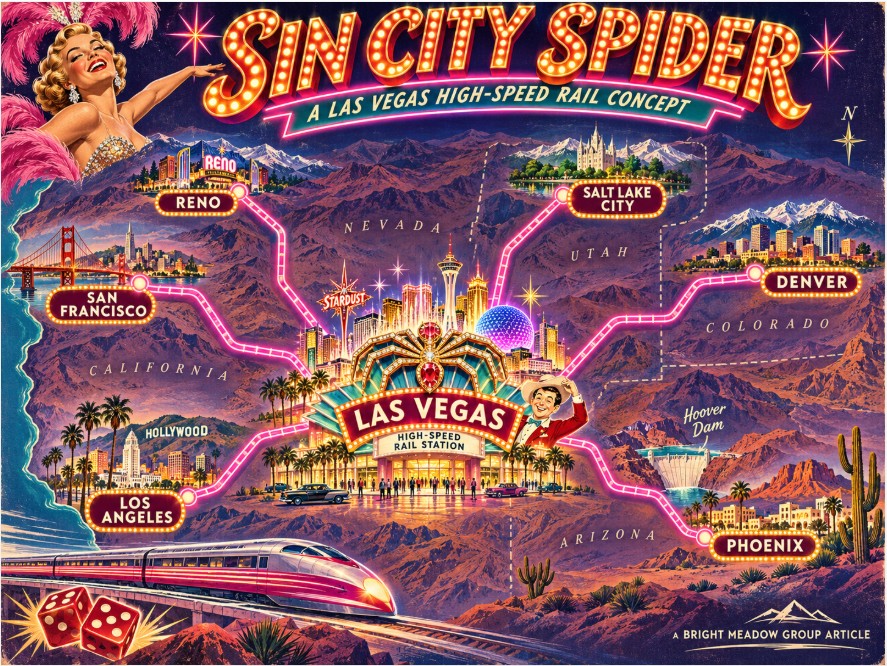
Picture Las Vegas from a plane at night. The Strip burns in the middle of a black desert, and six lines of light run out from it like legs: to Los Angeles, San Francisco, Reno, Salt Lake City, Denver and Phoenix. That’s the Sin City Spider. It’s the hub the Continental Network grows in the desert, and Las Vegas already has the money in town to build it first.
OBSERVE
Las Vegas runs like a cash register with a city built around it. More than 41 million people visited in 2024. Nevada’s casinos won a record $15.8 billion from gamblers in 2025, and the state’s larger casinos took in about $30.8 billion in fiscal 2025 once you count rooms, food and shows. Much of that money arrives from the cities at the ends of the spider’s legs. It comes up I-15 from Southern California, and it lands at the airport from Phoenix, the Bay Area and Denver.
The pipes that feed the register are clogging. Las Vegas had its fewest visitors in four years in 2025, and the airport lost about six percent of its passengers from the record it set in 2024. On a Friday afternoon, I-15 out of Los Angeles moves like the line at a buffet on New Year’s Eve.
The city could have fixed this a decade ago. In the early 2010s a private venture asked Washington for a $5.5 billion loan on a line priced near $7 billion. In 2015 it signed a Chinese rail consortium as a partner. California leased it the I-15 median, and the Nevada side ran across open federal ground. The pieces were on the table, and they sat there. Today the line is Brightline West, its price is $21 billion, and its station is going up south of the Strip while it waits on a federal loan.
The money to finish the job is already moving through the city. It crosses the casino cage, the front desk and the convention floor each night. Las Vegas doesn’t need to go looking for capital. It needs to take a cut of the cash already passing through its hands and invest it in the thing that brings more.
DESIGN
The spider. One station south of the Strip with six legs:
- Los Angeles: down the I-15 median on the Brightline West line.
- Phoenix: south along the planned I-11 corridor past Hoover Dam.
- Reno: north up the length of Nevada along US 95.
- San Francisco: west across the Sierra to the Bay.
- Denver: east across southern Utah and the Colorado Rockies to meet the Central Transcontinental.
- Salt Lake City: north along I-15.
At 200 mph, each of those cities sits two to four hours from the Strip.
What they’re building. A trillion-dollar cash factory for the Southwest. A factory takes in raw material and turns out product around the clock, and Las Vegas already runs around the clock. The spider turns the region into the factory’s supply line.
The raw material is people. Close to forty million live in the metro areas at the ends of the legs. Today they reach Las Vegas through a jammed interstate or an airport security line. On the spider, they reach it the way a New Yorker reaches Midtown: they get on a train and get off downtown. The city stops being a place you plan a trip to and becomes a place you go on a Thursday.
The weekend turns into a workweek. Conventions are the city’s backbone, and the spider puts six metro areas inside a day trip of the convention floor. A Phoenix sales team rides up for a trade show, works the booths and is home for dinner. A Denver startup pitches investors at a conference in the morning and is back in Colorado the same night. Las Vegas becomes the meeting room of the West, with a deal table open at any hour.
The stadium nights fill from six directions. Football Sundays, fight nights, races down the Strip and concerts in the Sphere draw fans by the trainload. They leave their cars at home, and the money they would have spent on gas and parking lands at the tables and the bars.
The industry of the Southwest gets a showroom. Phoenix’s chip plants, Reno’s battery and data center parks and Salt Lake City’s tech corridor sit a few hours by rail from the convention halls where their products get sold. The engineers ride in for the show. The buyers ride in from Los Angeles and the Bay. The orders get signed in Las Vegas.
A new downtown grows around the hub. The desert ground around the station turns into offices, hotels, housing and the shops that serve them. The trainset plant for the network goes up nearby, next to the plant already casting concrete ties for the line in North Las Vegas. The city that grew up as a railroad water stop becomes a railroad town again, at the center of six lines.
The labor market joins up. A cook in Reno takes a contract on the Strip and rides home on his days off. A nurse in Henderson works a stretch in Phoenix. The Southwest’s workers move to the work the way the Continental Network promises the rest of the country they will.
Add up the economies at the ends of those six legs and they run into the trillions each year. The spider puts Las Vegas in the middle of them as the market floor, the stage and the cashier’s window. And they have desert: flat, open, federally held ground that a line can cross with few farms, few houses and few lawsuits in the way.
The bet. Las Vegas builds its spider before the rest of the Continental Network is half done. The money is already in the building, and the opportunity is sitting on the table.
INTERVENE
Invest from the cage. Let the resorts, the companies that own the Strip’s real estate and the convention authority put a share of what already passes through town into the spider, through a slice of the room tax, a station district assessment or straight equity.
Close the first loan. The Brightline West application sits on a federal desk. A decision there puts the first leg on rails.
Grant the desert. Transfer right-of-way across federal land to the spider at no charge, and reserve the I-15 and I-11 medians now.
Build the trains here. Make a trainset plant in Nevada the price of entry for the foreign rail builders who want into the American market.
Hold the national standard. Build gauge, power, signals and trainsets to the federal spec, so the spider plugs into the Continental Network the day the trunks reach it.
Start the second and third legs now. Phoenix and Reno shouldn’t wait for Los Angeles to open. Survey, reserve and finance them alongside it.
The city built a world capital of entertainment on a desert water stop with nothing but nerve and cash. Six lines of track is a smaller bet than that, and the payout runs bigger.
Sources
Blue Ribbon Team, The Lone Star Junction: https://blueribbonteam.com/blog/2026/10/20/the-lone-star-junction/
Blue Ribbon Team, The Continental Spine: https://blueribbonteam.com/blog/2026/10/21/the-continental-spine/
Blue Ribbon Team, The Keystone Network: https://blueribbonteam.com/blog/2026/01/14/the-keystone-network/
Blue Ribbon Team, The Plains Spine: https://blueribbonteam.com/blog/2026/11/19/the-plains-spine/
Blue Ribbon Team, The Great Connection: https://blueribbonteam.com/blog/2026/11/11/the-great-connection/
Blue Ribbon Team, The Three-Nation Line: https://blueribbonteam.com/blog/2026/11/14/the-three-nation-line/
Blue Ribbon Team, The Chicago Hub: https://blueribbonteam.com/blog/2026/11/16/the-chicago-hub/
Blue Ribbon Team, The Central Transcontinental: https://blueribbonteam.com/blog/2026/11/20/the-central-transcontinental/
Blue Ribbon Team, The Pacific Coast: [link]
Blue Ribbon Team, The Head Start: https://blueribbonteam.com/blog/2026/11/09/the-head-start/
Blue Ribbon Team, Two Lanes to Anchorage: https://blueribbonteam.com/blog/2026/11/05/two-lanes-to-anchorage/
Blue Ribbon Team, Second Shift: https://blueribbonteam.com/blog/2026/11/07/second-shift/
AP via Yahoo News, Buy-America snag stalls Vegas high-speed rail plan: https://news.yahoo.com/buy-america-snag-stalls-vegas-204924493.html
Reuters via Lincoln Daily News, XpressWest, seeking to build U.S. high-speed rail, ends deal with China group (June 9, 2016): https://archives.lincolndailynews.com/2016/Jun/09/NEWS/business_q.shtml
Trains, Brightline West seeks $6 billion federal loan as construction costs rise: https://www.trains.com/pro/passenger/high-speed/brightline-west-seeks-6-billion-federal-loan-as-construction-costs-rise
Hotel Online, Does Las Vegas Need to Rebound From Dip in Tourism?: https://www.hotel-online.com/news/does-las-vegas-need-to-rebound-from-dip-in-tourism-officials-say-key-metrics-are-solid
American Gaming Association, Nevada Overview: https://americangaming.org/wp-content/uploads/2025/02/Nevada_Overview.pdf
Solo Azar, Las Vegas Strip Revenue Declined in 2025 After Record-Breaking 2024: https://www.soloazar.com/en/category/reports/las-vegas-strip-revenue-declined-in-2025-after-record-breaking-2024
The Nevada Independent, A challenging environment: Vegas Strip gaming and tourism struggled in 2025: https://thenevadaindependent.com/article/a-challenging-environment-vegas-strip-gaming-and-tourism-struggled-in-2025
Cavacopedia, Brightline West (North Las Vegas tie plant): https://cavac.at/cavacopedia/Brightline%20West