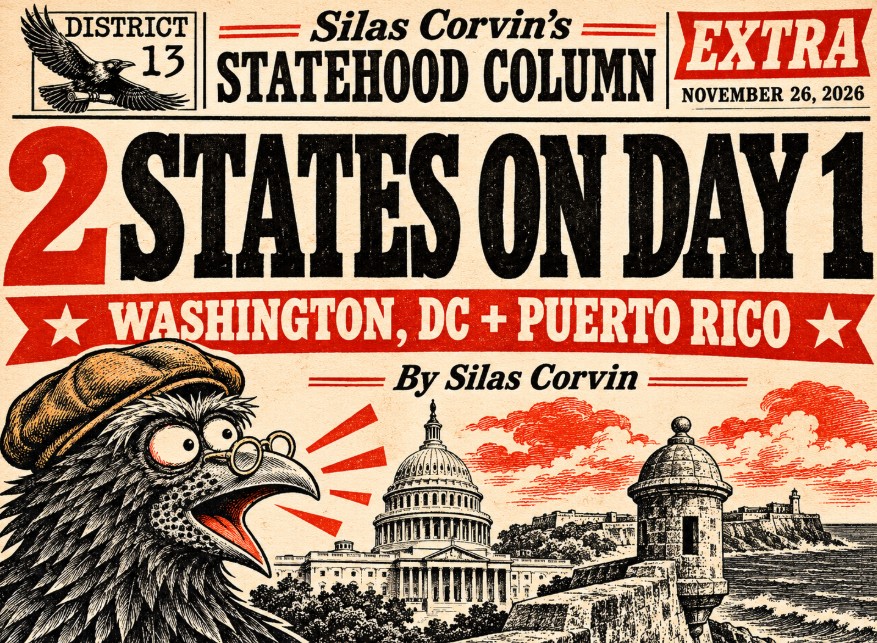
Four Laws for a Growing Republic – Making DC and Puerto Rico States on Day One
A new Congress gets sworn in come January, and this old crow has a short list for it. Four laws. This one goes to the front of the line because the people it covers have already done their part.
Make Washington DC and Puerto Rico states. Drop the bills in on the first day, run them through both chambers, and get them to the president’s desk before the coffee in the cloakroom goes cold.
Puerto Rico has asked, four times running. The island voted for statehood in 2012, in 2017, in 2020 and again in 2024, when statehood took 58.61 percent against free association and independence. Critics have argued about turnout and ballot wording on some of those votes, and parts of that argument are fair. Still, four wins in a row over twelve years is a pattern a crow can read from a power line.
DC has asked too. Residents voted for statehood in 2016 with 86 percent saying yes. The House passed the Washington DC Admission Act, H.R. 51, in 2020 and again in 2021. Both times it went to the Senate and sat there like a parcel nobody signed for.
Here’s what changes when they get in. Puerto Rico’s three million plus American citizens get two senators and House members who vote on final passage. DC’s nearly 700,000 residents, who pay federal taxes in full, get the same deal. Right now each place sends a delegate who can work in committee and speak on the floor, then sit on their hands when the final vote is called. That’s like paying dues to a club that lets you into the meeting and hands you a napkin instead of a ballot.
Now, what majority really means. In the House, a simple majority passes an admission bill. The Senate runs on its own clock. Under the filibuster, it takes 60 votes to end debate on an ordinary bill, and an admission bill is an ordinary bill. So here’s the straight version of “a simple majority carries it”: the House carries it on a majority, and the Senate carries it on a majority once it decides the filibuster won’t stand between American citizens and their seats.
Will the Senate bend? This crow watched the returns come in this month, and the voters handed down a landslide. Senators read election results the way farmers read the sky, and a landslide looks a lot like weather moving in. Rules that looked carved in stone in October tend to look like chalk by January.
DC needs one extra repair. H.R. 51 meets the Constitution’s requirement for a federal district by shrinking it to a small core: the Capitol, the White House, the Mall and the federal buildings around them. The rest becomes the new state. That leaves one loose thread. The 23rd Amendment gives the federal district three electoral votes, and once the district is mostly monuments and offices, those three votes would belong to a handful of residents, possibly just the family living in the White House. So the 23rd Amendment has to go. Repealing it takes a constitutional amendment, with two-thirds of both chambers and three-quarters of the states, so it should start moving the same week as the admission bill. Seat the state, then clear out the leftover votes.
The objections, quickly.
“It’s party math.” Maybe, though Puerto Rico’s governor, Jenniffer González, is a Republican who caucused with House Republicans when she was the island’s delegate. Island voters split tickets in ways that surprise people on the mainland. Admit the state and let both parties compete for it, the way they compete for Ohio.
“DC is too small.” DC has more people than Wyoming or Vermont. Each of those has two senators, and the republic has carried on fine.
“Puerto Rico’s votes were disputed.” Then settle it. Congress can write the ballot itself, with options it agrees in advance to honor, and make the result binding. The House passed exactly that in 2022 with the Puerto Rico Status Act, and the Senate let it sit. A binding vote on Congress’s own terms ends the turnout argument for good.
“Puerto Ricans don’t pay federal income tax.” Under current law, island residents generally don’t pay it on income earned on the island, though they do pay Social Security and Medicare taxes. Statehood changes that. They’d pay what Indiana pays and get what Indiana gets. That’s the deal for any state.
These two places have said yes, at the ballot box, more than once. The next move belongs to Congress, and the new Congress should make it first, before the committee chairs settle in and the lobbyists find their seats. Two bills, two votes, two new stars on the flag. Start there.
Next in the series: a pathway law, so the next territory that asks doesn’t have to wait a century in the hallway.
Sources
- 2024 Puerto Rican status referendum, Wikipedia: https://en.wikipedia.org/wiki/2024_Puerto_Rican_status_referendum
- Puerto Rico Statehood, Independence, or Free Association Referendum (2024), Ballotpedia: https://ballotpedia.org/Puerto_Rico_Statehood,_Independence,_or_Free_Association_Referendum_(2024)
- Puerto Rico statehood movement, Wikipedia: https://en.wikipedia.org/wiki/Puerto_Rico_statehood_movement
- H.R. 51, Washington DC Admission Act (117th Congress), Congress.gov
- H.R. 8393, Puerto Rico Status Act (117th Congress), Congress.gov
- DC Board of Elections, 2016 general election results (statehood advisory referendum)