Four Laws for a Growing Republic – Growing the Republic by Invitation
A Bright Meadow Group ODI piece on how a nation that wants to join the United States should find an open door, a published process and a seat at the table as an equal.
OBSERVE
Start with the good part of an old idea. Empires spread roads, courts, schools, trade routes and shared languages across continents. Some of that inheritance still holds countries together centuries later. The trouble was in how it arrived: at gunpoint, through rigged treaties, with the wealth flowing one direction and the people on the receiving end treated as subjects instead of partners. People resented the taking more than the roads.
The United States has grown both ways. Vermont governed itself as an independent republic for fourteen years and then asked to join, entering as the fourteenth state in 1791. Texas was a sovereign republic that sought annexation, and when a treaty failed in the Senate, Congress admitted it by joint resolution in 1845. Hawaii is the other kind of story. A small group of businessmen overthrew the queen in 1893, and Congress annexed the islands in 1898 over the objections of a large share of Native Hawaiians. Hawaii became a proud state, and the way it came in still stings.
The Constitution gives the power and leaves out the process. Article IV says new states may be admitted by Congress into this Union. It doesn’t say how a nation asks, what it has to show, or what protects it from being “invited” by someone else’s pen. Each case so far has been improvised, and an improvised process bends toward whoever holds the stronger hand.
Greenland is the reason this law needs writing now. In early 2026 the President renewed his demand that Denmark sell Greenland and threatened to take the island by force, setting off a crisis inside NATO. Greenland’s government answered that it could not accept a US takeover under any circumstance. A recent poll found that only 6 percent of Greenlanders want to leave Denmark and join the United States.
Without a written path, a future leader could claim a foreign government secretly asked to join, send troops in, and call it a homecoming. A published process takes that story away. If a nation wants in, the request happens in public, through its own vote, on a timeline the world can watch. Anything else is a takeover, and the law should say so.
The closest candidates have already chosen. In 1978 the Marshall Islands, Micronesia and Palau turned down US territorial status and chose free association instead. That choice was honored, and it works. A process for joining should sit beside that one as another honest option on the menu.
DESIGN
Lead with the offer. A growing republic should meet a neighbor the way a good team meets a prospect: here’s how we run things, here’s what membership brings, here’s what we’d gain from you, and here’s the door if you want it. The relationship runs both ways. The new state gains the protections, markets and voice of the Union, and the Union gains the new state’s people, ideas, ports, skills and trade. Each side grows with the other.
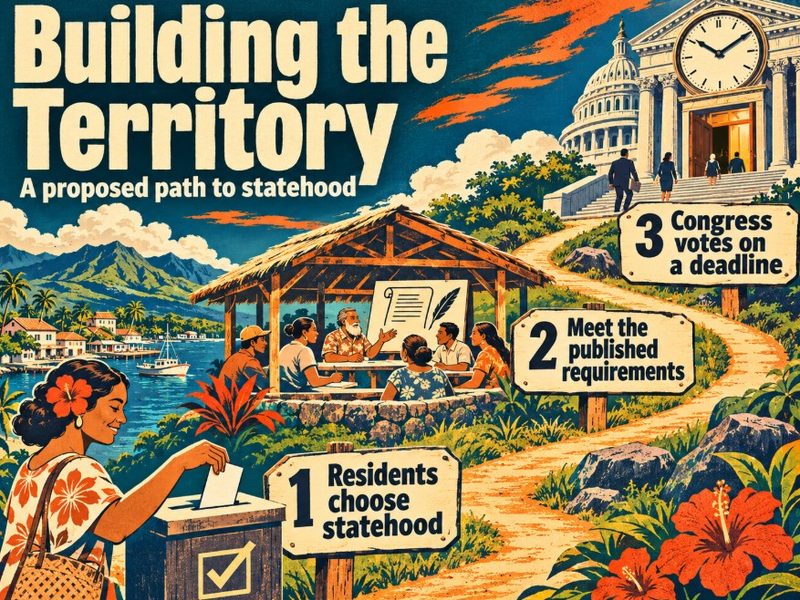
Track one: smaller nations. A smaller nation that wants to become one of these United States follows a set process:
- A national referendum on joining, open to its citizens and conducted under international observers
- A state constitution adopting the US Constitution as supreme law, with the same federal terms any territory accepts: a republican form of government, the oath to support the Constitution, and the limits Article I places on states
- A formal application to Congress, certified by the referendum results
- An up-or-down vote in Congress on a fixed deadline
A nation above the population floor set in the territory pathway law applies for statehood directly. A nation below it enters as a developing territory and follows the same trail Guam or the Virgin Islands would walk, with the same clock.
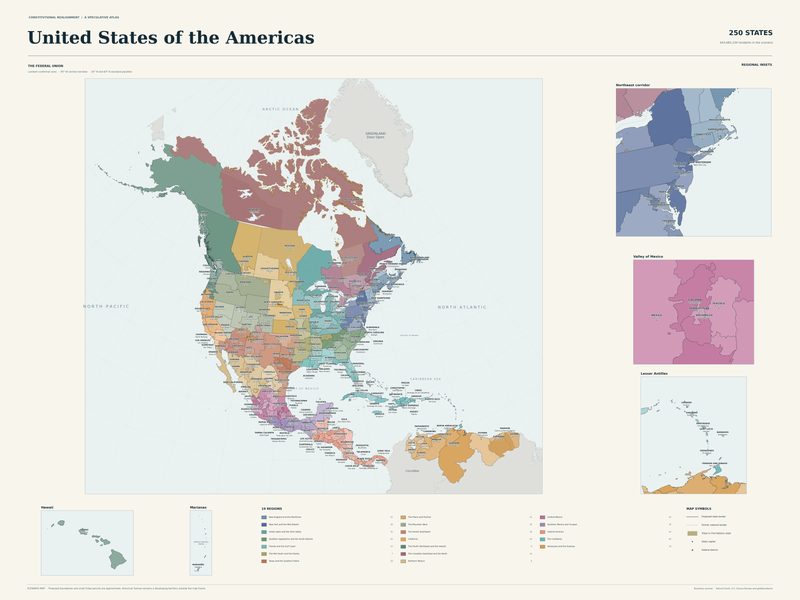
Track two: larger nations. A large nation merging with the United States will negotiate. Its debts, its institutions, its land systems, perhaps the question of becoming several states instead of one, all need settling at a table. The consent rule doesn’t bend for size. The same public referendum, the same certified request and the same rules against coercion apply, and Congress votes on the negotiated terms in the open.
Rules that keep it clean. The law voids a request obtained through threat or force, the same standard international law already applies to treaties. No petition counts while US forces are fighting in or against the petitioning country, or for a set period after the fighting stops. A request that exists only as a letter from a friendly official, without a certified public vote behind it, carries no legal weight.
Integration on an even footing. Joining has to mean full membership from the start. That means the same currency, the same market, the same federal programs, the same citizenship for residents, the same taxes, and two senators and House seats by population. The economics work the way they did when Texas joined: a new state brings its goods into the largest open market on earth, and the rest of the country gets a new partner to trade with, build with and learn from. The American system has absorbed fifty states of wildly different economies, from Alaska’s oil to Vermont’s dairy to Hawaii’s tourism, and it’s robust enough to absorb more on fair terms.
Timelines that respect both sides. A nation that votes yes shouldn’t wait a decade for an answer, and the Union shouldn’t be rushed into terms it hasn’t examined. The law sets deadlines for each step: committee review, negotiation where it applies, and a final vote. Either side can walk away before the final vote without penalty.
INTERVENE
If Bright Meadow Group were drafting the bill, here’s the sequence:
- Pass a Voluntary Admission Act setting out the process for sovereign nations, as a companion to the territory pathway law.
- Name Greenland in the record. The committee report should state plainly that the law exists so no nation, Greenland included, can be brought in by pressure or force, and that a peaceful door is open if its people ever choose it.
- Write the consent rules into the statute: a certified public referendum, international observers, no request valid under threat or during hostilities.
- Set the two tracks. Smaller nations adopt the Constitution and apply; nations below the floor enter as developing territories. Larger nations negotiate terms under the same consent rules.
- Guarantee equal membership. Full citizenship, full representation and full economic participation on admission, with no second-class arrangements.
- Put deadlines on both sides so a yes vote gets an answer in a reasonable span of years and either party can step back before the end.
- Keep free association on the menu as a respected alternative, the way the Pacific compact nations chose it.
A country that grows by conquest spends its strength holding what it took. A country that grows by invitation gains partners who chose to be there, and each new state makes the next invitation more believable. Greenland has said no, and that answer deserves respect. The door should still be built, published and left open, so that the next time a friendly nation looks at how Americans govern themselves and says, “We’d like to be part of that,” the answer is ready: here’s how.
Which kind of republic does the new Congress want to be remembered for, the one that took or the one that invited?
Next in the series: Nathaniel Leery on immigration, and the people who want to join one at a time.
Sources
- US Constitution, Article I Section 10, Article IV Section 3
- Vermont admission to the Union, 1791
- Joint resolution for annexing Texas, 1845
- Newlands Resolution annexing Hawaii, 1898
- “The Greenland crisis,” Cambridge University Press: https://www.cambridge.org/core/product/B57C18F29E185AD24DA44E59201B00E7/core-reader
- “Greenland rejects US takeover under any circumstance,” RNZ, January 13, 2026: https://www.rnz.co.nz/news/world/583860/greenland-rejects-us-takeover-under-any-circumstance
- “Why US designs on Greenland will ultimately end in compromise,” Bruegel, January 9, 2026: https://www.bruegel.org/first-glance/why-us-designs-greenland-will-ultimately-end-compromise
- The Freely Associated States and Issues for Congress, Congressional Research Service: https://www.everycrsreport.com/files/2024-12-10_R48311_7815b9c779c8255adc37d964e85c09babc67e841.html
- Vienna Convention on the Law of Treaties (1969), Article 52