Four Laws for a Growing Republic – Building the Territory Pathway
A Bright Meadow Group ODI piece on developing territories, and why a friendly people who want to join should find a marked trail instead of a political maze.
OBSERVE
Start with a map of 1787. Draw a line along the Ohio River and look north and west of it. In 1787 that was wilderness on paper: no states, no counties, a scattering of settlements and a long list of competing claims. Within a single lifetime it became Ohio, Indiana, Illinois, Michigan and Wisconsin, each one sending two senators to Washington.
That happened because the Confederation Congress wrote down the rules before anyone arrived. The Northwest Ordinance laid out three stages:
- Stage one: a governor and judges appointed by Congress.
- Stage two: once the territory counted 5,000 free adult men, an elected legislature and a delegate to Congress who could speak but not vote.
- Stage three: at 60,000 free inhabitants, the territory could write a state constitution and be admitted on an equal footing with the original states.
The numbers weren’t pulled from the air. The first census, in 1790, counted Delaware, the smallest state then seated, at 59,094 people. Sixty thousand set the bar for a new state at roughly the size of the smallest one already in. Five thousand free men, with their families, made a community of perhaps 20,000 to 25,000 people, a third or more of Delaware. At that size the founders judged a territory ready for a legislature of its own.
Equal footing is the phrase the ordinance turns on. A new state wouldn’t be a junior member or a colony with a flag. It would stand level with Virginia and Massachusetts from its first day. The Supreme Court held the country to that promise in 1911, in Coyle v. Smith, when Congress tried to tell Oklahoma where it could put its capital. Once a state is in, it’s in as an equal.
The bargain ran both ways. Later enabling acts told each territory what its constitution had to say before Congress would admit it. The 1889 act that brought in the Dakotas, Montana and Washington required constitutions that were republican in form and not repugnant to the Constitution of the United States or the principles of the Declaration of Independence. Utah’s 1894 act went further and required certain provisions to be irrevocable without the consent of the United States. A territory came in as an equal, and it came in having signed onto the same rulebook as the states already seated.
Now look at today’s map. The United States has five populated territories: Puerto Rico, Guam, the US Virgin Islands, the Northern Mariana Islands and American Samoa. Each sits at a different stage, and none of them has a written trail to follow.
- Puerto Rico has voted for statehood four times running, the latest with 58.61 percent in 2024. Congress has yet to vote on admission.
- Guam hasn’t held a status vote that measured its people’s wishes since 1982. A fight in court over who may vote stalled its plebiscite for years, and local lawmakers are now pushing for one in 2028.
- The Virgin Islands are on their sixth try at writing a constitution of their own, with a ratification vote scheduled for July 2027.
- American Samoa’s leaders have said they want their current status kept, with land and family traditions protected.
- The Northern Marianas operate under a commonwealth covenant signed in the 1970s.
Five territories, five situations, and one common problem: when any of them reaches the point of asking, the answer depends on whoever holds the gavels in Washington that year. The Puerto Rico Status Act passed the House in 2022 and sat in the Senate. The DC admission bill passed the House twice and sat in the Senate twice. A territory that does what’s asked of it can still wait decades, while its people pay into a system that gives them a delegate who can speak and can’t vote.
The founders had a better system than we do. In 1787, a settler in the Ohio country could read the ordinance and know the count that would make his territory a state. A family in Guam today has no such document to read, because the trail hasn’t been written.
DESIGN
Treat the territory as a pledge period. When the United States takes on a territory, it has already said “you’re with us.” What’s missing is the second half of that sentence: “and here’s how you become one of us.” A developing territories law writes the second half.
The design keeps the Northwest Ordinance’s bones and updates the details.
Stage one: organized territory. This is where the five sit today. Each has an elected local government and a delegate in Congress. The law changes nothing here except to name the stage and state plainly that it leads somewhere.
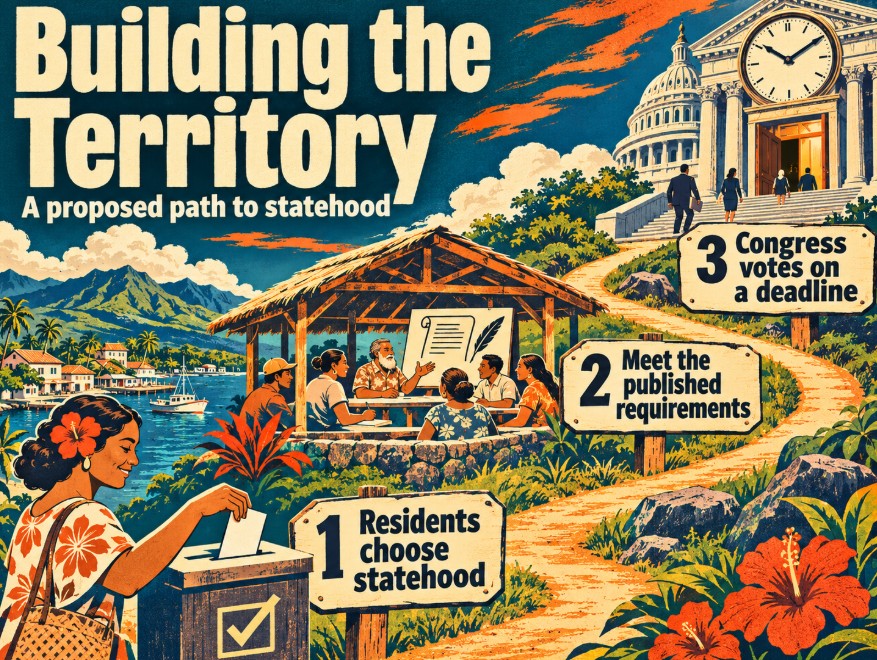
Stage two: developing territory. A territory moves into this stage by its own choice, through a status vote open to registered voters who live there. If residents choose statehood, the territory becomes a developing territory, and the federal government takes on duties toward it:
- fund and support a constitutional convention
- provide census and administrative help to show the territory meets the population floor
- start the work of matching federal programs to state terms, so admission day doesn’t open with a funding cliff
A territory that votes for a different status, or chooses to stay as it is, keeps that choice. Developing status is an invitation the territory accepts. Congress can’t push it on anyone.
Stage three: admission request. A developing territory that meets the checklist submits a formal request for statehood. The checklist is short, the way the 1787 version was:
- Population of at least one quarter of the smallest existing state
- A working local government with elected executive and legislative branches
- A ratified state constitution that meets the federal terms below
- A certified statehood vote of the territory’s residents
Setting the floor. The 1787 ratio carries over. The founders gave a territory its own legislature when it reached a third or more of the smallest state, and today’s tools for governing, from digital records to air travel to a phone in each pocket, let a smaller population run a state well. One quarter of the smallest state sits close to the founders’ ratio. Wyoming, the smallest state today, counted 588,753 people in 2025, which puts the floor near 147,000. The figure updates with each census, so it rises and falls with the country instead of sitting frozen in a statute.
Against the 2020 counts, Guam, at 153,836, clears the floor on its own. The Virgin Islands, at 87,146, and American Samoa, at 49,710, sit below it for now.
Neighbors can combine. Two or more territories may apply together as a single state if each one votes for it. Guam and the Northern Marianas, 47,329 people, share an island chain and a history, and together they count 201,165. With today’s travel and communications, a state spread across an island chain is a practical thing to run. Guam’s voters turned down a merger in 1969. Under this law the choice comes back to both peoples, and it stays theirs.
What the territory gives. To become a pledge, a territory cedes some of its agency, and the law should say so in plain terms. Its constitution has to accept:
- The Constitution of the United States as supreme law, with federal laws and treaties binding on its courts, as Article VI requires of each state
- A republican form of government, as Article IV guarantees
- An oath for its legislators, executives and judges to support the US Constitution
- The limits Article I places on states: no treaties or alliances with foreign powers, no currency of its own, no standing troops or warships in peacetime without the consent of Congress
Those are the same terms Pennsylvania lives under. A territory that writes them into its constitution has shown, in its own founding document and by its own vote, that it means to join the team on the team’s rules. That answers the detractor who asks whether a new state will pull in its own direction, and it ties the territory to the Union before the first senator is sworn in.
The clock. This is where the modern design has to go further than 1787. Once the request is certified, it moves on a fast track: a committee deadline, no filibuster, no amendments and a guaranteed up-or-down vote in both chambers within a fixed number of days. Congress already handles trade agreements and the review of federal regulations this way, so the method exists and has been tested.
One limit has to be stated plainly. A law passed by one Congress can’t force a later Congress to admit anyone, and each chamber can rewrite its own procedures. What the law can do is set the path in plain view and make walking away from it a visible, recorded act. A senator who votes down a territory that has met each published requirement, and accepted each federal term, has to explain that vote at home. That’s a different conversation from letting a bill die in a drawer.
Equal levels. Admission comes on equal footing. That means two senators, House seats by population, and full standing in federal programs from day one. The admission act should carve out no exceptions that leave the new state half in and half out. Oklahoma’s capital fight settled that more than a century ago. The territory gives up the same agency the states gave up, and it gets the same seat at the table they have.
INTERVENE
If Bright Meadow Group were drafting the bill, here’s the sequence:
- Pass a Developing Territories Act naming the three stages, modeled section by section on the Northwest Ordinance and its equal footing language.
- Open the status vote to resident voters. Guam’s plebiscite stalled over that question for years. The law settles it once, for each territory.
- Fund the development stage. Constitutional conventions, status votes, census work and program transition planning cost far less than the decades of limbo the country has now.
- Write the federal terms into the statute. Supremacy of the US Constitution and federal law, a republican government, the oath, and Article I’s limits on states, each stated as a condition a territory’s constitution has to meet.
- Set the floor at one quarter of the smallest state, recalculated each census, and let neighboring territories combine to reach it when each one votes to.
- Publish the checklist in the statute itself, so a family in Saipan or Hagåtña can read the same trail a settler in Chillicothe could read in 1787.
- Put a clock on Congress. Once a request is certified: a committee deadline, no filibuster, no amendments, an up-or-down vote on a fixed date.
- Honor each answer. Statehood, free association, independence and the current status stay open. A territory that doesn’t ask, like American Samoa today, keeps what it has.
The country grew across the Ohio River because someone wrote the rules down first and kept to them. A friendly people asking to join the team deserves the same courtesy: a marked trail, a clear count, a clear set of terms and a door with a clock on it. The question for the new Congress is whether it wants the republic to grow by invitation, or to leave the asking to wait in the hallway the way Puerto Rico and DC have.
If the measure is well received, it may well belong in the Constitution itself. A statute stays only as long as the next Congress lets it stand. An amendment would set the pathway beside Article IV’s admissions clause, so the way the republic grows is as systematized as the way it governs. The Developing Territories Act would serve as the working draft, proven in practice, and an amendment would make it the permanent rule.
Next in the series: growing the republic beyond its territories, and the path a nation can take to join without a shot fired.
Sources
- Northwest Ordinance of 1787, National Archives (Milestone Documents)
- 1790 Census of the United States, US Census Bureau
- US Census Bureau QuickFacts, Wyoming: https://www.census.gov/quickfacts/wyoming
- 2020 Island Areas Censuses, population counts, US Census Bureau: https://edit.doi.gov/sites/doi.gov/files/2020-island-areas-censuses-fpcia-12.14.21.pdf
- 1969 Guamanian–Northern Mariana Islands union referendum, Wikipedia: https://en.wikipedia.org/wiki/1969_Northern_Mariana_Islands_status_referendum
- US Constitution, Article I Section 10, Article IV Sections 3 and 4, Article VI
- Enabling Act of 1889 (North Dakota, South Dakota, Montana, Washington)
- Utah Enabling Act of 1894
- Coyle v. Smith, 221 U.S. 559 (1911)
- 2024 Puerto Rican status referendum, Wikipedia: https://en.wikipedia.org/wiki/2024_Puerto_Rican_status_referendum
- Puerto Rico statehood movement, Wikipedia: https://en.wikipedia.org/wiki/Puerto_Rico_statehood_movement
- “2028 plebiscite? Bill to seek voters’ nod to set Guam’s decolonization process in motion,” Pacific Island Times: https://www.pacificislandtimes.com/post/2028-plebscite-bill-to-seek-voters-nod-to-set-guam-s-decolonization-process-in-motion
- Davis v. Guam, Ninth Circuit decision, US Department of Justice: https://www.justice.gov/crt/case-document/davis-v-guam-court-appeals-decision
- “Will Virgin Islanders vote? Report reveals major constitutional awareness gap,” Gerald R. Ford School of Public Policy, March 10, 2026: https://fordschool.umich.edu/news/2026/will-virgin-islanders-vote-report-reveals-major-constitutional-awareness-gap
- Congresswoman Amata Radewagen, statements on American Samoa’s status: https://radewagen.house.gov/media/hr-6158
- H.R. 51, Washington DC Admission Act (117th Congress), Congress.gov
- H.R. 8393, Puerto Rico Status Act (117th Congress), Congress.gov