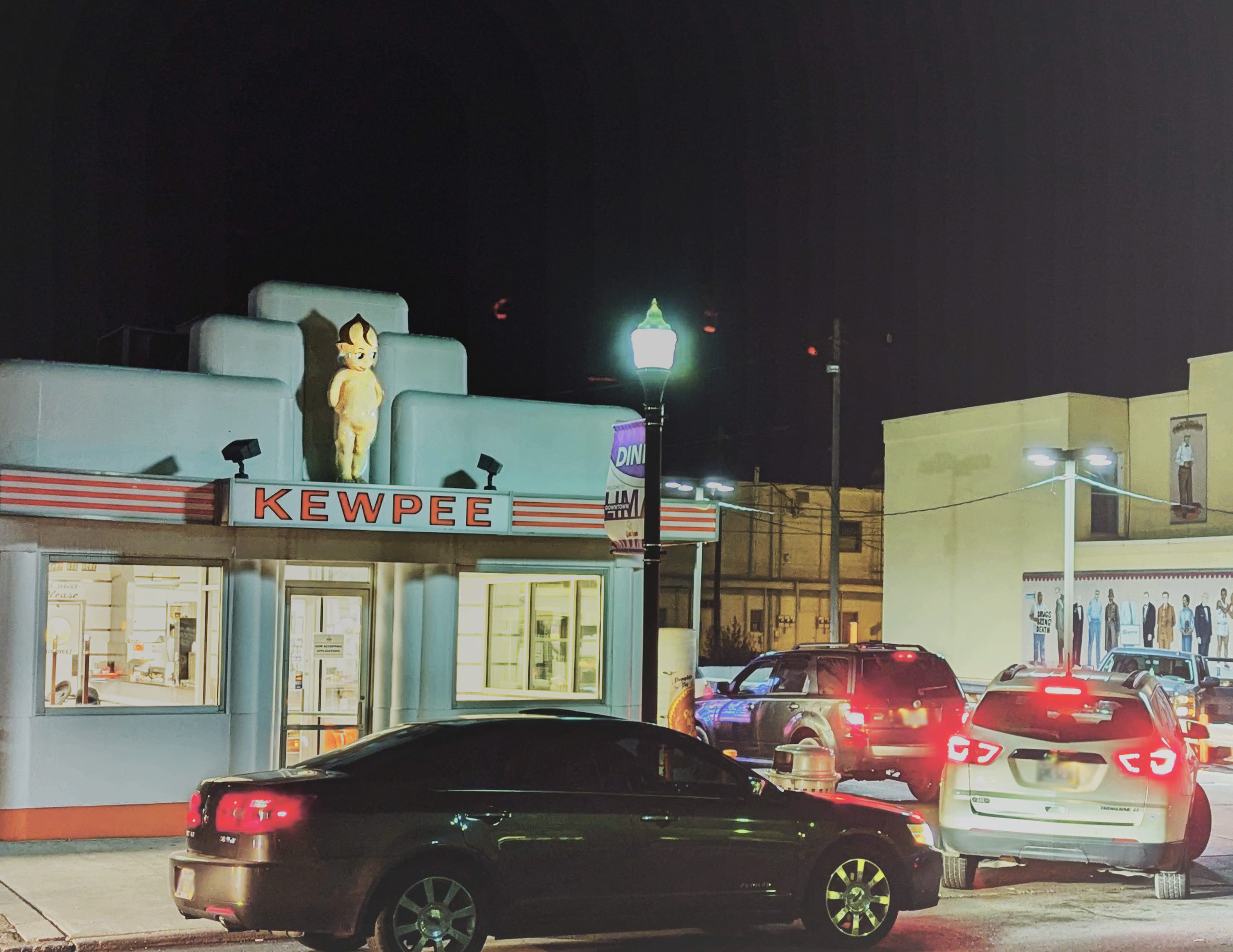
The line of taillights on North Elizabeth Street stretches past the lamp post and around the corner on a cold night in Lima, Ohio. The cars are waiting for square hamburgers with a pickle on top. Above the drive-thru window, on a stepped white parapet lit like a Christmas window, stands a naked toddler with his hands behind his back and a side-eyed grin. He has held that spot since 1939.
A writer for the Lima News once told a restaurant trade magazine that her kids kept asking her the obvious question: why is there a naked baby on top of the restaurant?
Fair question, kids. The answer runs through a Pennsylvania-born cartoonist, a Missouri farmhouse, a Michigan burger stand, a 400-store chain ground down to five, and a region that has spent the last few years pulling Michelangelo off school library shelves while the baby kept his post over the drive-thru.
The Building
Stub and June Wilson opened their first Lima Kewpee on this lot in 1928. It was a tiny stand with a walk-up window and a drive-up window, selling five-cent burgers, root beer, pie and coffee. By 1939 downtown Lima had outgrown it, and the Wilsons replaced it with the building in this photo.
The skin of the building is porcelain enamel over steel, trimmed in stainless. Porcelain enamel is powdered glass fused onto sheet steel in a furnace at around 1,500 degrees, so the panels you see are glass bonded to metal. That explains why the place still looks the way it does. Paint chalks and fades in the weather. Fired glass washes off with soap and water. The panels bolt to a frame like tiles on a bathroom wall, so a damaged one can come off and a new one go on without opening up the structure behind it. When the Toledo Blade visited in 2001, it reported that the building looked nearly the same as the day it opened.
The style is Streamline Moderne, the late-Depression look borrowed from trains, ocean liners and airplanes. The corners are rounded the way a locomotive nose is rounded, and the red and white bands wrap the facade the way speed lines trail a cartoon car. The roofline is the part to study in this shot. Rounded blocks step up in tiers toward the center, and the tallest block stands right behind the Kewpie like the panel behind a saint in a church niche. The architecture was built to present the baby.
Inside, the 1939 building was one of the first in Lima with central air conditioning. It seats about forty at booths and a lunch counter, and two more Kewpies keep watch indoors.
The lot had an engineering problem of its own. Once curbside service got impractical, the downtown store went back to the drive-thru window, and a narrow city lot gives a car nowhere to turn around. A full-size 1940s sedan needed something like forty feet of pavement to swing a circle. Kewpee’s answer was a car turntable at the back of the lot. You took your bag at the window, rolled onto the platform, and it spun you around to face the exit. Kids loved it. It was still turning in 1955 and went away when the lot was enlarged.
The Baby
Rose O’Neill was born in Wilkes-Barre, Pennsylvania, in 1874 and grew up partly in Nebraska before her family homesteaded in the Missouri Ozarks near Branson. They called the place Bonniebrook. By her early twenties she was selling illustrations to Puck, Life, Good Housekeeping and the Ladies’ Home Journal, and she is credited as the first published female cartoonist in the United States.
She drew the Kewpies at Bonniebrook. They debuted as a full page in the December 1909 Ladies’ Home Journal, and in 1912 the German toymaker J.D. Kestner started turning them into bisque dolls. O’Neill described a Kewpie as “a benevolent elf who does good deeds in a funny way.” The dolls made her a millionaire.
She also put the Kewpies to work for the suffrage movement. The little naked elves showed up on posters and postcards asking for votes for women, and the cuteness helped make the cause look friendly to people who found it threatening. So the baby on the Lima roof descends from a feminist campaign mascot.
O’Neill went back to Missouri, worked on her memoirs, and died in Springfield in 1944 with little money left. Bonniebrook is a museum now, and the Kewpie went into the National Toy Hall of Fame in 2023.
The Chain
Samuel V. Blair opened the first Kewpee in Flint, Michigan, in 1923. He called it the Kewpee Hotel Hamburgs, which is a grand name for a burger stand, and named it after the doll that was everywhere that decade. Only A&W and White Castle are older among American burger chains. In 1926 Blair sold the trademark to Ed Adams, a Toledo operator who turned Kewpee into a licensing business. There were about 200 Kewpees by 1929 and more than 400 just before the Second World War. The chain was among the first to run curbside service, which grew into the drive-in and then the drive-thru.
A boy in Kalamazoo named Dave Thomas loved eating at his local Kewpee. He said years later that it pulled him into the restaurant business. In 1969 he opened a place in Columbus that sold square hamburgers and thick frosty shakes. He called it Wendy’s.
Then came the grindstone. Blair’s original Flint stand became Halo Burger and was torn down in 1979. The Toledo licensing operation closed. The national chains came to Lima in the early 1970s, and Harry Shutt, who had become Kewpee’s general manager in 1970, responded by following the customers out of downtown. He opened a west side store on Allentown Road in 1972 and an east side store on Bellefontaine Avenue in 1981, which seats 180. He bought the downtown store when Stub Wilson died in 1980, and in 1985 he bought the Kewpee trademarks themselves.
Here’s the accounting. A chain of more than 400 stores is down to five: three in Lima, one in Racine, Wisconsin, and Weston’s Kewpee Sandwich Shop in Lansing, Michigan. That’s a loss of about 99 percent of the stores. The survivors share a profile. They’re owner-run, plain, and stubborn about changing. The Lima stores get locally raised beef delivered daily, open at 5:30 in the morning, and close only on Easter, Thanksgiving and Christmas. In 1982 the downtown building was approved for the National Register of Historic Places. The owner objected, so it isn’t on the list. A sign on the building reads “Your Grandpappy Ate Here.” Harry Shutt told the Blade in 2001, “We have stayed the same.”
The slogan has stayed the same too: Hamburg pickle on top makes your heart go flippity flop.
The Shelf
Rose O’Neill drew her naked elves in Missouri. In 2022 Missouri passed Senate Bill 775, an anti-trafficking bill with an amendment that made it a crime for school staff to give students “explicit sexual material.” The law defined that to include visual depictions of genitalia and carved out an exception for works of art. Districts started pulling books anyway. About 300 came off shelves in the first few months, more than 200 of them in one district west of St. Louis. PEN America counted 76 art history books in the pile, on Michelangelo, Leonardo da Vinci, Rembrandt, Raphael, Van Gogh, Picasso, Matisse, Edward Hopper and Georgia O’Keeffe. Holocaust histories and human anatomy books went too. A judge ruled the law unconstitutional in 2025, and the Missouri Supreme Court heard the appeal this September.
Indiana passed House Enrolled Act 1447 in 2023. It folded Indiana’s “harmful to minors” standard into school library rules and took away the defense that a book has educational value. Under Indiana code, the first test for “harmful to minors” is material that “describes or represents, in any form, nudity.” The definition goes on to require prurient appeal to minors and a lack of serious literary, artistic, political or scientific value. Indiana’s librarians testified that they didn’t have any books on their shelves that met the standard. Distributing harmful material can be charged as a Level 6 felony.
Iowa’s Senate File 496 ordered schools to remove books that describe or depict sex acts, with an exemption for religious texts. The Des Moines Register surveyed all 325 districts and counted about 3,400 books pulled, including Orwell’s 1984 and To Kill a Mockingbird. Federal courts have blocked and unblocked the law several times. In April 2026 the Eighth Circuit lifted the injunction again, and the challengers have asked the full court to rehear the case. The state’s position is that the law keeps school libraries age-appropriate and protects parents’ rights.
The pattern extends past the school library. In 2014 Adrian, Michigan, moved Mark Chatterley’s sculpture Blue Human Condition from city hall to a lower-traffic corner of a park after residents complained it looked like an orgy. In Tipton, Iowa, the police chief personally phoned 83-year-old painter Hugh Stumbo and asked him to take a nude torso out of his own gallery window before a festival. Stumbo took it down. He said a town that wants a gallery has to make room for what artists do.
And over North Elizabeth Street, the Kewpie keeps his post. A Missouri law that sent Michelangelo’s David to the review cart would trip over Rose O’Neill’s Missouri baby too, if he were printed in a library book. On a parapet over a drive-thru, he sells burgers.
The Midwest sorts its naked bodies the way a grandmother sorts her drawer. The Italian marble goes in the back where the kids won’t find it. The baby who’s been on the counter since 1939 stays out, because everybody’s grandpappy ate under him.
One more detail from the Blade’s 2001 visit. The family that owns the Kewpee helped renovate an old brick building on Lima’s Town Square into ArtSpace Lima, and that year the gallery opened its fourteenth annual Kewpee Invitational art show. In Lima, at least, the burger money hangs the art.