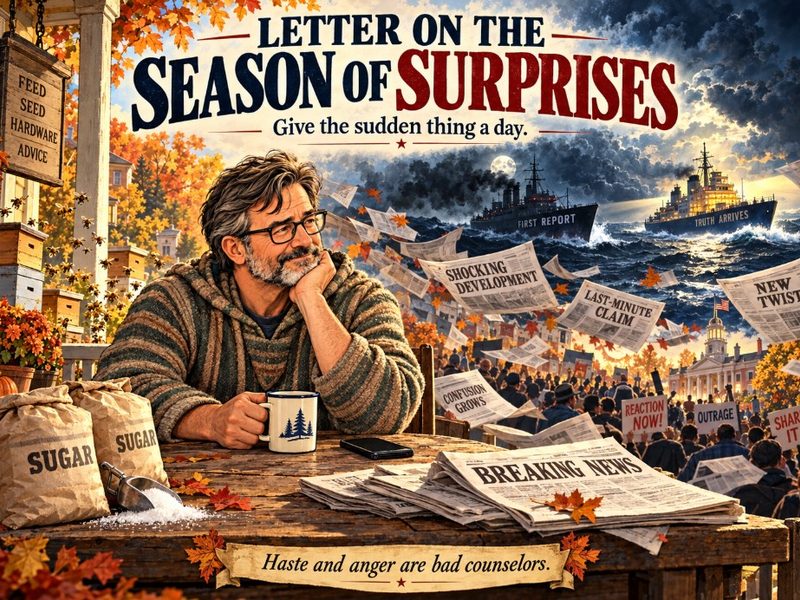
Turn on any political show right now and you’ll see it. Elected officials who can’t explain what government is supposed to do. Candidates who treat the Constitution like a mood board. Pundits who cover governing the way they cover football — who’s up, who’s down, who scored a point this week.
This isn’t new, and it isn’t about stupid people being stupid. It’s something more specific than that. It’s what happens to a country when it stops teaching its citizens what government is for.
I want to tell you about a man named Francesco Petrarch. He lived almost seven hundred years ago, in Italy, and he dealt with something worse than we’re dealing with. Bear with me on the history — it matters, because he figured out the answer.
When the World Falls Apart
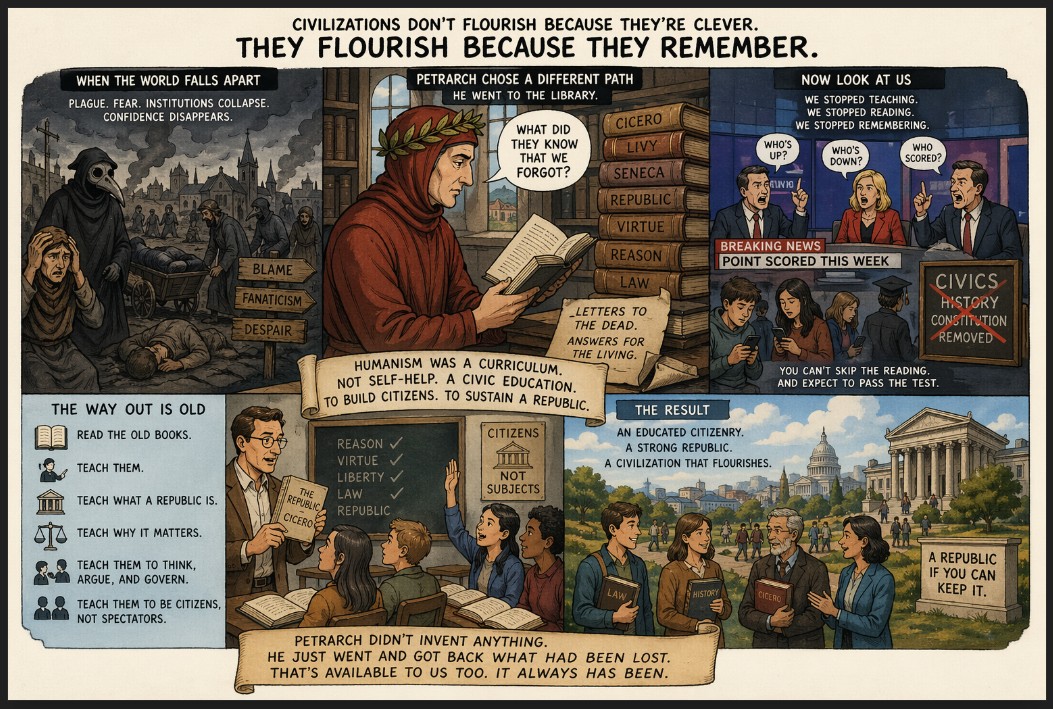
Petrarch lived through the Black Death. In the middle of the 14th century, plague swept across Europe and killed somewhere between a third and a half of the population. Whole towns vanished. Cities shut down. Governments stopped functioning.
And here’s the part that matters: it wasn’t only the death toll. It was the collapse of confidence. People stopped believing their institutions could hold. Sound familiar?
Most people responded the way most people always respond in a moment like that. They got scared. They got cynical. They looked for someone to blame. Some turned to fanatics. Some just gave up.
Petrarch did something different. He went to the library.
What He Was Actually Doing
Here’s the part that sounds strange until you understand it. Petrarch started hunting through monasteries for old manuscripts. Not holy books — Roman ones. Cicero. Livy. Seneca. Books that had been sitting on shelves for centuries while nobody bothered to read them.
Why? Because he’d noticed something. The Romans, back when Rome actually worked, had built up a whole body of knowledge about how to run a society. How to reason through a hard problem in public. How to hold office without embarrassing yourself. How to tell a good law from a bad one. How to argue with someone you disagreed with and still keep the republic standing.
And in Petrarch’s time, almost nobody was teaching any of that. People who went to school went to learn logic puzzles and theology. Nobody was reading the stuff that had actually built the Roman Republic in the first place.
So Petrarch wrote letters. Literal letters. Addressed to dead Romans, like he was dropping them in the mail. He argued with Cicero on paper. Because the question he was chasing was simple: what did they know that we forgot?
What Humanism Actually Was
This caught on. It became a movement called humanism, and it’s worth being precise about what humanism meant, because the word has gotten fuzzy over the centuries.
Humanism was not self-help. It was not “be nice to people.” It was a curriculum. A specific list of subjects — history, rhetoric, poetry, moral philosophy, and the classical texts — taught for one reason and one reason only. To produce citizens capable of governing a republic.
That’s it. That was the whole project. Humanism was civic education. It existed because the humanists had looked around at the world and said: we cannot run a functioning society if the people running it do not know how societies work.
The Renaissance came out of this. Every cathedral, every painting, every scientific advance you think of when you hear the word — it all came downstream of a group of people who decided that an educated citizenry was the difference between a republic and a mob.
Now Look at Us
Here in the United States, for about a generation now, we have been running the opposite experiment. We have cut civics out of the schools. We have treated history as optional. We have produced a voting public — and, more to the point, a political class — with almost no shared knowledge of how self-government is supposed to work.
And then we act surprised when self-government stops working.
The people embarrassing themselves on television right now are not freaks. They are what the system produced. You cannot skip the reading and then expect to pass the test. Petrarch knew that. The humanists knew it. Americans used to know it too.
The Way Out Is Old
Here’s the hopeful part, and I mean this seriously. The path forward is not mysterious. It has been sitting on the shelf the whole time.
Read the old books. Teach them. Teach kids what a republic actually is, and why it is different from other kinds of government. Teach what the separation of powers is for. Teach why Cicero mattered, why Madison read him, why any of this was ever a big deal.
Petrarch didn’t invent anything. He just went and got back what had been lost. That’s available to us too. It always has been.
Civilizations don’t flourish because they’re clever. They flourish because they remember.