The diner television was muted, but a rocket was rising on the screen above the coffee pot — slow, silent, almost dignified. The man beside me at the counter wore a feed-store cap and had the hands of someone who had spent his life attached to something. He gave the rocket about three seconds. Then he went back to his eggs.
I thought about Jefferson. I usually do.
Not the Jefferson of the monuments — the marble one, finished and serene. The working Jefferson. The one who rose before dawn, kept meticulous ledgers, obsessed over crop rotation, sketched buildings, wrote ten thousand letters, and believed, with a conviction that bordered on theology, that the man most fit to govern a republic was the man most rooted in one.
Jefferson’s great political theory was not really about freedom. It was about obligation. Specifically, the obligation that falls on those fortunate enough to have something worth protecting.
He never quite used the phrase noblesse oblige — he was suspicious of anything that smelled too much of the old world’s aristocracy. But the moral architecture was the same: those favored by fortune owe something back. Not charity. Not philanthropy as reputation management. A duty — civic, personal, and non-negotiable — to the community that made their fortune possible in the first place.
His instrument for this duty was the yeoman farmer.
The gentleman farmer wasn’t a romantic figure in Jefferson’s conception. He was a job description. Plow your acres. Read your Cicero. Pay your taxes. Serve your county when asked. Sit in the legislature when called. Go home when relieved. He was meant to be prosperous enough to be incorruptible and rooted enough to be accountable — a man with so much skin in the game that the game’s collapse would ruin him alongside everyone else.
That last part was not incidental. It was the whole mechanism. The yeoman’s virtue wasn’t a character trait — it was a structural condition. He behaved well because he could not afford not to. His wealth was tied to his soil, his soil to his neighbors, his neighbors to his reputation, his reputation to his children’s inheritance. The chain of consequence ran in every direction and caught him in the middle of it. He couldn’t flee the results of his decisions. He had to live inside them.
Jefferson called this arrangement the natural foundation of republican liberty. He was right about the mechanism even when he was catastrophically wrong about who got to participate in it — the enslaved men and women who worked his own Monticello fields being the most damning evidence that his theory of rooted obligation had a boundary drawn precisely where his comfort required it.
That failure is worth naming squarely, not to dismiss the theory but to complete it. A doctrine of civic obligation that exempts the most convenient cases is not a doctrine. It is a decoration. The yeoman ideal survives Jefferson’s hypocrisy only if we insist it applies without exception — which is precisely what Jefferson himself could not bring himself to do.
But the ideal itself is sound. And its disappearance from American public life is one of the quieter catastrophes of the last century.
What replaced the yeoman was not his superior. It was his negative image. Where the yeoman’s wealth was rooted, the new wealth is liquid. Where the yeoman’s consequence ran downward — to the soil, the neighbor, the town — the new consequence runs upward, to the shareholder, the board, the abstraction of the market. Where the yeoman governed locally because he lived locally, the new class governs globally and lives, functionally, nowhere in particular.
This is not a complaint about wealth. Jefferson was wealthy. The founders were, most of them, men of considerable means. The question was never whether the prosperous should lead. The question was what the prosperous owed in exchange for the privilege of leading — and what structural conditions ensured they remembered it.
The oblige was never a sentiment. It was the load-bearing wall of the whole arrangement.
A man who can move his money, his residence, his corporate registration, and his political loyalty across borders in an afternoon is not a yeoman. He is not bound. And an unbound man — however brilliant, however productive, however genuinely convinced of his own good intentions — is not the natural steward of a republic. He is a guest. A very powerful, very influential guest who may decide, on any given Tuesday, that the terms of his stay no longer suit him.
I do not write this from a moral height I have not earned. I keep books and bees and a small property near a river, and I am under no illusion that my own rootedness has been tested by anything more than inconvenience. The seduction of escape — from consequence, from obligation, from the slow and tedious work of civic life — is not exclusive to the rich. Every one of us has had a season where the republic seemed too broken to bother with and the door looked better than the work.
But noblesse oblige was never a doctrine for the wealthy alone. It is the original republican Virtue rendered at scale: the more you are given, the more you owe. It applies to the man with the private terminal and the man with the rototiller. It applies to me. The republic is held up not by the richest among us but by the most accountable — and accountability is a posture you choose, not a condition the market assigns you.
Jefferson’s yeoman is gone. The soil he farmed has been subdivided, the county seat he served has been consolidated, and the legislature he sat in has been professionalized past recognition. We are not getting him back, and I am not sure we should try. History does not run in reverse, and nostalgia is not a governing philosophy.
But the principle survives the man. What the yeoman embodied — consequence, rootedness, the inability to flee the results of your own decisions — is not a product of any particular era. It is a structural requirement of republican self-government in any era. The question is what institutions, what norms, what expectations we build to reproduce that condition in the world we actually have.
That is the work. It is unglamorous and slow and it does not make for good television. The man at the counter with the tired hands already knows this. He has known it his whole life.
He finished his eggs and left a tip and walked out into a morning that had nothing to do with rockets.
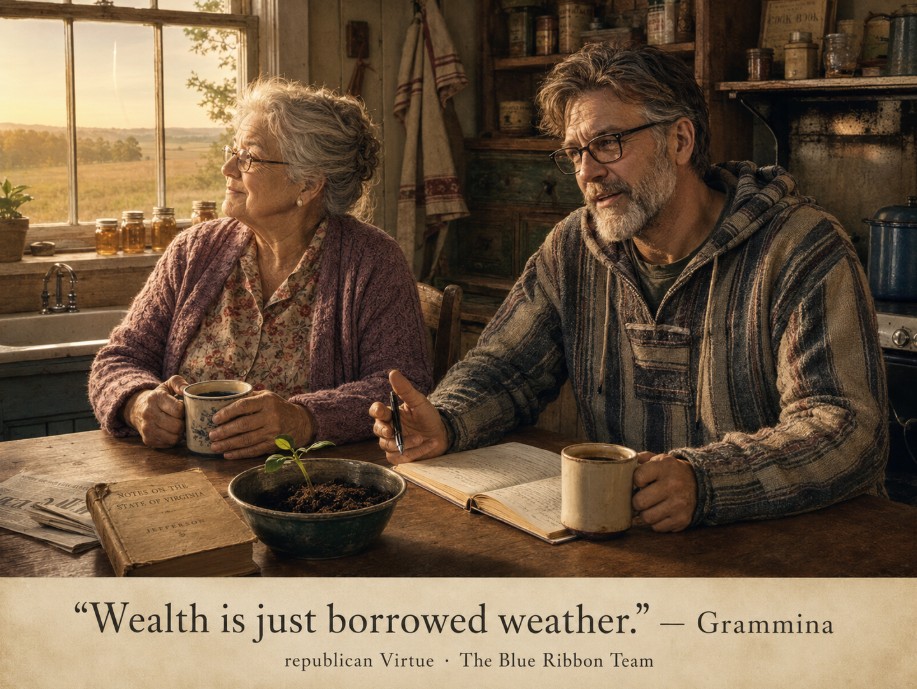
Grammina said wealth was just borrowed weather — it falls on you for a season, and the only honest question is what you grow with it before it moves on. She wasn’t quoting anyone. She didn’t need to. The republic has always depended less on what its fortunate citizens possess than on what they are willing to remain responsible for.