How a fish tank, a room full of bacteria, and a bed of living soil can put food on your table twelve months a year — and why you already know enough to build one
Bright Meadow Group
Let’s start with the honest version of what aquaponics is before the hobbyist forums and the YouTube channels get to it.
Fish eat. Fish produce waste. Bacteria convert that waste into plant food. Plants strip the nutrients out of the water and return it clean. The fish get clean water. The cycle repeats. You harvest fish and vegetables. That’s it. That is the entire biological engine. Everything else — every tank configuration, every grow bed design, every monitoring protocol — is just a decision about how to run that engine more reliably, more efficiently, or more productively.
If you can keep a goldfish alive and grow tomatoes, you can do this. That is not marketing language. That is the actual prerequisite list.
What follows is a plain-language description of how we design these systems, why we make the choices we make, and what each part of the operation is actually doing while you are doing something else. A full technical white paper is available through the Cernunnos Foundation for builders who want the detailed version. This is for everyone else.
Start Outside
Before you design anything, walk your land. Or your rooftop. Or your back lot. Or your basement, if that is what you have.
Permaculture design begins with observation, and the reason is simple: a system that works with what a site naturally does will always outperform one that fights it. Where does sun hit longest? Where does cold air pool at night? Where is access easiest when your hands are full of fish feed or a harvest basket? Where does rainwater go when it comes off the roof?
That last question matters more than it sounds. In our design, the roof feeds the cistern. The cistern is where the whole loop is refreshed. A site that sheds water well is a site that keeps your system from accumulating the mineral drift that slowly closes down a recirculating system over time. Let the sky do that work.
Aquaponic systems scale more faithfully to this principle than almost anything else in food production. The same observational logic that tells you where to put a ten-gallon tank and a lettuce tray on a windowsill is the same logic that governs where to site a watershed-scale remediation and production operation. The math changes. The method doesn’t.
Three Rooms, One Loop
A fully developed aquaponic system has three functional zones. I prefer they be separate rooms. Separate rooms mean controlled inputs — controlled light, controlled temperature, controlled access. Simpler systems put it all in one greenhouse and that works fine. But understanding the zones as distinct functional units is what lets you push any system toward higher efficiency, regardless of how the walls are arranged.
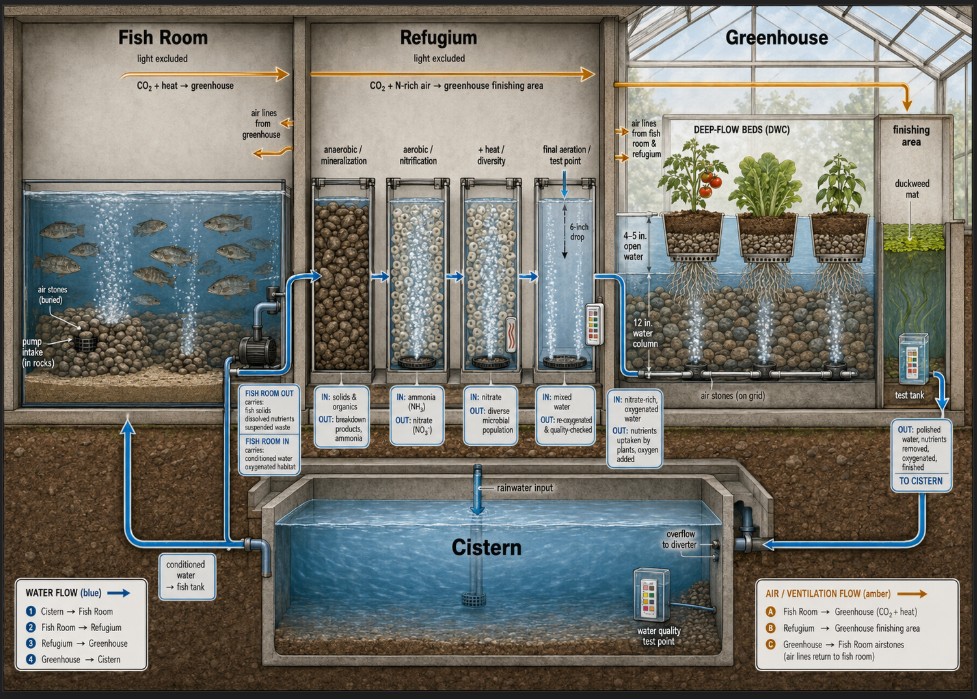
Call them the fish room, the refugium, and the greenhouse. Water flows from the cistern into the fish room, from the fish room into the refugium, from the refugium into the greenhouse, and from the greenhouse back to the cistern. Follow the water and you know the system.
The fish room is where you keep your livestock. Light is completely excluded — not because fish care much about it, but because algae cares enormously, and you don’t want uncontrolled algae in a tank you’re trying to manage. The room is insulated and built for thermal mass, because fish are acutely sensitive to temperature swings and a stable fish is an efficient fish. The tank itself sits on a base of sand and river rock — not for decoration, but because that substrate is bacterial real estate, it contributes minerals to the water continuously, and it protects the pump intake from every direction.
The airstones run almost to excess. They’re fed by air lines from the greenhouse — oxygen-rich air that’s already passed through a living plant environment — and they keep dissolved oxygen high enough that you can stock the tank right up to the physical limit of space and movement. An under-aerated tank costs you fish. An over-aerated tank costs you a few dollars of electricity.
The fish room ventilates directly into the greenhouse. The CO2 that the fish produce, the ambient heat of a room full of biological activity, the thermal stability of all that water mass — it all moves toward the plants.
Your species options are wide open. Yellow perch, catfish, tilapia, trout, bluegill — anything that eats feed and produces waste is a candidate. Social fish like catfish and schooling fish like yellow perch do well because their stress threshold is spatial rather than numerical: as long as they can move, they’re comfortable. For a very simple system focused purely on nutrient production with minimal management overhead, a tank of guppies will run a serious grow bed without breaking a sweat.
Size your tank to match your grow space, not your ambition. The working rule: roughly 25 tilapia on a standard feeding schedule can support a 10×20 greenhouse stocked floor to ceiling with tomatoes, peppers, and whatever you fit in between. Fish population to plant canopy is your sizing equation. A system that produces more nutrient than the plants can use is accumulating a future problem. A system that produces less is leaving food on the table.
The refugium is the part of the system that most people leave out, and it is the part that separates a system that works from a system that works well. Its job is transformation. The water coming out of the fish room is biologically rich but chemically wrong for plants. It carries ammonia — which at sufficient concentration is a toxin, not a fertilizer — along with dissolved organics, suspended solids, and everything else the fish produced. The refugium converts all of that into something the greenhouse can actually use.
It does this through bacteria. Specifically, through the bacterial populations that run the nitrogen cycle: the organisms that convert ammonia to nitrite, and nitrite to nitrate. Nitrate is what plants want. Ammonia and nitrite are what kills them. The refugium is where that conversion happens, in a sequence of tanks arranged to encourage bacterial diversity across different oxygen levels, temperatures, and media conditions.
Seeding the refugium is the part where people overthink it. Commercial bacterial products from any aquarium store work. They work fine. But the fastest, most reliable way to seed a refugium is to find someone with a healthy established aquarium and offer to do their water change for them. One gallon of waste water from a mature aquarium — the stuff they were about to pour down the drain — carries a bacterial population dense enough to seed your entire system and start the nitrogen cycle immediately. A bucket from a healthy pond does the same thing. Nature has been running this selection experiment continuously since before fish existed. You don’t need a laboratory to access what it has selected for. A nose test and a basic aquarium water test kit will tell you everything you need to know about whether the bacteria are doing their job: if it smells like a healthy pond and the ammonia and nitrite numbers are dropping, you’re on track.
The refugium also ventilates into the greenhouse — CO2 and nitrogen-rich air from active bacterial processing, headed straight toward the plants that want exactly that.
The Greenhouse — Where the Money Is
This design will get you argued with by at least half of any room full of aquaponic practitioners. The other half will want to borrow it.
The grow beds are deep flow — eight inches of water column minimum, a foot preferred. Deep beds do more to regulate greenhouse temperature than any piece of mechanical equipment you could buy. A foot of water across a full greenhouse floor holds heat, releases it slowly, and moderates the swings between day and night that stress plants and destabilize chemistry. It is passive, it is free once built, and it never breaks.
The water column is filled most of the way up with river rock, and airstones are layered across the entire bed on a six-inch grid, concealed just below the surface. Every square foot of bed is aerated from below. The water is oxygenated, the bacterial surface area is enormous, and the thermal mass of all that rock and water makes the greenhouse one of the most stable growing environments you can build without a control system.
The top four to five inches of open water is where the crop goes. And here is where the design gets opinionated: we use soil.
Planters with perforated bottoms sit in that open water column. Each one is based with a couple inches of river rock for weight and drainage, then six inches of living soil on top. The soil is made from compost generated by the system itself — fish waste solids, plant material, the ongoing biological output of a closed loop that produces its own fertility. Roots grow through the perforated bottoms into the water column. The soil above provides what purely hydroponic growing environments never have: biological complexity, moisture buffering, and a growing medium that most crops recognize as something like home.
This is Will Allen’s influence in the design, and it is the right call. A deep water culture system running bare roots will produce, but it is fragile. A system with six inches of living soil in every planter will produce through almost anything. If you have a complete fish kill — and it happens — the soil biology in the planters continues to support plant growth while you diagnose and fix the upstream problem. The beds do not crash. Production continues on its own timeline. You solve the fish room without a crisis forcing your hand.
Each planter is also its own crop unit. Harvest is simple. Variety management is simple. Market sorting is simple. Any other hydroponic format you want to run — drip systems, NFT channels, vertical towers, additional grow tables — feeds directly off the same water column. The deep bed is the backbone, and everything else hangs off it.
The last corner of the greenhouse is a finishing area: duckweed and algae, fed by the CO2 lines from the fish room and refugium. They strip residual nutrients from water that has already been through the main beds, produce biomass that feeds back to the fish as a free supplement, and close the loop on nutrients that would otherwise drift the chemistry over time. Next to the finishing area is a small testing tank — the last checkpoint before water returns to the cistern. What you read there tells you what the whole greenhouse pass accomplished.
The Only Input Is Fish Feed
Here is the part that stops people.
The only external nutrient input in this system is fish feed. Buy it or grow it — that is the one dependency. The sun drives photosynthesis. The biology drives the nitrogen cycle. The water carries everything from where it is produced to where it is needed and back again. The soil in the planters is made from what the system generates. The duckweed feeds the fish. Nothing leaves the loop except the food you harvest, and everything the system needs to keep running it makes itself.
That is not a claim about sustainability. It is a description of the biology. The biology is the point.
Running It
Walk the system every day. Run a basic water test at each major checkpoint. Use your nose. Watch the fish. Read the plants.
A person who knows their system intimately — who knows what healthy smells like, who can read a nitrogen-deficient plant at ten feet, who notices when the fish are sitting wrong before any meter tells them — that person will catch problems faster than any sensor array and solve them faster than any automated system. Sensors fail in ways that are sometimes harder to diagnose than the original problem.
The real failure points in this system are electromechanical. If the air moves and the water moves, the biology has what it needs to function. Water chemistry drifts — correct it. Disease shows up in the fish room — isolate and address it. A crop fails in the greenhouse — it is a loss, not a catastrophe. Keep the pumps running and you have time to think through everything else.
Equipment redundancy is best applied not within a single large system but across multiple smaller ones. Economies of scale work against animal husbandry. A single very large system concentrates risk. Three modest systems running in parallel means a failure in one is a problem to solve while the other two keep producing.
The Full Technical Document
The white paper behind this article — Designing an Aquaponic Food Production System: A Permaculture-Based Approach to Closed-Loop Water and Nutrient Management — is available as a free download through Cernunnos Foundation. It covers each zone in full technical detail, including water chemistry parameters at each stage, the bacterial filtration sequence in the refugium, substrate specifications, grow bed construction, and the gas exchange design that links all three rooms together.
It will also be incorporated into the Aquaponic Food Production System book, currently in development through Relevant Irreverence, which will add illustrated build specifications, species-specific data, seasonal management guidance, and the soil production methodology in full.
The white paper is free because the knowledge belongs to anyone who can use it. The book will cost what it costs to illustrate and print it properly.
Both are built on the same premise: a system this good should be this accessible. If you can keep fish alive and grow a garden, the rest is just following the water.
Bright Meadow Group is the systems consulting division of Cernunnos Foundation LLC. Technical white papers and supporting documentation are available at cernunnosfoundation.com.