A BMG Model for Networked DIY Venue Cooperatives
Observe. Design. Interact.
The Frame
There is a working middle in live music that the industry has stopped serving. Below the arena tier, above the basement-show tier, sit thousands of bands with real audiences, real albums, and real craft who can no longer afford to tour. The math broke. A four-piece band burning vacation time on a 30-day run cannot make rent on $300-a-night door deals. The DIY venues that would host them cannot offer more, because a single room cannot underwrite a tour. So the bands stop touring, the rooms stay dark on weeknights, and the audiences that wanted those shows scroll past them in feeds that never get filled.
The failure here is not artistic and it is not demand-side. The failure is infrastructure. There is no booking, routing, hospitality, and supply layer connecting DIY venues to each other, so each one operates as an island and the economics never close.
The Circuit is the layer.
The Model
A regional cooperative of independent venues, each running 200–800 capacity, networked through a single coordinating corporation. The corporation handles booking, routing, contracts, shared promotion, hospitality logistics, and supply. The venues remain independently owned and operated. Each venue keeps its character, its bar, its bookers’ instincts. What it gains is access to a touring circuit it could never assemble alone.
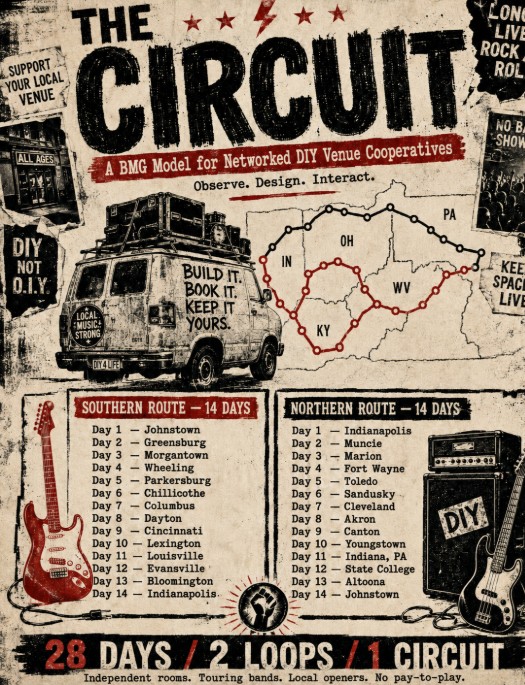
The corporation books touring bands across a coordinated route — a Northern loop, a Southern loop, or a full 30-day circuit with rest days built in. Bands sign a single contract for the full run. They show up, plug in, get paid, drive ninety minutes, repeat.
The Band Deal
Touring band gets a flat fixed nightly rate, negotiated up front, paid like a paycheck. The number has to make sense for four working adults burning vacation. At benchmark, that lands near $800 per night, all-in, scaling with the band’s draw and the run length. Across 30 nights, that’s $24,000 split four ways before expenses — enough to clear $5,000–8,000 per musician after van, gas, and food. That is the number that makes the month worth doing.
The band keeps 100% of merch. No facility cut, no platform fee, no soft skim disguised as a “shared marketing budget.” Ever. This is non-negotiable across the network and it is the line that separates this model from every other touring infrastructure currently operating.
Local opening acts on each bill are not paid in cash by the venue. They get 100% of their merch sales, free table, tip-out from the bar and kitchen, a real room with real sound, and an audience that came to see music. No pay-to-play, anywhere, ever. Plus, supporting bands on the tour is a great way to get to make the tour yourself.
The Venue Contribution
Each venue contributes its share of the touring band’s guarantee for the night it hosts — roughly the per-night flat rate plus hospitality. In exchange it gets a quality touring act it could not have booked alone, a pre-built opener structure, shared promotion across the network’s audience, and a predictable rhythm of nights filled. The corporation charges a modest per-booking coordination fee and offers optional shared services: insurance pooling, group purchasing on bar and liquor supply, shared social media and mailing list infrastructure, and the supply layer below.
The Supply Layer (and why it pays for itself)
Touring bands need things. Some they bring. Some they break. Some they forget. Currently, a touring band loses half a day off finding a Guitar Center in a city they don’t know. The Circuit eliminates that.
Rentals. The network owns and maintains a fleet of touring backline — drum kits, guitar and bass amps, keyboard stands, DI boxes, monitor wedges, in-ear systems, mic stands, basic cabling. A touring band signing the full circuit can opt to leave their backline at home and rent from the network at flat per-tour rates. Equipment moves with the route, gets maintained centrally, and means a band can fly to the first date and pick up a van locally without the gear-hauling overhead.
Consumables. Every venue carries the shop — a small, well-stocked merch counter of one-time-use items priced at cost plus a thin margin. Strings in every common gauge and brand, drumsticks, drumheads, picks, batteries, patch cables, gaff tape, Sharpies, setlist paper, earplugs, mic windscreens, in-ear tips, throat lozenges, hand warmers, hand sanitizer. The band needed to buy these anyway. Now they buy them from the venue, at fair prices, without losing a tour day to errands.
The shop is the network’s third revenue stream alongside bar and door. The margins are thin per-item by design — this is hospitality first — but volume across 14 rooms running 250 nights a year compounds into a real number. More importantly, it gives the venue a non-bar revenue line that runs even when alcohol sales are weak, runs in venues without full liquor licenses, and runs in markets where the kitchen is closed. Over time, the shop can expand into network-branded merch (Circuit-logo strings, picks, tape) — building a second merch stream that belongs to the venue layer rather than competing with the band’s table.
Replication Logic
This model is region-agnostic and genre-agnostic. The Ohio River Valley works because it has the right density of mid-size cities at 60–120-minute driving intervals, a saturated industrial-decline real estate market that prices DIY-suitable buildings within reach, and an underserved audience for live music outside major metros. The same conditions describe the Mountain West corridor (Salt Lake / Boise / Spokane / Missoula), the Gulf South (Birmingham / Mobile / Lafayette / Shreveport), the Upper Midwest (Madison / Eau Claire / Duluth / Grand Forks), much of the Carolinas, much of Quebec and the Maritimes, much of the UK Midlands, and so on.
Genre is set by the network’s bookers. A Circuit can run heavy music, Americana, jazz, hip-hop, electronic — whatever the operators love. The infrastructure is identical. The only thing that changes is who you bring across.
Capital Stack
Tiered ownership keeps the model accessible.
The coordinating corp owns one or two anchor venues in the lowest-cost markets on the route. These are the proof rooms — typically distressed commercial real estate in working-class cities, acquired for $50,000–$300,000, retrofitted with the venue operator’s own labor. The anchors set the template for the network’s standards and serve as the rest-day rooms on full-circuit runs.
The remaining stops are partner venues: existing independent rooms that sign onto the network for routing access, supply chain, and shared services. Partners contribute no capital. They contribute their building and their willingness to operate inside a coordinated calendar.
The rental fleet is the corp’s other major capital line — drums, amps, IEM systems, monitors. Bought used, maintained centrally, depreciated honestly. A starter fleet runs $40,000–$80,000 and serves a full 30-day touring product immediately.
Who This Is For
The Circuit is a BMG offering for entrepreneurs and small-collective operators who already love music and art more than they love the idea of getting rich on either. The model does not produce venture-scale returns. It produces a working living for the operators, a fair living for the touring bands, a real stage for local acts, a packed room for the audience, and a quiet network of resilient independent venues that compound their leverage by acting together.
If that math reads to you as a floor rather than a ceiling, this is the model.
Bright Meadow Group designs the structure, drafts the inter-venue contracts, builds the routing and supply systems, and consults on the launch. The Circuit then runs itself, owned by the operators who build it.