Why we celebrate our freedom with colorful bombs.
I should say up front that I have been drinking a cold thing on a warm porch, and that the following is from a recording I made on the Fourth of July many years ago. A man talking to himself when the sky is busy and the company has wandered off to find the cooler.
There is a book I have been writing in my head for about ten years now. I will never put it on paper, because the title alone would get me uninvited from the better sort of dinner party, and because the two books it steals from already said everything worth saying. But here it is, free to a good home: The Joy of War.
The title has two parents, and neither would claim it. The first is Comfort’s old manual — the frank one, with the tasteful line drawings of the bearded fellow and his companion, the book that lived on a great many shelves in houses that would have denied owning it under oath. I will note, with no further comment, that I resemble those drawings more every year. The second is Sun Tzu, twenty-five centuries old and quoted to this day, mostly by men who have never been in a fight. Put the candor of the one together with the gravity of the other, and you get the thing we are all standing in a field to watch.
Because that is what a fireworks display is, once you strip the patriotism off the top and look at the chemistry underneath. It is a manual. An illustrated, annotated, lavishly produced coffee-table edition of the one subject we have agreed to enjoy without discussing: the controlled and beautiful application of things that explode.
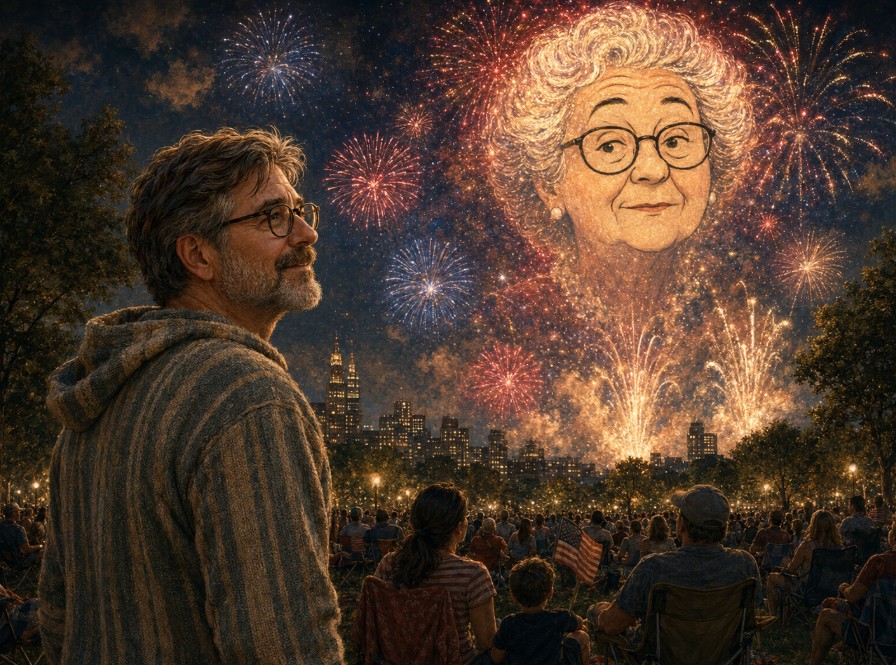
Watch the crowd instead of the sky for one round. You will see the whole thing. The long anticipation while the technicians fuss in the dark. The first tentative shells — the throat-clearing. Then the build; you can feel a field of strangers lean forward at once. The gasp goes up before the color does, which has always struck me as the most honest sound a crowd ever makes. And somewhere near the end, the part they have the decency to call the grand finale, where restraint gets abandoned altogether and the sky simply gives up being a sky.
And afterward, the hush. The smoke drifting east. Somebody’s baby crying. The slightly embarrassed business of folding the lawn chairs.
Grammina would have swatted me with a dish towel for the comparison, so I will let her. “Nathaniel,” she’d say, mangling someone — Augustine, probably; she loved to mangle Augustine — “the body knows what the mind won’t admit.” She meant it about appetite. She would not have minded me borrowing it here.
Here is what the comparison is for, though, because it is not a cheap one.
What we are oohing at is gunpowder. The same invention that ended the age of castles and the age of cavalry and a great many individual lives is the same invention we hand to a teenager with a lighter every July. We have taken the most efficient method our species ever devised for ending an argument by ending the man making it, and we have turned it into a thing we bring infants to see. We applaud it. We picnic under it. We let it put our children to sleep in the back seat on the ride home.
I find that astonishing. On my better nights I find it close to holy.
This year the Declaration turns two hundred and fifty. Think about the men who signed the thing we are out here celebrating. They were not, in that room, having a nice time. They were committing a capital crime in their own handwriting, in a string of colonies with no navy, against the largest military on earth, and they understood the penalty for losing to be the rope. The joy and the war were never separate transactions for them. The joy was the war — the decision to want something badly enough to risk the worst for it, and then to put your actual name under that wanting where the King could read it.
Adams guessed the day would be kept with pomp and parade, shows and games and sports, guns and bells, bonfires and illuminations from one end of the continent to the other. He got the bonfires right. He was off by two days on the date and dead wrong about almost nothing else. The man understood that a free people would need a ritual large enough to hold both halves of what they were feeling — the gratitude and the fear, the picnic and the gunpowder — and that the ritual would have to be loud, because the thing it remembered had been.
So here is the meander’s destination, if a meander gets to have one.
I have come around to thinking the fireworks are the most civilized thing we do all year. The speeches are the receipt; the mattress sales are the hangover; the fireworks are the actual rite. A nation that holds, at any given moment, the full and terrible capacity to do to others what was once threatened against it — that nation gathers its people in a field, takes a measured portion of that exact capacity, and aims it straight up at an empty sky for no reason on earth but delight.
That is a vow, if you let it be one. We know what this is. We know what it can do. We are choosing, tonight, in front of the children, to spend it on wonder.
The question Grammina would ask — she asked it about everything, usually while drying a plate — is whether we still know that is what we are doing. A people that remembers can keep pointing the powder at the sky for a thousand years. A people that forgets starts to imagine the sky was the only place the powder was ever pointed.
The grand finale is going over now as I write this. The whole field has gone quiet in the good way. I am going to set the pen down and watch the rest like a citizen instead of a columnist.
Grammina used to say — and I am fairly sure she was strangling a line of Pericles, may they both forgive me — “Anybody can be glad of a thing, boy. Free people are the ones who remember what it cost to be glad of it.”
The Joy of War. Read it every Fourth. The whole edition is up there.