Hydrothermal processing has been proven on four continents and made money almost nowhere. The reactor is not the reason.
I did not set out to solve anything for the biofuel industry. I set out to clean a river.
The question I started with was narrow and came out of permaculture rather than engineering: catch and store energy, stack functions, treat every output as somebody’s input. Those principles work on a quarter acre. Do they work on moving water at watershed scale — a river with a current in it, a load in it, and no property line you can fence?
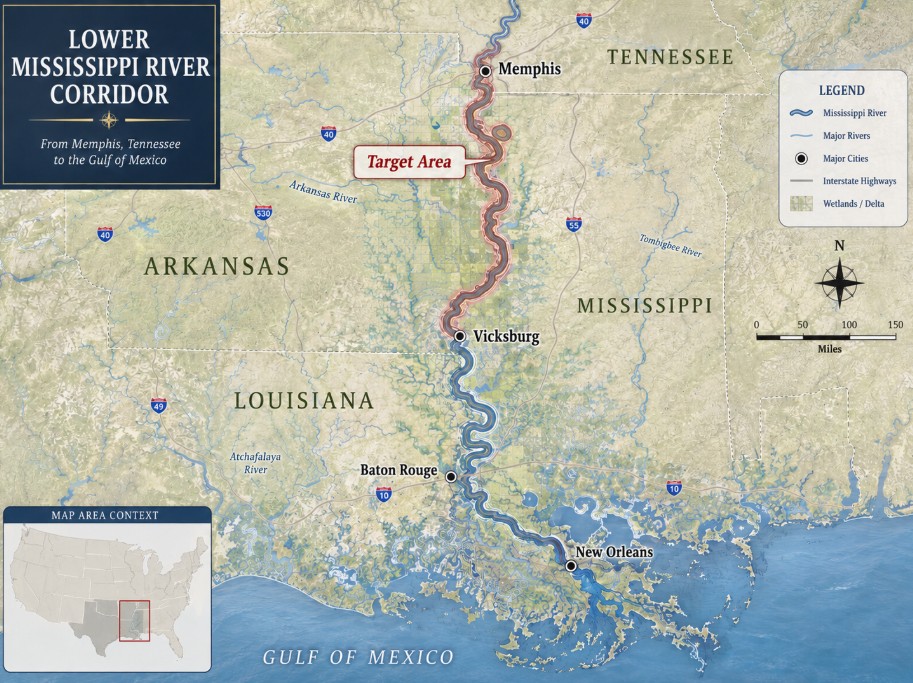
The reason to care was the dead zones. I read them as the clearest single indicator we have of ocean health, the way a blood panel tells you more about a person than watching them cross a room. The Mississippi–Atchafalaya basin drains forty percent of the continental United States, and NOAA’s forecast for this summer put the resulting Gulf hypoxic zone at roughly 7,027 square miles — a little under the footprint of New Jersey. Fix the rivers and you fix the coast. Leave the rivers alone and no amount of offshore management matters, because the nutrient keeps arriving. National Fisherman
Fifteen years in aquaponics gives you a specific way of looking at that. In a recirculating system, nitrogen is not pollution. It is inventory. You feed fish, bacteria convert the ammonia, plants take up the nitrate, the water comes back around clean enough to start over. Nobody in that loop is trying to dispose of anything.
So the River Refugium Project began as an inversion, and RRP1 still states it that way: the river becomes the nutrient source, the greenhouse complex becomes the engineered wetland, and the products are industrial fiber, algae, and biomass rather than food. Classical aquaponics turned inside out, pointed at a watershed.
The problem the design created
Here is where the thing bit me.
If your method for pulling nitrogen and phosphorus out of water is to grow plants in it, then success looks like tonnage. Duckweed doubles in about two days. Filamentous algae mats up in sheets. Success at watershed scale stops being a harvest and starts being a disposal question.
Composting works and I have no argument with it. It is slow, it is low-value, and the windrow acreage begins to compete with the land you were protecting. Drying the material for fuel is worse than useless — fresh duckweed runs above ninety percent water, and the drying costs more energy than the biomass contains. That single fact killed twenty years of algae-to-fuel ventures before anyone reached the reactor.
I went looking for something that would eat wet plant material without complaint and hand back something a market wanted. That search ended at hydrothermal processing, and the chemistry of why it works is in Water Under Pressure — I won’t re-run it here.
What I did not expect was that the industry had a hole in it shaped like my problem.
What the record actually shows
The technology is not speculative and it is not new. It is international, documented, and has run at commercial scale for over a decade in places most Americans have never heard of.
Ingelia has operated an industrial HTC plant in Valencia since 2010. CPL Industries commissioned one in the UK in 2018. A third went in at Oostende, Belgium. The technology carries a TRL9 rating — the number you assign something proven in commercial operation. A two-reactor Ingelia installation processing 14,000 tons a year produces roughly 750 tons of fertilizer concentrate and 3,500 tons of biocoal, the coal running about 24 MJ/kg — bituminous range, made from pruning waste and food scraps. BioenergyDOI
China has run HTC industrially on sewage sludge since 2016, with the largest such plant at Jining in Shandong Province. TerraNova operates in Germany, where phosphorus recovery from sludge is legally mandatory, and builds acid leaching for phosphorus recovery directly into the process line. DOIDiva-portal
Liquefaction has moved slower and gone bigger. Licella’s Cat-HTR is paired with Canadian forest products firm Canfor to produce 50,000 barrels a year of biocrude at Prince George, British Columbia. Steeper Energy runs a Hydrofaction pilot in Norway at 25 barrels a day. IEA Bioenergy’s survey of direct thermochemical liquefaction counted six HTL demonstration plants across fourteen countries. ADI AnalyticsBioenergy
Nobody in this field is arguing about whether the chemistry works. Fifty years of laboratory data and two decades of demonstration plants settled that. The argument is entirely about money.
The pattern in the failures
PNNL went back through the early hydrothermal demonstration plants and found something worth sitting with: none reached full commercial scale. Their retrospective assigns the blame to the capital cost of high-pressure reactors and the difficulty of financing early-stage technology. Pacific Northwest National Laboratory
True, and downstream of something else. Reviewers of large-scale HTL keep landing on feedstock availability as the critical variable, because transport logistics carry the cost. Each wet feedstock brings its own seasonal and geographic availability curve, plus whatever the local regulators think about it. PubMed CentralPacific Northwest National Laboratory
A hydrothermal reactor is a capital asset that wants to run. Every idle hour, the note is still due and the revenue is not. It is a sawmill with no log deck. The saw is fine, the building is fine, the crew knows the job, and the operation bleeds because logs arrive in bursts. Agricultural residue is seasonal. Forestry residue is seasonal and scattered across a hauling radius. A harmful algal bloom is spectacular feedstock that shows up for six weeks and then apologizes.
Now look at which feedstock actually carried hydrothermal into standing commercial operation. Municipal sewage sludge. Every time.
The reason has nothing to do with sludge chemistry. A city produces sludge on a schedule, at a fixed address, in a forecastable volume, and pays a tipping fee to have it removed. Steady supply, fixed location, negative feedstock cost, and in Germany a regulation requiring the phosphorus come back out. Give a reactor those four conditions and it pencils. Take any one away and it doesn’t.
The constraint has never been the reactor. It is the log deck.
Where the feedstock already is
We have been loading rivers with nutrient since before we had the vocabulary for it. Concentrated settlement managed it without help from chemistry — the Thames was a scandal before anyone synthesized ammonia. Then Haber and Bosch worked out how to pull nitrogen out of the air, industrial agriculture followed, and the volume changed by orders of magnitude rather than by percentages.
Global agricultural use of inorganic fertilizer hit 190 million tonnes of nutrient in 2023, up from 142 million tonnes in 2002 — 112 Mt of nitrogen, 41 Mt of phosphorus, 38 Mt of potassium. That is what feeding eight billion people costs, and I am not writing against it. Rain moves a fraction of it off the fields, and the fraction is enough. In one high-flow May, USGS measured 156,000 metric tons of nitrate and 25,300 metric tons of phosphorus entering the Gulf. One month, one river system. Bought once, mined once, manufactured with natural gas once, then abandoned in moving water on its way to killing a section of ocean. FAONational Oceanic and Atmospheric Administration
Set that beside the industry’s problem and the fit is almost rude. A reactor sector that cannot find supply that is enormous, continuous, located, and free. A continent-scale nutrient stream that is all four, delivered by gravity to any point on the bank we care to stand on.
What the RRP contributes
For two decades the sector has tried to solve a supply problem from the reactor end — better pumps, cheaper alloys, wider feedstock tolerance, longer offtake contracts. The solution is structural and sits upstream. That is the claim this framework makes, and three parts of the architecture carry it.
The refugium conditions the water so the crop performs. Rock-filled contact media, biofilm surface area, settling and buffering. What comes off the far side is prepared water rather than clean water — biologically stabilized and ready to grow things hard. This is the stage that converts variable river chemistry into a predictable growing input.
The greenhouse complex makes standing stock a design variable. Harvest is continuous, not seasonal. Phosphorus removal is limited by how fast you crop, rather than by how long the water sits. You size the standing stock, and harvest rate follows from the sizing instead of from the weather.
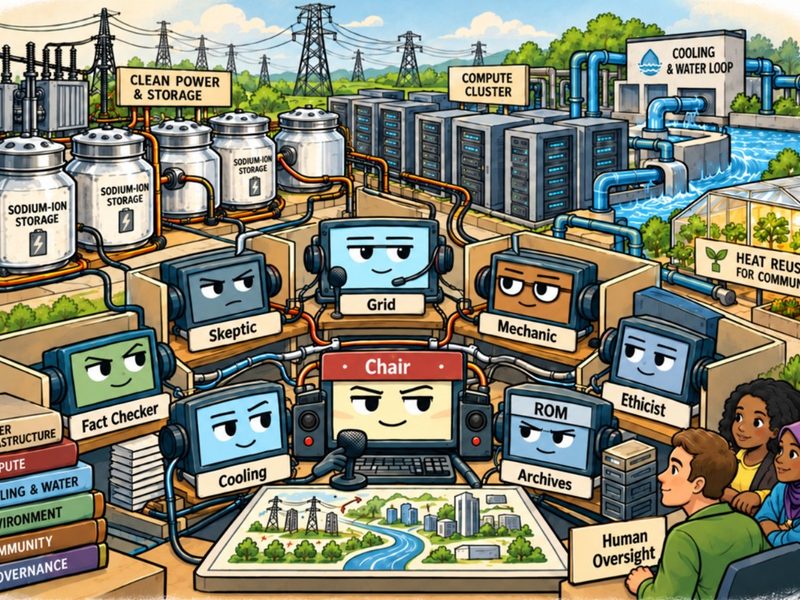
The cluster architecture is a log deck, engineered as one, from the water side. RRP5 §6 specifies one Model A hub — the node carrying the HTC/HTL plant on site — serving five to ten Model B satellites that ship harvested biomass in. The purpose is to hold reactor throughput at steady state across the aggregate biomass supply of the whole cluster, protecting maintenance cycles and taking any single node’s seasonal curve off the critical path. Surge tanks handle the hour. The cluster handles the season. No reactor developer has been able to build this, because it has to be built out of watershed rather than out of contracts.
Routing follows feedstock character, and the framework commits to numbers: algae houses send 80 percent to HTL and 20 percent to HTC; fiber, grasses and coppice run 60 percent HTC and 40 percent HTL. Lipid-bearing aquatic material liquefies. Lignin condenses. The aqueous phase from both reactors returns to the algae houses as nutrient input, off-gas and waste heat return to the greenhouses, and under normal operation the thermal loop closes without purchased heating or cooling.
Published yields on aquatic feedstock support the case. Duckweed grown on mixed domestic sewage and agricultural wastewater, run through HTL at 360°C, gave 34.7 percent bio-oil by dry weight at 36.41 MJ/kg, carrying better than 86 percent of the feedstock energy into the oil. Harmful macroalgal bloom biomass processed at a milder 270°C with a sodium carbonate catalyst returned about 20 percent bio-oil, and its leftover aqueous phase proved nutrient-rich enough to culture four separate microalgae strains. ScienceDirectNature
That last point deserves weight. The aqueous byproduct of HTL is treated across the industry as a disposal headache, because it carries high concentrations of organics and nutrients. In a system organized around cultivation, a stream loaded with nitrogen and phosphorus is not a headache. It is what you built the greenhouse to receive. ScienceDirect
The honest part
Every yield figure in the framework carries a flag, and the flags mean what they say. The integrated multi-species arrangement the RRP describes has no direct precedent at this scale. The literature gives uptake and yield for individual species under controlled conditions. It does not give integrated performance for a rotating crop complex running on variable river chemistry with continuous harvest cadence.
That gap is the founding argument for the pilot, not a hole in the design. The reactor parameters in RRP5 come from the smallest commercially demonstrated continuous systems in the published literature, chosen deliberately so the numbers can be checked against something real. Commissioning replaces them.
The known hard parts stay hard: high-pressure slurry pumping, corrosion at temperature from organic acids and chlorides, nitrogen in the biocrude, phenolic accumulation in recycled aqueous phase, heat integration that has to be near-perfect. All solved in the laboratory. None solved at commercial scale, continuously, on a specific feedstock — because until now nobody has had a feedstock worth the trouble.
The age of permanent reuse
Line the pieces up.
Reactor technology proven across four continents and stalled on supply. A nutrient stream so reliable the federal government maintains a task force, three thousand stream gauges, and an annual forecast just to measure it. A harvest architecture that converts the second into the first and returns cleaner water to the river on the way through.
Gulf hypoxia has been narrated as an engineering challenge for forty years. I would put it differently. The engineering is running today in Valencia, in Shandong, in Düsseldorf, and in British Columbia, waiting on somebody to hand it something cheap enough to justify the pressure vessel. What is missing is the connective layer, and the decision to stop calling river nutrient runoff and start calling it stock.
The framework is published open-access at cernunnosfoundation.com/rrp. That is a position, not a giveaway. This sector has spent twenty years with its process knowledge behind license agreements and its plants sitting idle for want of something to eat, and the arithmetic on that approach is now available for anyone to check. The design is free to build, free to modify, free to improve, and free to prove wrong. What it needs is operators, not licensees.
Every year we wait, we pay for the same nitrogen three times — once to make it, once to spread it, and once more in lost fisheries when it reaches the coast. The technology to collect that third payment exists.
The age of permanent reuse can start this year, on one reach of one river. The reasons to wait have gotten a lot thinner than they were.
Bright Meadow Group works under Observe → Design → Intervene. The River Refugium Project framework is published open-access by the Cernunnos Foundation. Inquiries: robert@brightmeadowgroup.com