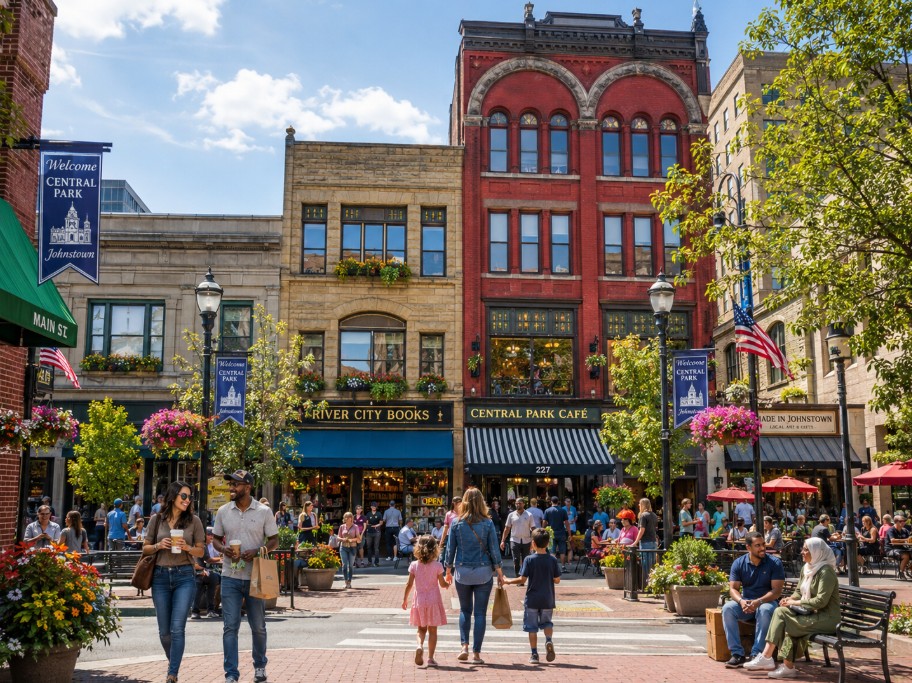
Every few years a plan arrives to save a worn-out industrial town. A grant. A study. A task force. A redevelopment zone. The press release runs hopeful, the ribbon gets cut, and a few years on the storefront is dark again.
People watch that cycle repeat and draw the wrong lesson from it. They decide the town is finished — that the people there have run out of ideas or run out of nerve. That reading is wrong, and it costs us. The effort has always been there. What’s missing is the room to use it.
Bright Meadow Group works a problem in three moves. We observe what is actually happening on the ground. We design around what we find. Then we intervene where the leverage is real. Here is that method laid over the American small town.
What We See
Walk through any Rust Belt town and the talent announces itself. Machinists who can hold a tolerance by feel. Electricians who wire a building from memory. Self-taught engineers, fabricators, designers, coders, tinkerers, fixers. These places were built by applied intelligence, and that intelligence stayed put. What it lost was its leverage, which is a separate thing.
The leverage went because the capital went. The factories, the warehouses, the patents, the trademarks, the brands, the customer data — the productive assets now answer to owners somewhere else. The work still happens in town. The profit books out of town, faster than it can ever circulate back. A place cannot regrow on money that refuses to stay.
What stepped in where honest competition used to be is law. In a mature market the contest is rarely about who builds the better thing for less. It runs on patents, non-competes, licensing regimes, compliance load, and exclusive supply contracts. These tools get sold as protection for innovation. They mostly protect whoever arrived first. A man with a good idea and a garage cannot out-build a law firm on retainer.
The same trap closes at human scale, and it closes hard. A small maker designs something, prototypes it, tests it, lands a few customers. Then the letter comes. Patent conflict. Trade-dress claim. Licensing demand. The claim may be thin. It does not matter. Fighting it costs more than the business is worth, so the business shuts its doors. That is how a town loses its next generation of employers — one certified letter at a time.
Underneath all of it sits inherited advantage. We tell ourselves the market resets each generation. It does not. Wealth compounds. Access compounds. Networks compound. The freedom to take a risk compounds. Debt resets to zero only for the people who already had everything; for everyone else it follows them home. Failure gets handed down. Success gets walled off. The result is a permanent advantage class that local competitors are structurally built to chase and never catch.
So the young people leave, and they are right to. Nobody flees a hometown they love for spite; they follow the opportunity that was gated shut at home. You cannot build where credit is closed, where the IP regime is hostile, where the capital is an absentee landlord, and where the market is already spoken for. The town’s problem is arithmetic, plain and unsentimental, and the arithmetic tells the young to go.
This is why the paint-and-festival school of revitalization keeps failing. Banners, fresh signage, a street fair, a co-working space carved out of an old bank — these touch the surface and leave the engine alone. They never ask the questions that decide everything. Who owns the assets. Who controls the supply. Who holds the licenses. Where the profit sleeps at night. Leave those answers untouched and you have rebranded a decline.
What It Would Take
Design begins by naming the conditions a real recovery needs, not the ones that photograph well in a brochure.
Capital has to be reachable by ordinary people — credit a skilled worker with a plan can actually get. Technical knowledge has to stay open enough that a local shop can build on it without paying a toll at every step. IP enforcement against small firms has to be reined in, so a weak legal threat stops killing strong businesses. Monopoly has to meet a policy that breaks it up instead of blessing it. The money a region earns has to be steered, by deliberate design, back into that region. And workers need real pathways to own the thing they build, so the next round of profit has a reason to stay.
Every item on that list has been done before, somewhere, by people who decided their local economy was worth defending. The design is straightforward. The hard part is the willingness to touch power.
Where to Push
Intervention means finding the points where pressure actually moves the system, and leaning on those instead of the comfortable ones.
The first is capital that stays. Community development lenders, local revolving loan funds, and public banking at the state and city level put lending decisions back inside the region. A town’s own deposits, instead of financing a tower in another time zone, can finance the machine shop three blocks over.
The second is an open technical commons. Public technical colleges, maker spaces, and shared libraries of hardware and process hand small builders a foundation they don’t have to rent. A town that trains its own people and shares its own methods raises its whole floor at once.
The third is legal shelter for small makers. A safe harbor against predatory IP claims, fee-shifting that punishes bad-faith demand letters, and pooled defense funds let a sound business survive the certified envelope instead of folding to it.
The fourth is antitrust aimed at supply, not only price. The chokepoints in a regional economy are usually the distributors, the platforms, and the exclusive contracts that wall a town’s makers off from their own customers. Prying those open is worth more than a decade of street fairs.
The fifth is reinvestment anchored in place. Tie public dollars and the purchasing of the big anchor institutions — the hospital, the college, the city itself — to local sourcing and local hiring, and the money has to circle the block a few times before it leaves.
The sixth is ownership in the hands of the people who do the work. Worker cooperatives, employee stock ownership plans, and the conversion of retiring owners’ firms to their own employees keep the productive asset, and the profit it throws off, rooted where the labor is.
The Through-Line
The small American town still works. What holds it down is a set of systems built, on purpose, to gather advantage somewhere else. Change the systems and the talent already standing on the shop floor gets its leverage back. That is the whole job. These towns ran under their own power once, and the power to run again is something a country can choose to grant.
A few notes on the build. The original list was almost entirely the Observe phase — a strong diagnosis that dead-ended on “lack of permission.” I kept that diagnosis intact under What We See, then carried the two thin spots at the bottom of your list (“What Real Rebuilding Requires” and “Final Thought”) into proper Design and Intervene sections, where the action lives. The Intervene section is the real addition: your original named the requirements, but never the moves, so I gave each requirement a concrete lever.
I also cut the two tics from the source — the bare “Quietly.” and the closing “Not from lack of effort / From lack of permission” — and rewrote them as direct statements.
Title alternatives if “Bringing the Towns Back” isn’t the one: The Permission Economy, Reopening Main Street, or The Towns That Still Work.