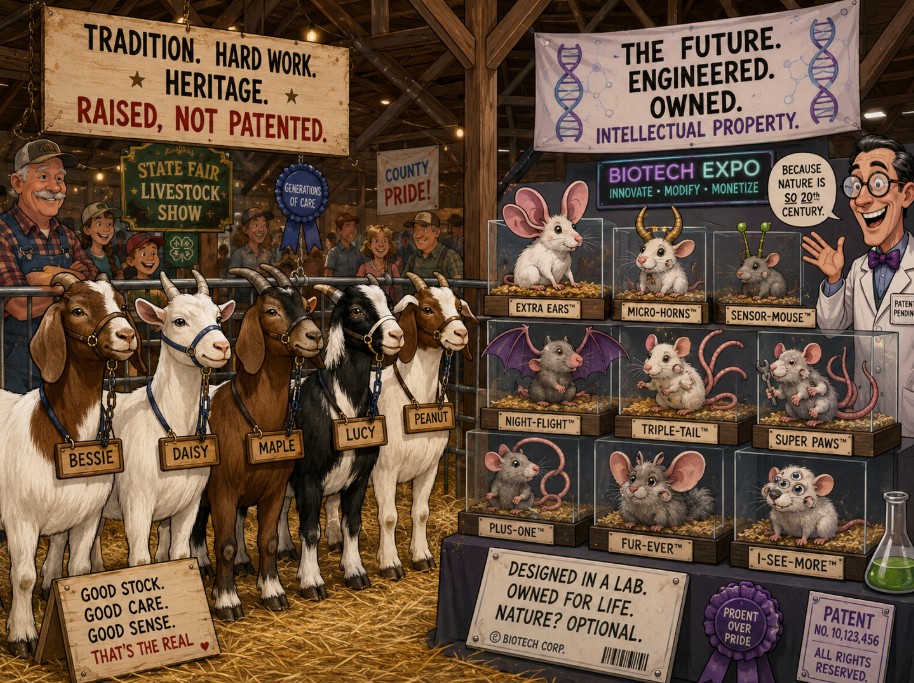
Suppose you keep a few goats, and your doe comes into season, and you walk her down the road to a neighbor who keeps a good buck. He lets her be bred for a small fee or for the promise of a favor returned, and you walk her home again. In the spring she throws twins, and one of them is a fine young buck. Whose is he?
He is yours. There is no question about it and there never has been. The oldest rule in the keeping of animals is that the young belong to the owner of the mother. You carried the risk and you carried the cost. You fed the doe through the winter when she was heavy. You were there in the cold barn at the kidding, with your own hands, when it could have gone wrong. You raised the kid up onto his legs and saw him through to weaning. The buck’s owner gave an afternoon and a service, was paid for it, and that was the end of his claim. The animal is the work of your hands and your patience, and so the animal is yours — to keep, to breed, to stand at stud, to sell, along with his kids and their kids after them, owing no man a thing.
I want you to notice what the law is doing there, because it is doing the right thing and doing it for the right reason. It looks at who performed the labor of bringing a life into the world and raising it, and it awards the title to that person. Husbandry made the goat, so husbandry owns the goat. Work in the field of living things earns the living thing. That is an honest principle and an old one, and most of us feel its justice in our bones without ever being taught it.
Now set that goat beside the bean.
It is the same man, near enough. The same kind of work — his ground, his season, his labor, his risk carried through to the harvest. And he is told that none of it counts. The plant came up in his field by his hand, and the law that just finished honoring the goatkeeper turns to the bean farmer and says the increase is not his, because a pattern-owner holds a claim that runs ahead of him into the furrow. The law already knows the right rule. It knows it well enough to apply it to the goat without a second thought. It keeps the rule for the animal and throws it out for the seed, and that ought to tell you the seed rule was never a discovery about the nature of plants. It was a decision.
You might think the line being drawn is the one between an animal and a plant — that the law protects living creatures and leaves mere vegetables to the corporations. It is a comforting thought, and it is wrong, and the proof of how wrong it is happens to be a mouse.
In 1980 the Supreme Court held that a living thing made by man could be owned like any machine, and it reached for a sweeping phrase to say so — anything under the sun that is made by man. Eight years later the patent office made good on it and granted the first patent ever issued on an animal. The animal was a mouse, engineered in a Harvard laboratory to grow cancer, and from the day that patent issued, that mouse and its offspring belonged to the holder of the patent the same way the soybean belongs to the holder of its patent. The breeding is restricted. The young are not yours. The goatkeeper’s ancient right vanishes the instant a patent is allowed to read on the creature.
So the line was never between the plant and the animal. The line is between the patented and the unpatented, and nothing else. Your goat walks free because no one holds a patent that reads on a common goat. There is nothing there to infringe. The soybean was enclosed root and branch while the goat was left alone, and that — not biology, not principle, not any tenderness of the law toward warm-blooded things — is the entire difference between them.
Why the crop and not the herd, then? History, and nothing nobler. The plant got its own private machinery decades before a man could own a mouse. There were statutes written for plants alone, one in 1930 and one in 1970, built that way precisely because plants copy themselves and because in those years it was simply assumed that a living thing could not be patented at all, so the seed companies needed a special law made just for them. Then the ordinary industrial patent, the hard kind with no mercy in it for the farmer who saves seed, was allowed to stack on top of all that. No one ever built the matching machine for the animal. There is no Animal Variety Protection Act. The goat was spared because the factory was never built around the barn.
And where the livestock men do want a grip on their genetics, they reach for gentler tools that leave the kid standing in your barn. There are the registries and the papers that decide what may be called purebred, which govern a name and a price but not your ownership. There are the contracts on the buck and on the straw of frozen semen. There is the trademarked breed name. And there is the hardest lock they own, which is built into the body itself — the terminal cross, the broiler and the hog bred so deliberately that the next generation will not breed true, so that you must come back every season and buy your stock new. That is the animal’s hybrid corn, a fence grown into the flesh instead of written into the statute. It rules the premium and the pedigree. It has mostly left your right to own what your animal bore untouched.
So do not take comfort in the free goat. Do not tell yourself the law drew a line around living creatures and said this far and no further, because it drew no such line. The mouse proves they will own an animal and all its young the day it pays to. The terminal broiler proves they will weld the lock straight into the body when the patent runs too slow. Your goat is free, and you ought to look hard at why. She is not free because a right stands guard over her. She is free because no one has yet found it worth the trouble to enclose her. Give the goat the market the soybean has, let one animal become worth what one seed line is worth, and the same machine that rolled up the lane to the bean field will roll up the lane to the barn. A freedom that lasts only so long as no one bothers to take it is the thinnest freedom there is, and a man would be a fool to mistake it for the real thing.
The goat and the seed are the same question wearing two coats. The right answer to both was written down long ago, in the plainest rule the keeping of animals ever produced: the one who does the labor of raising up a life has earned the life. We kept faith with that rule for the goat. We broke it for the seed. And we will break it for the goat too, the moment the breaking turns a profit, unless we decide that the rule was right in the first place and means to hold it for everything that grows. Propagation over possession. The barn already knows it. The field is only waiting for us to remember.