The Battle of Homestead, 1892 — and what it still asks of working people
Pull up a crate. I want to walk you through a summer on the Monongahela River, a hundred and thirty-four years ago this very week, when the best steelworkers in America found out exactly what their standing was worth — and what it cost to hold onto it.
Homestead, Pennsylvania. Seven miles up the river from Pittsburgh. The Carnegie Steel Works sat right there on the bank, and the men who ran it were the finest in the trade. I mean that plainly. The skilled rollers and heaters and puddlers in that mill earned the best wages in the country, and they earned every dollar. Their union, the Amalgamated Association of Iron and Steel Workers, was the strongest trade union this nation had yet produced. Their contract didn’t just set their pay. It set the work rules. How the turns were apportioned, how the machinery got changed, how a man was treated on the floor — the men had a voice in all of it.
Now sit with that a second, because here’s your first lesson and I want it to land. Their skill was their leverage. A company can replace a body. It cannot easily replace a craft. Those men had spent their lives building a thing nobody could take off a shelf and hand to a stranger, and that craft is what bought them their dignity at the gate. Your labor’s your product, Jack. Build it to last, and it’ll stand up for you when the talking gets hard.
The owner of all that steel was Andrew Carnegie — Scotsman, richest kind of rich, a man who wrote pretty words about the workingman’s right to organize. His chairman, the one who actually ran the operation, was Henry Clay Frick. And Frick had no pretty words. He’d written to Carnegie that the Amalgamated men held the mill back, that the union “placed a tax on improvements, therefore the Amalgamated had to go.” Carnegie himself drafted a notice saying the works would run non-union once the agreement expired. The company was clearing a record profit — four and a half million dollars that year — and Carnegie crowed about it. “Was there ever such a business!”
So when the contract came up at the end of June 1892, understand what the fight was truly about. The local paper saw it clear and said it was a design upon the labor organization itself. The wage cut was the smaller matter. They came for the men’s voice. They came to erase the union and put every man back to standing alone, hat in hand. Respect is the first safety rule, and what Frick proposed was the removal of respect from the premises. A working man should learn to hear that note early, because it sounds the same in every century.
Watch what Frick did next, because a man tells you his intentions with his hands before he tells you with his mouth. Before one word of real negotiation was settled, he built a fence around that mill — ten, twelve feet high, topped with barbed wire, cut with loopholes like a gun emplacement. The men took to calling it Fort Frick. Now I’ll teach you to read a room and a blueprint, both. When management fortifies before it bargains, the bargaining’s already over in their mind. They’ve decided. Frick locked the men out a day before the contract even lapsed, fenced them off their own livelihood, and on the second of July he fired all thirty-eight hundred of them at once.
Here’s where I want you to see these men at their best. They did not scatter. On the thirtieth of June they met as one and declared the company had broken faith. The skilled men of the Amalgamated, the mechanics and transport men of the Knights of Labor, the thousands of unskilled hands — many of them immigrants fresh off the boat from Eastern Europe — they stood together. They organized the whole town. Set patrols on the river and the rail. Ran their own discipline. When the sheriff came to open the plant for the company, the men turned him back. For days that solidarity held the field, and solidarity that holds is the most powerful thing a workforce owns. Skilled and unskilled, native and foreign-born, one local and another — when they stand on the same line, no fence in the world is tall enough.
Frick’s answer came up the river in the dark.
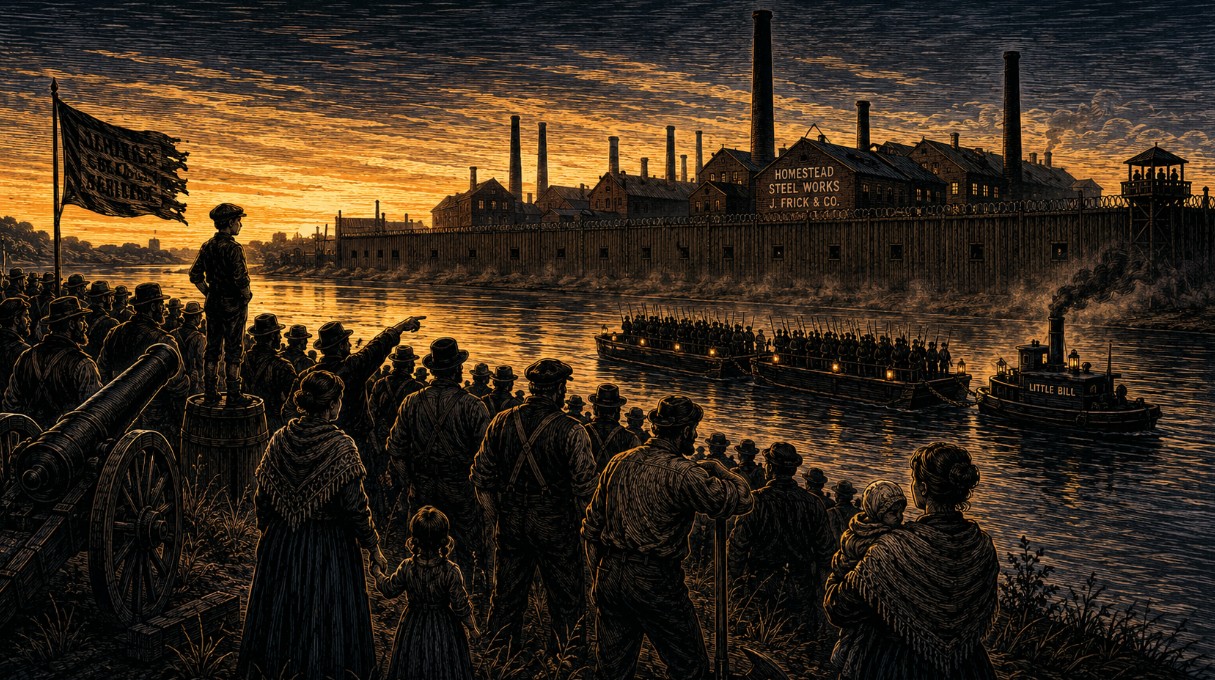
Early on the sixth of July, two barges came towing up the Monongahela behind a little tug called the Little Bill. Aboard were three hundred Pinkerton agents — a private army, hired guns, armed with Winchester repeating rifles. The plan was cold and clever: land them on mill property at first light, so any worker who resisted would be trespassing on company ground. But the men got word. By the time those barges nosed in toward the bank, thousands of workers and their wives and their children were down at the water’s edge, and they were not moving.
Nobody knows who fired the first shot. Once it was fired, the river ran loud all day. The workers held the high ground above the landing and fired down; some old soul even hauled out a cannon. The Pinkertons were pinned on those barges and could not get ashore. By evening, after raising the white flag more than once, the hired men surrendered. Seven workers dead. Three Pinkertons dead. Dozens carried off bleeding on both sides of the water.
And now I have to teach you the hardest part, because I hold the men accountable the same as I hold the company. They had won the field. They had every right to be angry, every grievance in the world. But when those beaten Pinkertons came ashore to surrender, the crowd ran them through a gauntlet and laid hands on them — men, women, and children both. The union’s own president stood there pleading for a peaceable surrender, and the crowd rolled right past him.
Check your measure, then check your motive. That right there is the lesson inside the lesson. The moment those workers turned a victory into a beating, they handed their story to the other side. The newspapers that had been ready to call them defenders of their homes started calling them a mob. A man can be entirely in the right and still lose the room the instant he forgets his discipline. Discipline is not the boss’s tool to use against you. Discipline is the thing that protects you when you’ve got the high ground and the temptation to abuse it. They lost their grip for one afternoon, and they never got the public back.
After that it came apart by degrees, the way these things do. The governor sent eight thousand National Guardsmen and put the town under martial law. The mill reopened with replacement workers under guard. A stranger named Alexander Berkman — an anarchist with no tie to that union and no standing in that town — walked into Frick’s office and shot him, and wounded him, and the men of Homestead who had nothing to do with it carried the blame for it anyway. Guard your name, Jack, because the world will define your whole cause by the worst thing that ever stands next to it, whether you invited that thing or not. Then division crept in among the strikebreakers themselves, and the long siege wore the families down to the bone, until in November what was left of that proud local voted, in a near-empty hall, to go back to work. The union was broken.
I won’t soften the cost. Over the next fifteen years the skilled men’s daily wage shrank by a fifth, and their shift grew from eight hours to twelve. Membership in that mighty Amalgamated collapsed from twenty-four thousand toward eight. Carnegie’s profits climbed into the hundreds of millions. And organized steel in this country lay in the grave for forty years. Forty years, Jack. That’s a man’s whole working life spent standing alone at the gate, hat in hand, the exact thing those Homestead men bled to prevent.
So you might ask me — what was it for, then, if they lost it all?
Here’s the answer, and it’s the whole reason I tell you the story. They lost the battle. They planted the seed. In 1937, in the teeth of the next great fight, the steelworkers finally organized U.S. Steel and won recognition — and every man who signed that card in ’37 was standing on the ground the Homestead men were buried in. The eight-hour day, the right to a voice on the floor, the simple notion that a working man brings dignity through that gate and not just muscle — those things came down the line to us like an inheritance, paid for in advance on a riverbank in 1892. Knowledge is inheritance. Standing up is inheritance. Somebody bled so you’d know it could be done, and now it’s your job to keep the knowing alive and hand it on clean.
My old man was a Pullman porter. He used to tell me, “We carried other folks’ baggage, son — but never their shame.” The Homestead men understood that down to the soles of their boots. They carried Carnegie’s steel and built his fortune, and they refused to carry his contempt on top of it. They asked for one thing money can’t pay out — to be treated like men with a craft and a voice. They lost the asking, and they made sure the asking never died.
Keep your craft sharp. Keep your conscience sharper. And when the day comes that somebody builds a fence before they’ll sit at the table with you, you remember Homestead — remember the strength of standing together, and remember the discipline that has to ride right alongside it, because the one without the other will leave you bleeding on the bank.
Well. Now you know, Jack.
— Mr. Wright