A City Skyline on the Ohio River
There is a particular authority to a skyline viewed from across a river.
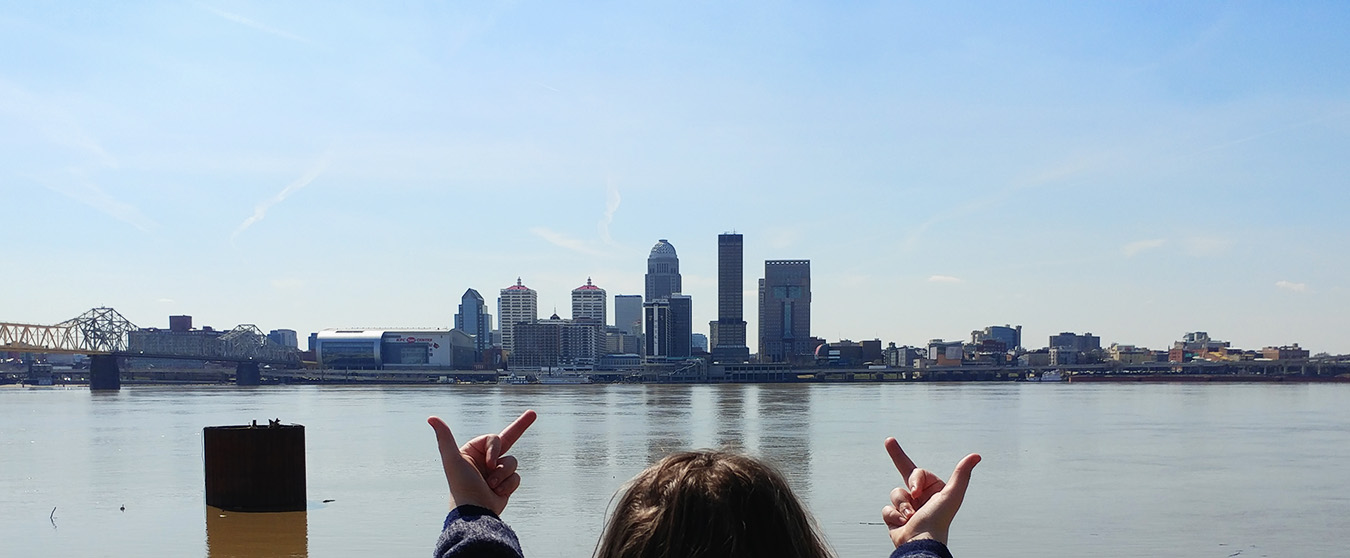
From this side of the Ohio, Louisville does not arrive as a street grid, a traffic pattern, or a list of neighborhoods. It arrives as a shape. The city rises in layers from the water: bridges first, then low industrial and civic mass, then the clean vertical marks of downtown. The river flattens the foreground and gives the skyline room to declare itself.
Louisville’s skyline is not one of those cities that tries to overwhelm the horizon through sheer height. Its strength is composition. The buildings sit in conversation with the river, with the bridges, and with the long horizontal line of the opposite bank. There is height here, certainly, but the more interesting quality is balance. Towers rise, but they do not erase the older city beneath them. The whole scene keeps a working-river character: practical, commercial, engineered, and still handsome when seen in the right light.
The bridges matter. They are not background decoration. They are part of the architecture of the place. A river city is never just the buildings on one shore. It is the crossings, the piers, the steelwork, the lanes of movement, and the daily act of tying one side to the other. Louisville’s skyline depends on that relationship. The city looks most complete when the Ohio is visible in front of it.
That is what this photograph catches well. The water gives the city scale. The open sky gives it room. The skyline itself sits low and broad at first, then gathers upward into a downtown cluster: glass, concrete, arena roofline, bridge truss, office tower, and waterfront infrastructure all compressed into one clean civic profile.
There is also something useful about photographing a city from outside itself. Distance removes the noise. The signs, the potholes, the restaurant arguments, the construction cones, the parking disputes — all of that drops away. What remains is the made object: a human settlement reduced to edge, mass, reflection, and intent.
Louisville, from here, reads as a river city that knows it is a river city. It does not float above its geography. It sits on it. The Ohio is not a scenic accessory; it is the reason the city’s shape makes sense.
That is the core of ManMade as a category. Not just “things people built,” but the way built things reveal what people were trying to solve. A skyline is not only architecture. It is transportation, commerce, ambition, floodplain, power, labor, land value, engineering, and habit — stacked into a silhouette.
And then, of course, there is the foreground.
We offer Louisville a half-hearted apology for the double salute. The photography crew is from Indianapolis, and if you are from the region, you know.