We See You in the Server Logs: A Note to the Students Citing Us
Something interesting has been showing up in our traffic reports.
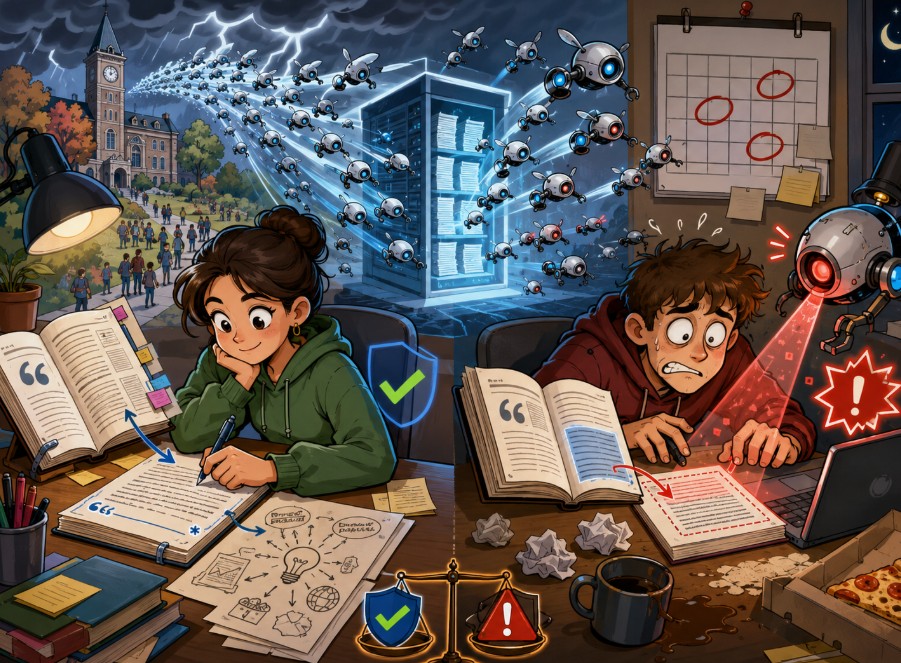
Alongside the usual visitors — the readers, the regulars, the AI crawlers hoovering up the archive — there’s a distinct pattern of automated checks that behave differently from everything else. They arrive in clusters. They hit specific articles rather than browsing. They pull pages that correspond, almost too neatly, to the academic calendar. Midterms bring a wave. Finals bring a bigger one.
These are plagiarism-detection services. Turnitin and its cousins, dispatched by universities to compare student papers against the open web. And when those systems keep returning to the same publication, it means one thing: our articles are turning up inside student work, often enough that the machines have learned where to look.
To the students doing that work: welcome. We’re glad you found us. And we’d like to clear something up, because the distinction matters to your grade and to your education.
Quoting us is not plagiarism. Citing our ideas, testing our arguments, building a paper around whether one of our theories holds up — that’s scholarship. That’s the entire point of publishing this material in the open. If you take our piece on Senate appointment mechanics, or landfill reclamation, or the economics of a dry music venue, and you write a paper that proves us right or tears us apart with your own evidence and reasoning, you have done exactly what a paper is for. Put our name in your bibliography, quote us in quotation marks, attribute the ideas that are ours, and argue with them using thoughts that are yours. No detection system on earth will flag that, and no professor will either.
Copying us is a different animal. Lifting paragraphs, lightly rewording our arguments and presenting them as your own analysis, dropping our conclusions into your paper without a citation — that’s what those bots exist to catch, and judging by the traffic, they’re catching it. When a plagiarism scanner pings the same article of ours forty times in a week, somebody’s paper didn’t go well.
The frustrating part, from where we sit, is that the honest version is easier. We publish everything in the open on purpose. Our sources are documented. Our reasoning is laid out step by step, specifically so it can be checked, challenged, and built upon. A student who engages with that material honestly has a head start most research subjects never offer. A student who copies it has taken the one publication designed to be argued with and used it in the one way that helps nobody.
So here is our standing invitation. Cite us. Quote us. Disagree with us in print. Write the paper that dismantles one of our concept papers line by line — we’ll probably enjoy reading it more than you’ll enjoy writing it. If your professor questions the source, our archive is public, our documents are timestamped, and our work stands where anyone can inspect it.
Just do the thinking yourself. The bots are watching, and so are we.