They Named It Open
In December 2015 a nonprofit incorporated in California with a stated mission to develop artificial intelligence for the benefit of all humanity, a commitment to publish its research, and a promise to share any patents with the world. It took the name OpenAI. The name was doing work. It was the pitch to funders, the recruiting instrument, and the standing permission slip.
Over the next four years the corpus went in. Crawled web. Wikipedia. Books. Linked pages from public forums. Code repositories. Archived journalism. Every person who has ever typed anything into a public channel contributed to that pile — without a contract, without a payment, and without a vote.
Then it closed. In 2019 a capped-profit arm appeared, along with an exclusive license to Microsoft. In 2023 the GPT-4 technical report declined to disclose the architecture, the dataset, or the training method, citing the competitive landscape. In October 2025 the recapitalization finished: profit cap gone, public benefit corporation stood up, IPO pathway cleared, nonprofit foundation holding roughly a quarter of an enterprise now valued in the hundreds of billions.
Hypocrisy is the weakest available reading of that sequence, and it is the one the industry is best defended against. Missions evolve. Circumstances change. Fine.
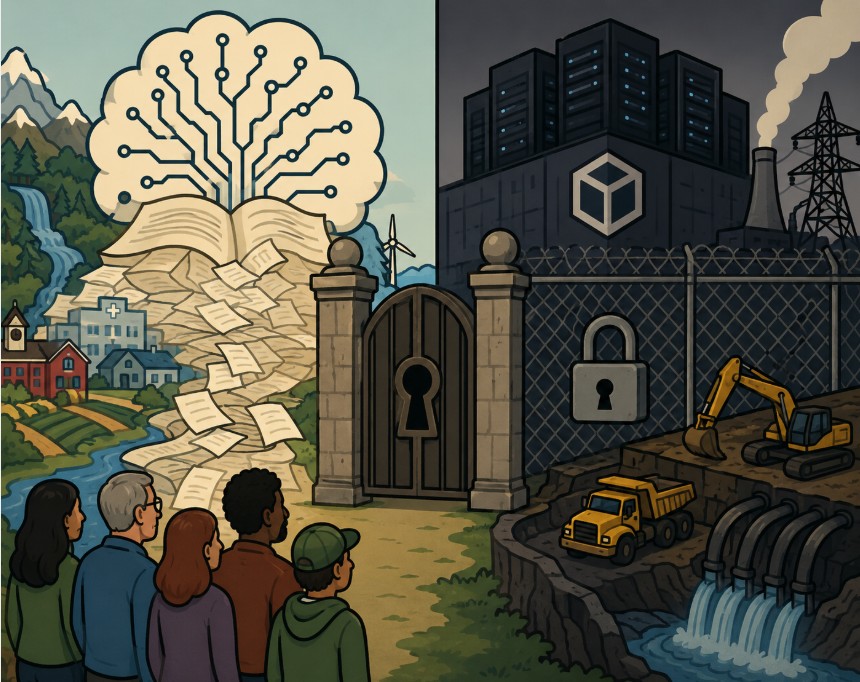
The strong reading is contractual. The public supplied the corpus. The consideration offered in exchange was openness — stated in the founding documents, worn in the name, relied upon by everyone who left their writing in a public place during the accumulation years. The consideration was withdrawn after delivery. When consideration fails, the transaction does not simply become a bad deal. It becomes a transfer without basis, and what was transferred is still owed back.
What was transferred is the accumulated written output of the species. That is the seed stock of every frontier model now operating, including those built by companies that never made the promise, because the techniques and the corpora both descend from work done under that flag. There is no clean-hands branch of this industry. It all grows from the same field, and the field was held in common.
The count cannot be produced
Here is where it stops being about one company.
The Times and other publishers have spent two years trying to determine what is inside that corpus. OpenAI’s position through much of the litigation was that searching its own training data and chat logs was infeasible and would raise privacy problems. In July 2026 the plaintiffs moved for sanctions, alleging that a deposition revealed the company had already run internal searches of the corpus for copyrighted journalism, and had built tooling to detect when its models reproduced protected text.
Set the merits aside — discovery fights are ordinary and the allegations are unresolved. Look at the shape.
A private book-entry system holds the record. The record is demanded against an adverse party, in a courtroom, by a judge with jurisdiction. The keeper says the count cannot be produced.
American courts have already run this experiment at a scale of trillions. In the 1990s the mortgage industry built MERS, a private electronic registry, to route around county recorders and their few-dollar recording fee. It worked for a decade. Then foreclosures hit the courts by the million, judges asked who holds the note, and in an enormous number of cases nobody could answer. Assignments were backdated. Signatures were manufactured in industrial volume. Title was clouded across millions of American properties and portions were never cleaned up.
Nobody conspired. The incentive was a recording fee. A private register substituted for a public one because it was cheaper, the public one atrophied from disuse, and when the count finally had to be produced against an adverse party, the count did not exist.
Data is not a commodity. It is a venue — the place where claims are established, contested, and honored. Property, identity, eligibility, debt, guilt, innocence: none of these exist apart from a record asserting them. You cannot privatize a courtroom and then guarantee its litigants a fair hearing by regulating the ticket price.
The utility lineage
Every general-purpose network America has built arrived with a public obligation attached, and the obligation attached to the function rather than to the deed.
Canals and turnpikes were chartered with common-carrier duties inherited from English law, which bound ferrymen and wharfingers to serve all comers on reasonable terms. Railroads got rate regulation. The telegraph and then the telephone were carriers before they were companies. Rural electrification was a public authority because private capital declined the geography. The interstate system was built with public money and opened to everyone with a license. The internet was a federal research network released into public use.
In 1877 the Supreme Court decided Munn v. Illinois over grain elevators at Chicago — the terminus, the actual gate on the American grain trade. Property devoted to a public use, the Court held, is clothed with a public interest and becomes subject to public control. The elevator men argued that regulating their rates confiscated their property. They lost. In 1946 the Court held in Marsh v. Alabama that a company-owned sidewalk performing a public function carries public obligations regardless of who holds the deed.
Compute is the elevator at the terminus. The doctrine is a hundred and fifty years old and sitting there unused.
Public is the opposite of enclosed
The reflex objection is that public ownership concentrates the register and builds a surveillance state.
The concentration exists either way. Registers concentrate; that is what a register is. The choice is between one with remedies attached and one with the remedies stripped off. Public ownership is the condition under which open records law applies, due process attaches, judicial review is available, an inspector general has jurisdiction, and an election can eventually reach the thing. Every one of those handles exists because the function is public.
Build the transparency into the architecture and the objection inverts. Immutable access logs, so a query cannot execute without writing who looked, when, and under what authority. Subject notification by default, on the medical-records model, with narrow judicially supervised exceptions that expire and then notify. Published aggregate statistics on a fixed cycle. A funded adversarial auditor with subpoena power. None of that is available against a trade secret. You cannot log a system you cannot inspect.
MERS was not less centralized than a county recorder’s office. It was equally centralized and unreachable. That is the whole difference, and it is the only difference that has ever mattered.
The dividend keeps the circuit closed
Which brings the argument to the check.
Alaska kept a share of the oil and has paid every resident from the fund’s earnings since 1982 — one of the most popular policies in the history of American government, in one of the reddest states, and no other state has copied it.
The compute version rests on something firmer than resource royalty. If the claim ordinary people hold on total output thins out — and the entire investment thesis of this industry is that it will — then purchasing power has to reach households by some route other than wages, or exchange itself seizes. Trade needs lubricant. A dividend is not charity in that scenario. It is the mechanism that keeps the circuit closed, and it is cheap insurance against a transition whose shape nobody has settled.
Where the gate actually is
The visible fight is over data centers: water, land, neighborhood impact. Real concerns, and not the position.
The scarce good is grid interconnection and firm power. Queue times in primary markets now run past four years, which means the binding constraint is administered through public process — interconnection queues, utility commissions, transmission planning, siting authority, tariff design. Publicly owned, publicly governed, and being negotiated away in increments through abatement and preemption, in dockets with no gallery.
Pennsylvania has spent three decades demonstrating what happens when public subsidy and private control are packaged together and the ownership question is never put.
The corpus was ours. The grid is ours. The land is ours. The water is ours. The doctrine is a century and a half old and already on the books.
Go to the docket.