The Navy is asking contractors whether houseboats will do. Where is the support-our-troops caucus?
The first thing you do when you enlist is sign a contract. Before the oath, before the haircut, before anybody hands you a seabag — DD Form 4, Enlistment/Reenlistment Document, Armed Forces of the United States. It runs a couple of pages and it is specific. You agree to serve. The government agrees to pay you, feed you, and quarter you, as provided by law.
There is a clause in there that every recruit signs past without reading. It says that the laws and regulations governing military personnel may change without notice, that such changes may affect your pay, allowances, and benefits, and that you have no right to rescind your enlistment on that account. It is printed in capital letters. You sign it at seventeen or eighteen or nineteen, in a room with a flag in it, and you don’t ask a question about it because you don’t yet understand that it is the only escape hatch in the document and it belongs to the other party.
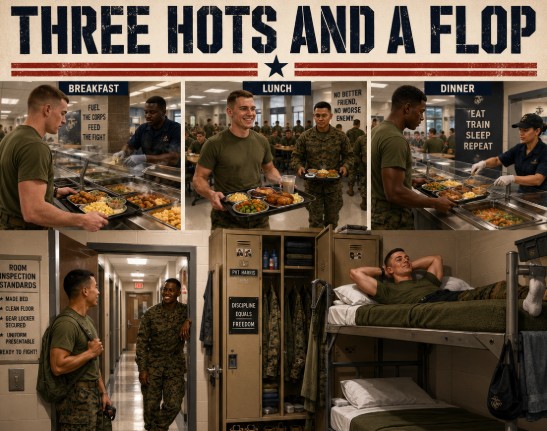
Sailors used to summarize the rest of the deal as three hots and a flop. Food you didn’t pay for, a bunk that’s dry, and a roof that belongs to the government that ordered you there. Everything else — the training, the GI Bill, the pension — sits on top of that. The foundation itself was never supposed to be in question.
It is in question now, and the party in breach is the one that wrote the contract.
This July the Navy published a request for information asking private industry to solve a shortage of somewhere between eight thousand and twelve thousand beds. The solicitation came out of Naval Facilities Engineering Systems Command Atlantic and named the installations: Great Lakes short about a thousand beds and surging toward fifteen hundred, Corry Station in Pensacola short six hundred, the Naval Air Technical Training Center at Pensacola short two thousand and surging toward twenty-five hundred. Meridian and Panama City fill out a training-center gap the Navy puts at 3,950 to 5,800 beds. The document invites vendors to propose modular units, containerized housing, trailers, recreational vehicles, turnkey workforce camps, leased apartments, extended-stay hotels, converted buildings, and houseboats. Navy Times + 2
Read the Pensacola line again. Along with the beds, the Navy asks about temporary shower solutions. Navy Times
The United States Navy is asking the open market whether anyone can supply bathing facilities for its own sailors.
At Joint Base San Antonio the Army is running the ground version of the same emergency. Roughly 5,200 enlisted medical students from the Army, Navy and Air Force are being moved out of their dormitories in phases, about two thousand of them since July 11. The buildings cost $140 million apiece, hold twelve hundred students each, and were finished in January 2014. A base spokesman attributed the failure not to age or wear but to systemic infrastructure problems rooted in how they were built. Demolition starts in September. Replacement is projected to run past $1.4 billion. Common DefenseYahoo!
Twelve years. A billion-dollar campus built to consolidate every service’s enlisted medical training, and it is coming down before the students who broke ground on it finish twenty.
The same failure, at sea
Ask the crew of the Gerald R. Ford what the deal is worth right now.
She came home to Norfolk in May after 326 days at sea, the longest deployment by an American aircraft carrier since Vietnam, running the Atlantic to the Caribbean to the Middle East. She left Virginia in June of 2025 and the deployment was extended twice. The old record was 294 days. NPR + 2
Admiral Daryl Caudle, the Chief of Naval Operations, said in January that he would push back on any order to extend her. She was extended. The uniformed head of the United States Navy objected in advance, in public, and was overruled by civilians who then spent the spring congratulating the crew. 19FortyFive
Here is what those extra months bought. A fire in the ship’s laundry burned for more than thirty hours and spread through the ventilation system into berthing. Around two hundred sailors were treated for smoke exposure. More than a hundred sleeping areas were destroyed. Sailors slept on the floor and on tables. Six hundred were displaced, and some lost everything they had brought aboard — which, on a warship, is a seabag. One spouse put it plainly: imagine losing your toothbrush and your underwear when that was most of what you had. Mail was taking two months to reach them. The vacuum plumbing failed over and over across the whole deployment. The sewage problems started before she ever left. NPR + 4
A first-in-class nuclear aircraft carrier, the most expensive warship ever built, and the enlisted men and women aboard her spent the better part of a year with unreliable toilets and no reliable mail.
Nobody can claim surprise
This is the part that should end careers.
The Government Accountability Office wrote nearly this exact report in June 2002, on recruit training barracks, and found inadequate heating and air conditioning, mold, and plumbing failures across all ten basic training locations. It identified the cause in the words of Army officials themselves: the migration of funding out of maintenance accounts to support other priorities. Inspectors also found that Parris Island barracks rated near the top of the condition scale were among the worst buildings they walked through. KFOX TV
GAO wrote it again in 2023 — sewage overflow, inoperable fire systems, barracks that fail the Defense Department’s own privacy and amenity requirements, and a department unable to say how much of its facilities money reaches barracks at all. Thirty-one recommendations. Servicemembers described brown tap water. Six of twelve discussion groups reported bedbugs, rodents, roaches. At three installations, servicemembers or their first sergeants raised thoughts of suicide. Just The NewsYahoo!
Of those thirty-one recommendations, nineteen are done. Twelve are still open. The Washington Post
Twenty-four years, two reports, the same findings, the same stated cause, and a dozen fixes still sitting on somebody’s desk.
The money exists
Nobody in this town gets to plead poverty.
The fiscal 2027 request is $1.5 trillion in total defense spending, an increase of $445 billion — forty-four percent — over the trillion enacted the year before. It is the largest single-year defense increase since Korea, larger in real terms than the Reagan buildup. Golden Dome alone draws $17.5 billion, nearly all of it routed through reconciliation. LexologyLexology
The department will tell you it is fixing this. The request carries $21.5 billion for barracks inside a $26.8 billion construction line, and in December the Navy directed $375 million from last year’s reconciliation bill toward barracks at fifty-six installations. That is a real number and I will not pretend otherwise. Common Defense
Now do the arithmetic. Three hundred seventy-five million dollars spread across fifty-six installations is about six point seven million dollars apiece. The repair bill at one campus in San Antonio is $1.4 billion. And the $21.5 billion arrives in fiscal 2027 — after the demolition order, after five thousand trainees were moved out, after the Navy went to industry asking about houseboats. Money appropriated to rebuild what was lost is not the same thing as money that would have kept it. Yahoo!
Meanwhile the people in those buildings are hungry. The Military Family Advisory Network’s survey, fielded last October through February, found food insecurity among currently serving families rose from about fifteen percent in 2023 to more than forty-one percent in 2025. Among junior enlisted families it runs near seventy-four percent. Almost sixty percent of active-duty families pay more out of pocket than their housing allowance covers. More than eight in ten junior enlisted families spend over half their household income on housing. Federal News NetworkStars and Stripes
And Congress had a fix in hand. The December defense authorization stripped the provision that would have let junior enlisted families actually qualify for the basic needs allowance, and rejected a pilot program to give them commissary coupons, on the grounds that the department already runs comprehensive food-security initiatives. Military.com
Then there was the shutdown. Forty-three days, the longest in history. Congress passed a law to keep troops paid in 2013. It passed one in 2019. In 2025 it passed nothing. The Pentagon instead accepted an anonymous $130 million private gift toward military payroll — money legal scholars said it had no lawful authority to spend, because covering a lapse in appropriations with donations runs straight into the Antideficiency Act. Federal News Network + 2
A private citizen was invited to make payroll for the armed forces of the United States. That happened. In this country. Last fall.
Who is running this
There is no mystery about how an institution arrives here. You put someone in charge who has never run anything this size, and then you find out what that costs.
Pete Hegseth left the Army National Guard as a major in 2021. He deployed three times — Guantánamo, Iraq, Afghanistan — and earned two Bronze Stars. In Iraq he was an infantry platoon leader. In Afghanistan he taught counterinsurgency. Between the uniform and the Pentagon he hosted a weekend cable show and ran two veterans nonprofits. Factually + 2
I want to be careful here, because the point is not that his service was small. A platoon in Iraq is not small to the men in it, and I have no interest in the sport of ranking other people’s deployments. Plenty of majors are better men than plenty of generals.
The point is arithmetic, and it is not close.
The Department of War employs something near three million people counting civilians. It owns hundreds of installations and a real-property portfolio in the trillions. Running it is a logistics and infrastructure job — a facilities job, a maintenance-account job, a job about whether the money that is supposed to fix a roof in Pensacola actually reaches the roof in Pensacola. The officers who spend thirty years learning that trade command battalions, then brigades, then run installations, then run commands, and by the time they are trusted with a service they have been personally accountable for the plumbing in somebody’s barracks a dozen times over.
The man now responsible for all of it topped out running an infantry platoon. He has never commanded a battalion. He has never been an installation commander. He has never owned a maintenance account, never defended a milcon line in front of a committee, never had to explain to a command sergeant major why building nine still smells like mildew in July.
So look at what got decided on his watch and ask which decisions look like a company-grade officer’s instincts scaled up past their limit. Demolition scheduled before replacement housing was under contract. Five thousand trainees moved with the beds sourced afterward. A carrier extended twice over the stated objection of the Chief of Naval Operations, because the theater looked good and the follow-on maintenance was somebody else’s fiscal year. A birthday parade for the Army’s 250th that ran somewhere between twenty-five and forty-five million dollars, defended by the Secretary himself — while sailors at Pensacola waited on a vendor to quote temporary showers. Ballotpedia
And in March of 2025 he was in a commercial messaging thread discussing operational details of strikes on Yemen, alongside the Vice President and the Secretary of State, with the editor of The Atlantic accidentally added to it. Any lieutenant who did that with a fire mission would have lost his clearance by Friday. Encyclopedia Britannica
You can call it a warrior ethos. On the deckplates it reads as a man who learned to lead thirty people and was handed three million.
But he did not appoint himself.
Where Congress went
The Senate confirmed him on January 24, 2025, by a vote of 51 to 50, with the Vice President summoned to break the tie. Three Republicans — Collins, Murkowski, McConnell — voted no with every Democrat. It was only the second time in modern history that a vice president had to come to the Capitol to break a tie on a Cabinet nomination. KQ2Factually
Four Republican votes would have sunk it. They got three.
That is the ballgame. Advice and consent is not a formality and it is not a courtesy extended to a president. It is the one moment in the whole system when the Senate stands between the armed forces and whoever the executive wants to put over them. Fifty senators looked at a major with a cable show and decided the Department of War was a reasonable place for on-the-job training. Every one of them wears a flag pin. Most of them have a Memorial Day speech in a drawer with the same three paragraphs in it.
And it did not stop at the confirmation.
The February attack on Iran was launched without congressional authorization; the White House notified the leadership shortly before and asked no one for permission. The Senate voted down a war powers resolution on Iran, 47 to 53. The House rejected its companion the next day. A Venezuela resolution failed in the Senate by a single vote in January. A House measure to rein in the boat strikes went down 210 to 216. Constitution Center + 2
Set aside whether you supported any of it. Congress was asked four times to say whether the country is at war, and four times it declined to answer — which is not the same as saying no, and is not the same as saying yes. It is a body voting to have no opinion about the wars it is funding, while the people fighting them sleep on tables.
So the same institution that could not spare four votes to reject an unqualified nominee, and could not muster a majority to say what its own wars are, found the time in December to strip a food allowance fix out of a defense bill and vote down grocery coupons for junior enlisted troops. Then it went home for the holidays. Then it came back and celebrated the Fourth of July.
Where are they? They are exactly where they have been. Available for the parade, available for the ribbon cutting, available for the photograph at the airport when the ship comes in. Unavailable for the vote.
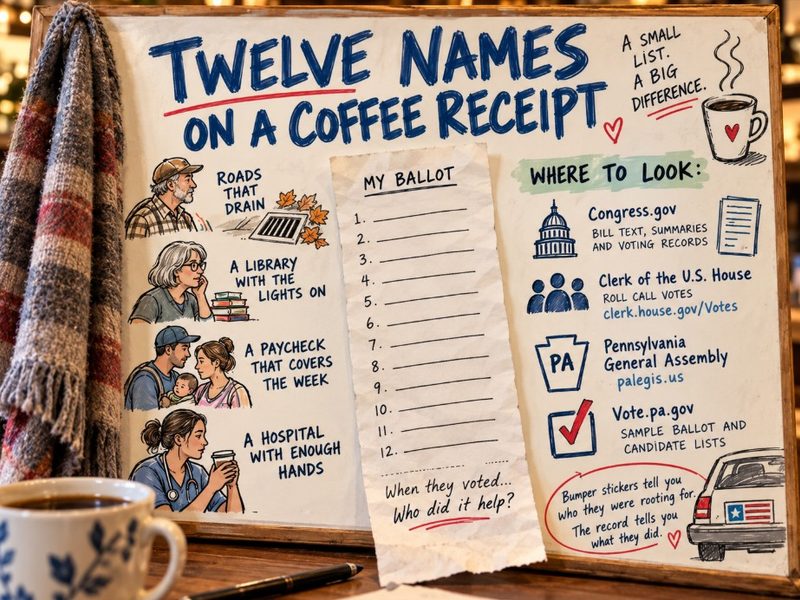
Support for the troops is not a sentiment. It is a line item and a roll call, and every one of them knows precisely where both are kept.
What the debt actually is
I am not asking for a monument. Neither is any nineteen-year-old at Great Lakes tonight.
Fund the barracks before you empty them, and put replacement housing under contract before demolition is scheduled, not after. Close out the twelve GAO recommendations that have been open since 2023 and publish the date each one clears. Stop counting a sailor’s subsistence allowance against him when the galley is the only place he can spend it. Pass a standing law that pays the military through any lapse in appropriations, so that no president of either party ever again takes a check from an anonymous donor to cover a private’s rent. And before the next deployment is extended over the objection of the Chief of Naval Operations, haul the person who signed that order in front of a committee and make him say out loud what the crew is going to eat, where they are going to sleep, and when their mail is going to arrive.
None of that requires a new appropriation. It requires senators and representatives who are willing to be as demanding on a Tuesday in committee as they are eloquent on the last Monday in May.
Three hots and a flop. It is the oldest promise this country makes to the people it sends into harm’s way, it is the cheapest one on the books, and it is written into the contract we make them sign before they are old enough to rent a car.
We are not keeping it. And the men and women whose actual job it is to make us keep it have decided they would rather give a speech.