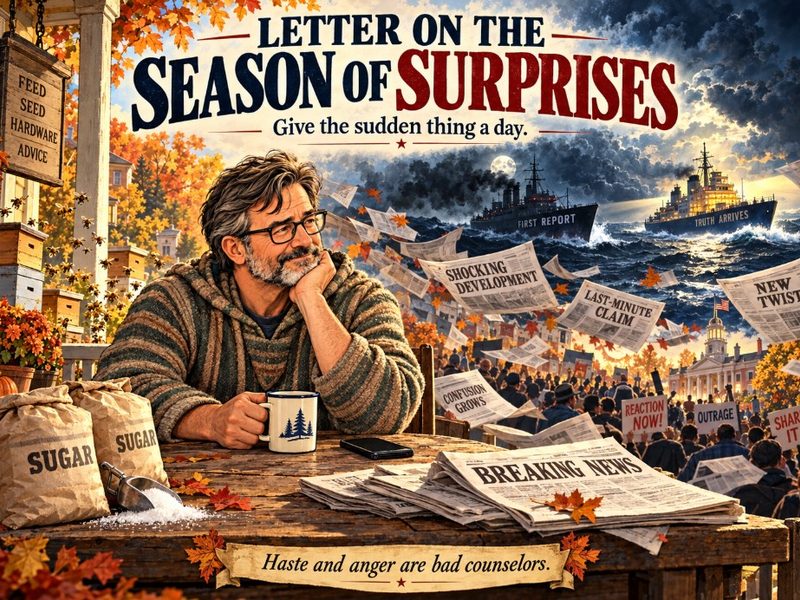
My grandmother saved seed. Not because she had a theory about agriculture, but because that’s what you did — you kept back the best of the beans, dried them on a screen in the pantry, and put them in the ground the following spring. What she planted was the accumulated judgment of everyone who had grown that bean before her, each of them keeping back the ones that did well and letting the rest go. Nobody owned it. It came down through hands.
I think about that when people ask why I’m optimistic about artificial intelligence, and why I’ve come to have doubts about how we handle intellectual property. The two questions turn out to be the same question, and the answer has less to do with technology than with how human beings have always gotten better at things.
Progress is a jagged line
If you chart the twelve thousand years since we started planting on purpose, the line goes up. People live longer. Tools work better. More of us can read. The trend is real and it is worth being grateful for.
But it is not a smooth climb. There are collapses in that line, and long flat stretches where nothing much moves. Libraries burn. Empires come apart. Whole bodies of understanding disappear and have to be found again by someone three hundred years later who has no idea the work was already done. Roman concrete outlasted the people who knew how to make it. We have spent a great deal of our history relearning what we already knew.
Not for lack of intelligence. For lack of access.
The reason the line goes up at all is that progress is iterative. Somebody makes a thing, somebody else looks at it and makes it a little better, and a third person finds a use for it nobody intended. Civilization is that process, repeated across generations, and nothing else. It is the seed on the pantry screen, scaled up to everything.
What secrecy costs
If iteration is the engine, then anything that keeps people from seeing each other’s work is friction.
Knowledge gets held back for reasons that are usually understandable at the time. Military advantage. Competition. Institutional pride. Somebody’s career. A company that spent real money on research would like to make that money back, and I don’t begrudge them the wish.
But the effect compounds regardless of the motive. When people can’t compare notes, they repeat work already finished. They walk into mistakes that someone else already learned to avoid. Fields go quiet for decades because the pieces that would have fit together were sitting in different buildings.
The cost of secrecy isn’t mainly that some people are excluded, though they are. The cost is time. Years of it. Lives that ended before the treatment arrived, harvests that failed because the technique hadn’t traveled yet.
The pace picks up
For most of history knowledge moved at the speed of a horse. A manuscript took decades to circulate. A discovery might wait two generations to be generally understood.
Then it got faster. The press multiplied books. The telegraph and the telephone collapsed distance. The internet made most of the written record theoretically available to anyone with a connection.
Artificial intelligence is the next turn of that same crank. These systems can read across the whole shelf at once — every discipline, every language, the papers nobody has cited in forty years — and notice where two things line up that no single person was positioned to see. That is a genuinely new capability, and I don’t think we’ve reckoned with what it means.
What it means, mostly, is that the archive finally has a reader adequate to its size.
Where the archive came from
Here is the part I’d ask people to sit with.
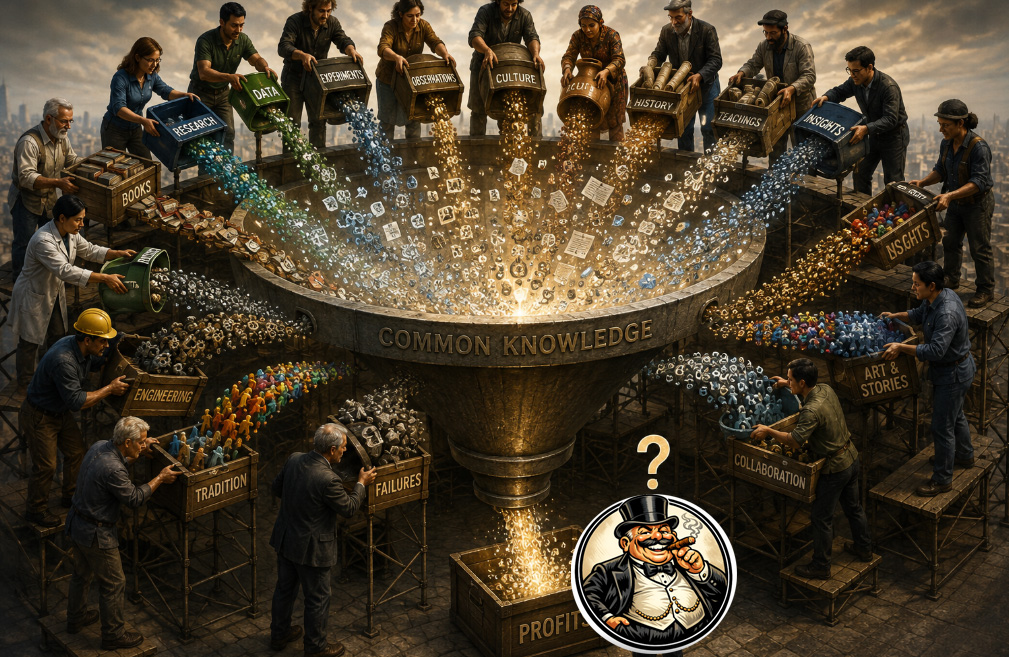
That archive is not anyone’s private property in any deep sense. It is the collected work of everybody who ever wrote something down. The papers, the manuals, the forum posts, the county extension bulletins, the recipes, the maintenance logs, the arguments in the letters column. Millions of people, most of them long dead, most of them never compensated for anything.
A model trained on that material is a distillation of the commons. It was made out of us.
Which raises a question I don’t think we get to skip: if the raw material belonged to everyone, what should be true of the result? The data that trains these systems, the models that come out the other end, the value they generate — the ownership question is going to be settled one way or another in the next decade, and it will be settled by whoever is paying attention. I’d like the answer to reflect where the material actually came from. Public input has some claim on public benefit. That seems like a plain thing to say, and I notice how rarely it gets said in the rooms where it would matter.
Rethinking the fence
The traditional case for intellectual property is honest enough. Creators need to eat. Exclusive rights give them a way to. In an era when producing and distributing knowledge took presses and warehouses and capital, protection was how you made sure the work could continue.
I don’t want to wave that away. I make things. I’d like to be paid for them.
But the ground has shifted under the argument. Copying costs nothing now. Analysis costs almost nothing. Under those conditions, strict control starts doing something other than what it was designed to do — it becomes a toll booth on a road that has no maintenance costs, and the traffic backs up behind it.
The question worth asking is simply whether restricting access still speeds innovation up. In a lot of areas I think the honest answer is that it has started to slow it down. Research behind paywalls that the taxpayers already funded. Techniques locked inside proprietary systems. Patents on seed.
What it could look like
Imagine the accumulated understanding of the species genuinely available. Scientific literature, engineering drawings, medical findings, four thousand years of agricultural trial and error — open, searchable, and readable by tools capable of holding all of it at once.
A researcher in one field could see immediately what a neighboring field figured out in 1974. An engineer could start from the existing design instead of the blank page. Medicine could integrate what’s known globally rather than in the fragments any one institution can afford.
The number of people able to build on any given idea would multiply. And that multiplication is the whole mechanism. That’s all progress has ever been.
We have most of the pieces already. Across science, engineering, medicine, and farming, the tools to address our largest problems exist in some form, somewhere. What keeps them from scaling isn’t a shortage of good ideas. It’s that the ideas are scattered across institutions that don’t talk, journals nobody can afford, and systems designed to keep them in.
Comparing notes
Libraries were built on a conviction. So were public universities and the extension service and the free schools. The conviction was that knowledge held in common makes everyone stronger, including the person who gave it away.
Artificial intelligence is a very large extension of that same conviction, and it will only be worth much if we treat it that way — as a public inheritance being read back to us, rather than a private asset assembled from unpaid material.
The next real advance probably won’t come from a lone genius or a single well-funded lab. It will come from the combined work of a great many people, most of whom never met, finally able to compare notes.
So why should a small percentage get to own everything derived from it?