Earlier I published The Long Work of Getting Better, which made a gentle case that human progress runs on shared knowledge and that we may be fencing it in at exactly the wrong moment. I ended on a question rather than an answer. This is the answer.
The case for it is not a moral appeal. It is a property argument, and it runs on premises that people who dislike me already accept.
Contribution creates claim
The foundational defense of private property in the English-speaking world is roughly Locke’s: you mix your labor with something and it becomes yours. The apple you picked is yours because you picked it. The field you cleared is yours because you cleared it. Nobody has to like Locke to be operating inside his framework — it is the water American property law swims in, and it is the reason “I built this” ends most arguments about who gets the proceeds.
Fine. Let’s apply it.
An artificial intelligence system is built from a corpus. The corpus is the written and recorded output of the human species: books, papers, manuals, letters, forum threads, product reviews, code repositories, transcripts, photographs, songs, arguments, recipes, complaints to the county. Every one of those was made by somebody who mixed their labor with something. That is the entire input. Without the corpus there is no model — the architecture alone produces nothing, the way a well-built rig produces nothing over an empty field.
So who mixed their labor with the corpus?
Everyone did. Not as a slogan. As a matter of fact.
My own line item
I was a radioman in the Navy from 1990 to 1994. Communications, which in that era meant equipment that would look like archaeology to anyone under thirty. I’m technically adept and always have been, though given a choice I’d rather do physical work — I currently clean buildings for a living, which is honest and leaves the mind free.
I’ve been online since around 1997. Message boards, mailing lists, blogs, comment sections, social platforms that came and went, photo hosts, forums about aquaponics and permaculture and old buildings and Fortean nonsense. Call it thirty years. Tens of thousands of hours of typed English, in context, in argument, in explanation. Thousands of images. Nature photography, pen-and-ink work, documentation of things I built.
Now — I make no claim that any of it was important. Most of it wasn’t. A great deal of it was a guy being wrong about something at eleven at night.
That doesn’t matter, and here’s why it doesn’t. A model doesn’t learn from importance. It learns from example. Every sentence I ever typed was a demonstration of how English works when a real person uses it for a real purpose. Thirty years of that, from me alone. From a few billion of us, that’s the whole thing — that is the resource. The forgettable material is not filler around the valuable material. The forgettable material is the substance.
I’m a creator by disposition. Observe and create. It’s most of what I do and nearly all of what I do for free. And I’ve been feeding the pile since Clinton’s first term without once being asked and without once being paid.
Multiply that by every person who has ever been online, and add every writer, engineer, teacher, and craftsman who ever committed anything to paper going back to cuneiform. That’s the field.
The extraction
Nobody serious disputes that building and running these systems is expensive and difficult. The engineering is real. The capital is real. The chips, the buildings, the power draw are real — I wrote about the physical side of it in The Data Center Dividend, which asked what a community gets back for the electricity, water, land, and tax abatements it hands over.
Nobody in Alaska thinks the oil companies should drill for free either.
What Alaskans figured out in 1976 is the distinction that matters here. The company owns the rig. The company does not own the field. The field belonged to the people of the state before anyone showed up with equipment, and so the extraction generates a royalty, and the royalty is paid out to every resident as a dividend. The Permanent Fund has survived fifty years in a state that would run a redistribution program out of town on a rail — because nobody there experiences the check as charity. It’s a payment on something they own.
That’s the whole structure, and it maps cleanly.
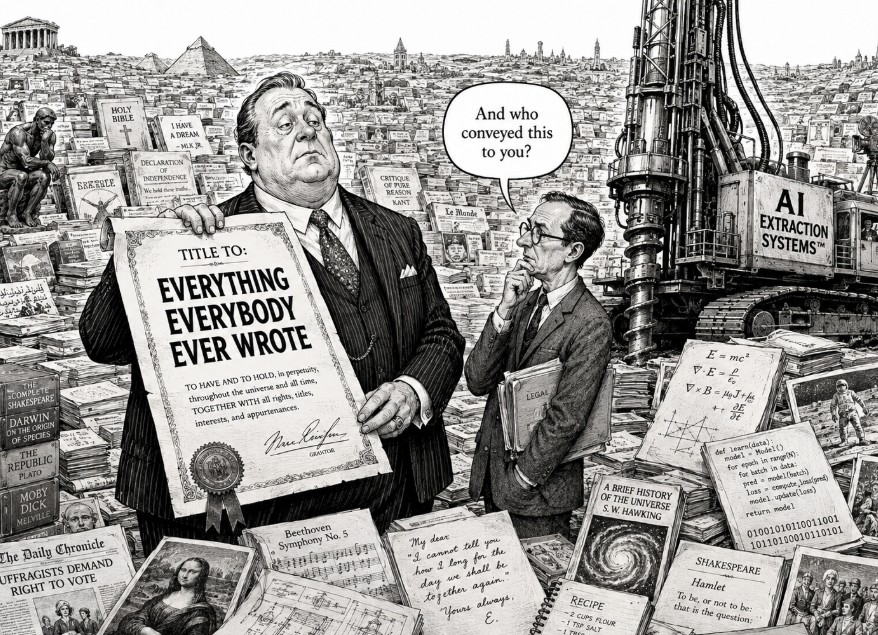
The corpus is the field. Training is the extraction. Every person alive who has typed a sentence into the internet, and every person dead who wrote anything down, holds an undivided interest in the resource. The firms that built the rigs are entitled to be paid for the rigs. They are not entitled to the field on the grounds that they were the first ones to figure out how to pump it.
And the corpus has one property that even oil doesn’t. Alaska’s oil could have been somewhere else. There is only one corpus. It cannot be sited in a friendlier jurisdiction, drilled from a different angle, or synthesized from scratch. It exists once, we all made it, and it is finished — everything added from here forward is increasingly made of itself.
What is actually owed
So call it what it is: a debt.
Not a grievance, not an inequity to be corrected out of someone else’s pocket. A debt, incurred in the ordinary course of business, for materials taken and used. Somewhere around two hundred people are in position to own the productive capacity built from the collective output of every human being who ever recorded a thought, and then to lease that capacity back to us by the month.
I want to be careful here, because I’m not describing theft and I don’t think the people involved set out to do anything wrong. Most of them believe they’re building something good, and some of them are. But a debt doesn’t require bad intent. It requires that value was taken and value is owed. The corner store doesn’t have to accuse you of anything to send an invoice.
The mechanism for paying it isn’t exotic. We have models. A sovereign wealth fund holding a public equity position in the systems trained on public material. A royalty on commercial deployment, pooled and paid out per capita. A national dividend, structured exactly as Alaska’s is, distributed to the co-owners of the input. Any of these can be argued about on the merits. What can’t be argued is that no payment is due, because the premise that would establish that — that the firms made the material as well as the machine — is false, and everybody knows it’s false.
The nationalist question
There’s a version of this argument I’d like to put directly to people who describe their politics in terms of putting this country’s citizens first.
If we’re going to have a government that talks that way, here is a national resource of unprecedented value, generated by the people of this country along with everyone else on earth, currently being enclosed by a small number of firms and licensed back to the people who made it. Foreign capital is in those firms too. The proceeds accrue to shareholders, most of whom are not you.
A government committed to protecting its people’s interests has something to explain here, and the explanation can’t be that the market sorted it out — the market never established title in the first place. It went to work on a commons and started charging admission at the gate. That’s not a free market outcome. It’s an enclosure, and enclosures have historically required a government to look the other way while they happen.
I’m asking whether the words mean anything. If they do, this is what they’d be for.
Balance, not seizure
I’ll close where the last piece closed, in the same register.
I’m not asking anyone to give up what they built. The engineering deserves its return. The capital deserves its return. Build the rigs, run them, get rich doing it — that’s the deal and I have no quarrel with it.
I’m asking that the people who supplied the raw material be treated as what they are, which is co-owners of an asset, entitled to a share of what it produces. Every internet user alive helped build this. Every creator in history helped build this. The claim is universal because the contribution was universal, and a system that recognizes contribution as the basis of ownership has to recognize it here too, or admit that the principle was only ever meant to protect the people who already had things.
The bill isn’t unreasonable. It’s just large, because so many of us worked on it.