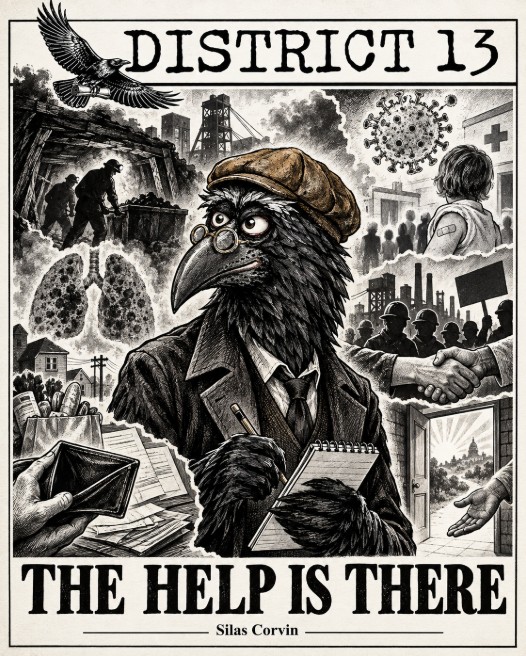
The Help Is There. A Lot of Us Aren’t Getting It.
Some weeks the news reads like four strangers at the same bar, each nursing his own bad luck. This week I pulled the stools together and found out they punch the same clock.
A coal-dust disease we thought we’d beaten is back to 1970s numbers. Measles, which my generation filed next to polio as something grandparents talked about, killed an 18-year-old in Mifflin County. Teachers in Hollidaysburg started the school year without a contract. Steelworkers in Pittsburgh are arguing over who pays when the kid needs the doctor. And under the whole pile sits a United Way number that explains why these stories land so hard around here.
The paycheck that doesn’t make it to Friday
In 2024, 39% of Pennsylvania households fell below what United Way calls the ALICE threshold. ALICE stands for Asset Limited, Income Constrained, Employed, and the E is the letter people skip. These are households with somebody working, sometimes two somebodies, whose money runs out before the bills do. Think of a bucket with a hole in it about the size of the rent.
Our corner of the state sits right on that average. In Blair County, 27% of households were ALICE in 2024, meaning they earned above the poverty line and still couldn’t cover basics. Cambria was 24%. Somerset was 26%. Add in the households below the poverty line and the three-county average comes to 39.4%.
Karen Struble, who runs United Way of the Southern Alleghenies, told WJAC that the cost of household essentials has climbed more than 70% over the past 17 years, while Pennsylvania’s minimum wage hasn’t moved since 2009.
So when somebody tells you the economy is fine because unemployment is low, remember the gas gauge and the oil light measure two different things. A person can have a job and still be running out of road.
Read it: https://wjactv.com/news/local/united-way-poverty-rates-remain-high-in-cambria-somerset-and-blair-counties
The full report: https://www.unitedforalice.org/introducing-ALICE/pennsylvania
Black lung came back
Federal researchers at NIOSH looked at chest X-rays from underground coal miners in Kentucky, Virginia and West Virginia who had put in at least 25 years. Over the past five years, 32.5% of them showed black lung. The last time miners with that kind of work history tested that high was 1978. When NIOSH last reported the rate, in 2018, it was 20.6%.
The reason is ugly and simple. The thick seams are mined out, so the machines cut through rock to reach the thin ones, and that rock is full of quartz. Silica dust scars a lung the way sand scars a windshield, only the lung doesn’t get replaced.
I’ll be straight with you about Pennsylvania. Those numbers come from central Appalachia, and the same research found much lower rates elsewhere. I’m not going to dress up a Kentucky statistic in a Cambria County coat. But this is coal country too, and black lung is patient. UPMC Altoona’s program points out the disease forms slowly and can start causing symptoms long after a man leaves the mine. We have a lot of retired miners in these hills.
And the benefits fight is its own disease. A GAO report in May found 40% of approved federal black lung claims were appealed, generally by the coal operators on the hook to pay. The Guardian this weekend profiled a miner who has spent 12 years in appeals with a diagnosis in hand. His question to the reporter: “That ought to be enough, or do you have to be dead?”
Read it (NPR): https://www.npr.org/2026/08/05/nx-s1-5894884/appalachia-black-lung-coal-miners-silica-dust
The Guardian, Sept. 21: https://www.pressreader.com/usa/the-guardian-usa/20260921/281685441754083
GAO report: https://www.gao.gov/products/gao-26-107612
Measles is in District 13
As of Sept. 18, Pennsylvania had confirmed 767 measles cases across 38 counties this year. We lead the country. Lancaster County has the most cases. Mifflin County is second, with 93.
On Sept. 15 the state confirmed that an unvaccinated 18-year-old from Mifflin County had died of acute disseminated encephalomyelitis, a rare brain and spinal-cord complication of measles. That was one of four measles-associated deaths in Pennsylvania this year. State officials also warned of a possible exposure at a Mifflin County Aldi earlier this month.
Mifflin is our district. An 18-year-old from here is dead of a disease with a two-shot fix.
I have no interest in turning a virus into a shouting match. I’m interested in keeping the people reading this out of the hospital. Two doses of MMR give about 97% protection for life. The Health Department has been running pop-up clinics in affected communities, and doctors, pharmacies and the state health centers have the vaccine. If you think you were exposed and you’re showing symptoms, call your doctor before you walk in, or call the state hotline at 877-PA-HEALTH (877-724-3258).
Read it (CBS Pittsburgh): https://www.cbsnews.com/pittsburgh/news/18-year-old-measles-related-death-mifflin-county-pennsylvania/
State measles dashboard: https://www.pa.gov/measles
Workers keep getting asked to pay for their own raise
Then I laid the labor stories side by side.
In Hollidaysburg, the teachers’ contract expired in August. At the Sept. 9 school board meeting, a standing-room crowd packed the high school library. Robert Burkey, a fifth-grade teacher with about 30 years in the district, said one of the major barriers was the district’s expectation that teachers take health-care concessions to help fund their own raises. He reminded the board the teachers once took a districtwide pay freeze to help the district through a tough stretch.
The board’s side, in fairness: President Carmen Bilek said the district has held 11 negotiating sessions and made four settlement offers. She said the last contract averaged 3.2% raises a year, the union opened by asking for 5.8%, which she put at $882,000 a year, and the board offered something above 3.2% that was rejected. She said the board has bargained in good faith.
Read it (Altoona Mirror): https://www.altoonamirror.com/news/local-news/2026/09/hollidaysburg-hasd-meeting-teachersunion-contract-negotiations-tensions-flare/
Down the road in Pittsburgh, the United Steelworkers are across the table from U.S. Steel, now owned by Nippon Steel. The company is offering a five-year deal with raises compounding to about 18.2% and a $4,000 signing bonus. The union says the same package shifts health costs onto workers through higher copays, coinsurance and out-of-pocket maximums, and would start charging premiums to people who pay none today. The company calls its approach a collaborative way to manage rising health costs.
Read it (Northwest Indiana Times): https://nwitimes.com/news/local/article_a2f2646c-3425-4221-b7e5-6ff4fd663ff5.html
The company’s side: https://negotiations2026.uss.com/
At the University of Pittsburgh, more than 6,000 staff, also Steelworkers, are still bargaining their first contract. When Pitt passed its budget, non-union staff got 2% raises. The union staff were left waiting, with the university saying pay is a mandatory subject of bargaining. The two sides go back to the table Sept. 22.
Read it (University Times): https://www.utimes.pitt.edu/news/pitt-s-328-billion-budget
You can argue the numbers in any one of those rooms. Management has a budget. So does the worker’s kitchen table. That’s why they bargain.
What caught my eye is the pattern. A raise on one hand, a bigger health bill on the other. Go back through the stories above and you can guess how that math feels to a household already in the ALICE column.
Before you decide you don’t qualify
Here’s the part I set out to write.
Spotlight PA reported today that Pennsylvania’s electric and gas companies are required to offer discounted bills to low-income customers. From 2014 to 2024, about 23% of eligible electric customers and 22% of eligible gas customers got that help in a given year. Fewer than one in four. This while bills climb and shutoffs hit record highs.
One detail from that story could save you a pile of paperwork. When you apply for LIHEAP heating help, you can agree to share your income information with your utility, so you don’t have to prove your income twice to get into their discount program. Check that box.
Read it (Spotlight PA): https://www.spotlightpa.org/news/2026/09/pennsylvania-automatic-enrollment-assistance-data-sharing-energy
So here’s my plain-English, not-an-expert rundown. These are rough numbers. Let the agency tell you no before you tell yourself no.
Utility Customer Assistance Program (CAP). Lowers your monthly electric or gas bill and can chip away at old debt. Generally for households up to about 150% of the poverty line: roughly $23,940 a year for one person, $32,460 for two, $40,980 for three, $49,500 for four. Call your utility and ask for the Customer Assistance Program by name. A payment plan is a different animal.
LIHEAP. Heating help, plus crisis grants when a shutoff is coming, the fuel tank is running dry, or the furnace quits. Same income range as CAP. Renters and homeowners both qualify, and you don’t have to be behind on your bill. The season opens in the fall, so mark the calendar now instead of waiting for January when the furnace and the checking account both go cold.
SNAP (food assistance). Pennsylvania’s gross income limit is 200% of poverty: about $2,610 a month for one person, $3,526 for two, $4,442 for three, $5,360 for four. Most households face no asset test, so owning a home and a car doesn’t knock you out. The limits reset Oct. 1, and there are new work rules for adults without dependents, so apply and let the caseworker do the math.
Medical Assistance (Medicaid). For most adults, roughly 138% of poverty: about $22,025 a year for one, $29,864 for two, $37,702 for three, $45,540 for four. Kids and pregnant women have higher limits. If your kids don’t qualify, look at CHIP, which covers uninsured Pennsylvanians under 19 for free or at low cost depending on income.
Child Care Works. Helps pay for child care while a parent works or trains. To get in, a household can earn up to about 200% of poverty: $43,280 for a family of two, $54,640 for three, $66,000 for four, $77,360 for five. Generally the parent needs 20 hours a week of work, or 10 hours of work plus 10 of school or training. For a family paying a second rent to a daycare, this one can change the month.
Federal Black Lung Benefits. For miners totally disabled by black lung from coal mine work, meaning dust has damaged your breathing enough that you can’t do your old mining job. Surviving spouses and dependents can qualify too. The Department of Labor pays for the testing when you file a claim. In 2026 the payments run from about $9,500 to $19,000 a year depending on dependents, plus medical coverage for the disease.
If you mined coal, get checked before you’re short of breath climbing the porch steps. Federally funded black lung clinics serve active, retired and disabled miners and their families regardless of ability to pay, with screening, treatment, pulmonary rehab and help with claims:
Lung Disease Foundation of Central PA, 800 Chestnut Ave., Altoona, (814) 800-2309
UPMC Altoona Black Lung Program (you can refer yourself): https://www.upmc.com/locations/hospitals/altoona/services/black-lung
Lungs at Work, McMurray, (724) 941-1650
Centerville Clinic, Fredericktown, (724) 632-6801
Two doors to start with
COMPASS lets you screen for and apply to SNAP, Medical Assistance, CHIP, Child Care Works and, in season, LIHEAP from one place: https://www.compass.state.pa.us
Or call or text 211. PA 211 connects you to local help and can walk you through what’s out there.
One more thing
I know how folks around here think, because I think the same way. We hear “public assistance” and figure it means somebody else.
Look at the numbers again. Close to four in ten households in Blair, Cambria and Somerset are below the line. They’re the aide at the nursing home, the guy running the register at Sheetz, the machinist, the bus driver, the cook. They’re your neighbors. Could be they’re you.
We raise working people to be embarrassed about needing help, then we build programs for exactly their situation and leave three out of four eligible utility customers unsigned. That’s like building a bridge and posting a guard who tells people they don’t look like the bridge type.
If you qualify, find out. Keep the lights on. Feed the kids. Get the shot. Get the lungs checked. Get the child care covered.
The Raven can go back to complaining about Washington next week. This week I’d rather make sure somebody in District 13 knows where the door is.
— Silas Corvin