When I was small, my dad was a mechanic. Around the time I hit third or fourth grade, he started driving trucks, first for a moving company and then line haul. He didn’t work union shops. He stayed off true over-the-road work after one too many weeks stuck in California waiting on a load back east. I’ve spent a good share of my own working life around shipping in one form or another, which is hard to avoid when freight is the bloodstream of the economy. So when I talk about truckers, I’m talking about the people I grew up around.
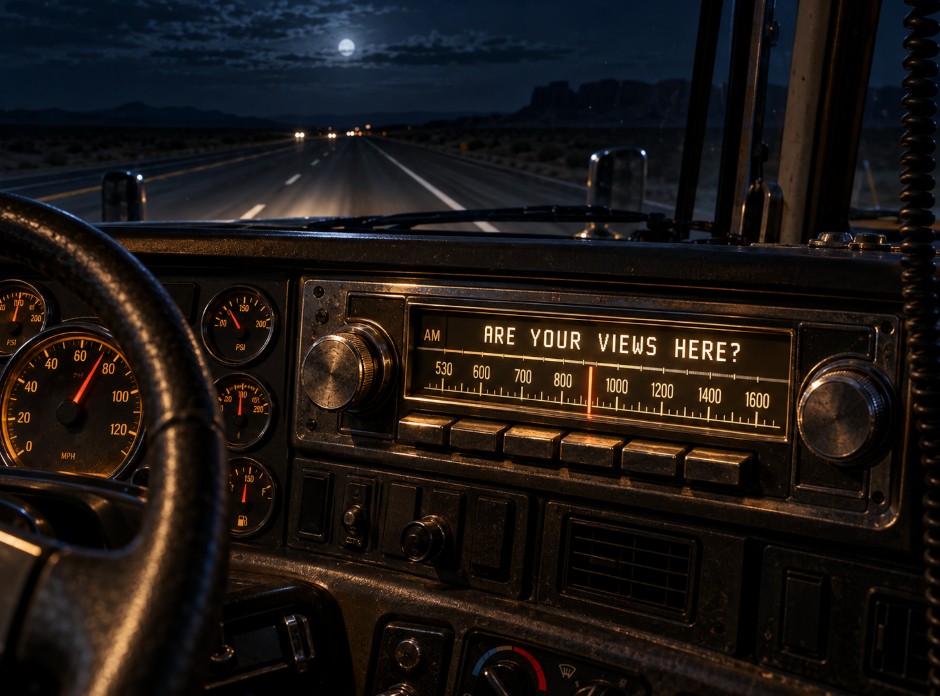
If you drive for a living, you know the fight with a fading signal. You come down out of the hills and the FM station you liked turns to static somewhere past the county line. AM holds on. It carries at night, it reaches the dead spots, it keeps you company across the long empty stretches. The trade-off is that AM is mostly talk, and talk on the AM dial leans hard right. Rush Limbaugh built three hours a day of one man talking straight into your ear back in the 1980s, years before anybody said the word podcast. A truck cab is a good place for that kind of program to take root. You’re alone, you’re tired, and the voice on the radio is the only one talking back.
I watched it work on my dad and his friends.
We were poor. Poor enough that I wore work boots and sweat pants to junior high in 1983, which earned me more than one fight in the hallway. When my dad talked about why he couldn’t get ahead, he had an answer ready: unions. Their work rules, their dues, their bosses. He didn’t get that from his own father. My grandfather was a union tradesman in a big shop, and he made a good living at it. My dad got it from the radio.
Here’s what the radio left out. In 1980, Congress passed the Motor Carrier Act and deregulated trucking. Over the following decade, union coverage in long-haul freight came apart, low-cost carriers flooded in, and driver pay slid. My dad started driving right into the middle of that. The men on the radio told him the union was holding him back during the same years the union was being run off the road and his paycheck was shrinking with it. That’s like blaming the fire department for the smoke.
The radio had its own turning point. In 1987 the FCC dropped the Fairness Doctrine, which had required broadcasters to give airtime to opposing views. A year later Limbaugh went national. From then on the AM dial could run one side of the argument around the clock, and it did. That format and the hosts who came after him have been on the air without a break for close to forty years.
The other side didn’t answer, and the reason is simple. The people who know how to talk to working people don’t have broadcast money, and the people with broadcast money don’t care to talk to working people. The party runs on money before it runs on ideals. Air America took a swing in 2004 with celebrity hosts and a party message pitched at big-city listeners. It had money for a while, but it spoke the party’s language instead of the language of the shop floor and the truck stop, and it folded in 2010. Drivers kept listening to the stations that sounded like they were on their side.
So a lot of drivers came to see themselves as part of the owners’ team: the shippers, the carriers, the brokers. They lined up against the workers whose labor makes the whole business possible. A trucker who sides with the freight owners over other drivers is a bit like a deckhand cheering the captain for cutting the crew’s rations.
Then the bill came due. Tariffs slowed the freight coming through the ports and drove up the price of parts, tires, and equipment. Wars overseas pushed diesel higher. Cancelled green energy contracts took cheaper power off the table and left the country leaning harder on oil. Each of those lands in the cab as higher fuel, fewer loads, and thinner rates. The administration talk radio cheered for turned out to care about drivers about as much as the owners do.
Drivers noticed. They’re talking about banding together, forming something that lets them stand as one instead of bidding against each other load by load. Some are already doing it. Drivers at 10 Roads Express, a big Postal Service contractor, have been voting to join the Teamsters this year, and they’re part of a wider push to organize in trucking.
I think that’s a great idea. And I think it needs a second half. If the AM dial is where working drivers got talked out of standing together, the AM dial is where they can be talked back into it. Somebody needs to put worker-friendly programming on the air, in the dead spots and the long night stretches, in a voice that sounds like it has changed a tire on the shoulder. AM radio got written off years ago by people who don’t drive for a living. Anybody who has crossed Nebraska at two in the morning knows better.