The first shop I worked in after the Army had an old millwright the whole floor called Deacon. He was seventy if he was a day, with a bad knee, good hands, and a way of setting his coffee cup down that told you the conversation was over.
One morning the young fellows were griping about a contract vote. Deacon let them run down like a wind-up toy. Then he said, “Boys, I jumped into France with a rifle and came home to a pay cut. Took me about a week to figure out which one made me madder.”
Somebody laughed. Deacon didn’t.
I was fresh off the drill field back then and still carried my shoulders like a coat hanger. I asked him what he meant, and he told me about 1945. I’ve been reading about that year since, and I’ve come to believe he undersold it.
So pull up a bucket.
There Was a War to Win
From Pearl Harbor to V-J Day, organized labor made the country a promise: no strikes. The national unions signed a no-strike pledge and, by and large, they kept it. When a local walked off in a fit of temper, the international leadership was usually first on the phone telling them to get back inside. Germany and Japan came first.
Wages were frozen too. The War Labor Board sat on raises the way a sergeant sits on a footlocker lid. Workers got hours instead. A good share of industrial men and women worked a 48-hour week with overtime past forty, and the Labor Department figured that came out to about 52 hours of straight-time pay. That overtime kept families even with prices that kept climbing.
Meanwhile the plants turned into arsenals. A machinist who’d spent the thirties stamping fenders spent the forties building aircraft engines. Women who had been told for years they had no business near a lathe were suddenly running one, because the bombers needed engines and the men were overseas. Miners knew that without coal the mills went cold. Railroaders knew freight sat still without them. Dockworkers knew ships don’t unload themselves.
The man I was named for had already shown the country what organized pressure could do. In 1941, A. Philip Randolph told Franklin Roosevelt he would bring a hundred thousand Black workers to march on Washington unless defense jobs were opened to them. Roosevelt signed Executive Order 8802 rather than find out whether Randolph meant it. My father told me that story so many times I could recite it before I could ride a bike.
Labor held the line for four years. Then the line moved.
Two Armies Come Home
I spent a good piece of my life turning young people into soldiers, so I can tell you what the Army teaches.
You learn that you don’t make it alone. For the length of an operation, the man on your left and the man on your right are your whole world, and you owe them your best effort whether you like them or not. You learn organization and logistics, and you learn that a plan is only as good as the people carrying it out. You learn that a private takes charge when the sergeant goes down, because somebody has to.
That last lesson sticks. Once you’ve watched authority get handed to whoever is left standing, you understand that it doesn’t come down from heaven. People make it.
Sixteen million Americans put on a uniform in that war. Millions of them came out of mines, mills, garages and farms. They crossed oceans, slept in mud and buried friends. Then the country brought them back to the same factory gates they’d left, where a fellow in a clean shirt was waiting to tell them what their labor was worth.
That’s a lot to ask of a man who just finished the biggest group project in history.
A second army was waiting at home, and it had learned the same lesson without the uniform: ordinary people working together can do what no one person can. For four years the country had been proving what unions had been preaching for generations. Then victory came, and those people were supposed to forget it.
They didn’t.
Veterans did show up on picket lines, some of them still in uniform. What lit the fuse, though, was money. Four years of frozen wages, prices on the rise, and the minute a war plant converted back, that 48-hour week dropped to forty. The hourly rate stayed the same and the check got a lot smaller. A man could come home a hero on Friday and learn on Monday that his family was taking a cut.
That was Deacon.
The War Ended
Japan surrendered on August 14, 1945. By the end of the year the Labor Department had counted 4,750 work stoppages involving about 3.47 million workers and 38 million worker-days of idleness, the biggest numbers since 1919. About three-quarters of that idleness came after V-J Day. Before the surrender, stoppages ran short and local, often wildcats the union never authorized. After it, they got bigger and longer and went straight at wages, prices and profits.
The Bureau of Labor Statistics found 42 strikes that year with ten thousand or more workers apiece. Here are some of them.
Coal didn’t wait for the surrender. In April, about 100,000 bituminous miners in thirteen states stopped work over portal-to-portal pay: the idea that a miner’s day starts at the mine entrance, so the long trip down to the coal face counts as work. In May, 63,000 Pennsylvania anthracite miners went out. That fall, a dispute over supervisors’ representation eventually idled about 209,000 men across eight states.
Electrical. On September 10, about 40,000 salaried Westinghouse employees in six states walked out for nineteen days over a bonus the War Labor Board had turned down.
Oil. On September 17, about 43,000 refinery workers in twenty states struck for higher wages. By October, roughly fifty refineries were shut down, about a third of the nation’s refining capacity. On October 4, President Truman ordered the Navy to seize the refineries of twenty-six companies. The war had been over for fifty-one days.
Lumber. On September 24, about 44,000 lumber and sawmill workers struck across five western states.
The docks. On October 1, about 30,000 longshoremen shut down New York Harbor over wages and the weight of a sling load.
Hollywood. On October 5, after months of a strike by the Conference of Studio Unions and a bitter fight with IATSE over who represented whom, strikers and replacement workers collided at the Warner Bros. gate in Burbank. They still call it Hollywood Black Friday. The painters, carpenters and set crews who built the country’s daydreams wanted their share too.
Machinists. On October 29, about 37,000 machinists and shipyard workers walked out around San Francisco Bay.
That fall also brought Akron rubber workers at Goodyear, Goodrich and Firestone, glassworkers at Pittsburgh Plate Glass and Libbey-Owens-Ford, 18,000 New England textile workers, 25,000 leather workers in fifteen states, and 14,000 Illinois Bell telephone workers.
General Motors came on November 21. The UAW struck GM in eleven states, with about 200,000 workers out by the government’s first count and closer to 225,000 as it went on. Walter Reuther’s union asked for a big raise and told GM to open its books, because the union said the company could pay it without raising the price of a car. That strike ran into the spring.
GM had my respect for one thing. It built a great deal of the arsenal. So did the men on that line. I tell management, “You want efficiency? Start with respect.” I tell labor, “You want a fair day’s pay? Give a fair day’s work.” By 1945 those workers had given four years of fair days and then some. They figured the second half of that bargain was coming due.
Bring Them Home
Then came the one I think about most.
On December 3, 1945, about 13,000 maritime workers in Atlantic, Pacific and Gulf ports put down their tools for one day. Wages weren’t the issue. They walked off to protest how slowly the government was bringing American troops home from overseas.
Think about that. Working men stopped the ships for a day because they wanted other working men back off the ships and in their own kitchens. That was the two armies shaking hands.
Labor Presented the Bill
So here is 1945 in four lines:
There was a war to win.
Labor held the line.
The war ended.
Labor presented the bill.
And when New Year’s Eve came, nothing was settled yet. The country had just cleared its throat.
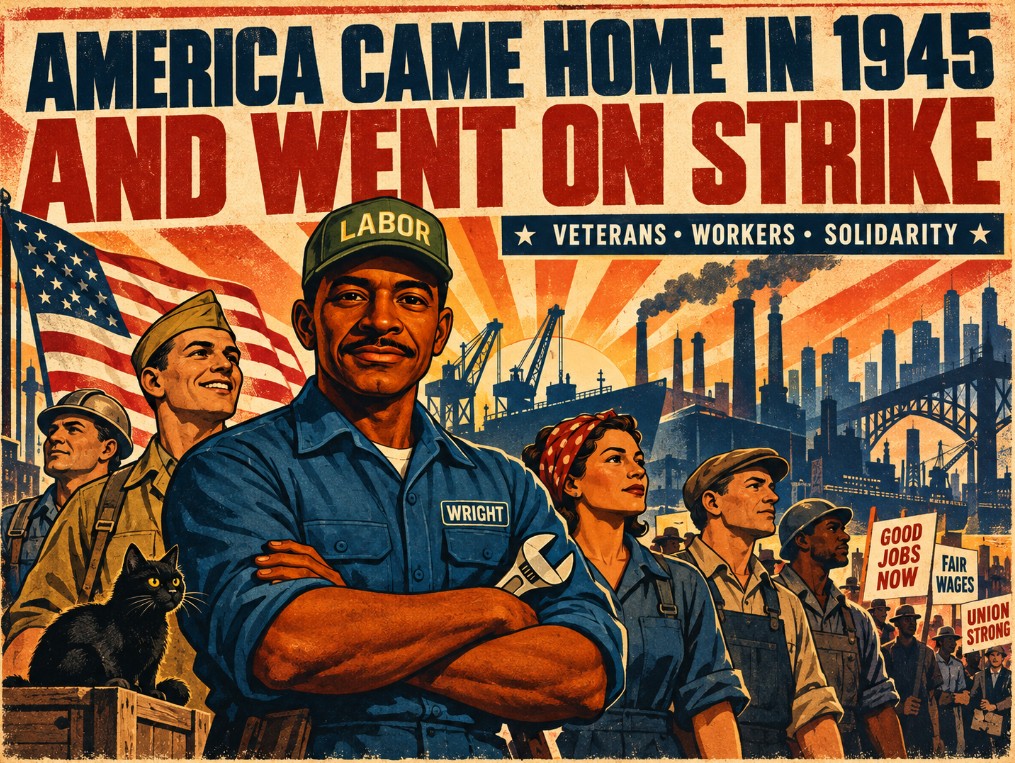
In January 1946, three-quarters of a million steelworkers went out. Then the electrical workers, the meatpackers, the coal miners and the railroads. Over five million Americans took part in strikes in the year after V-J Day.
The men had come home. The women who kept the plants running for four years were still there. And for four years the country had told them democracy was worth fighting for.
They took that at its word. They decided democracy covered the union meeting, the bargaining table and, when it had to, the picket line.
Deacon walked one in ’46. He told me it was the second-proudest march of his life, and he wouldn’t say what the first one was. I didn’t push. A man who’d been where he’d been gets to keep a few things.
Respect is the first safety rule. Those workers in 1945 had given the country plenty of it. They asked for some back.
Now you know, Jack.