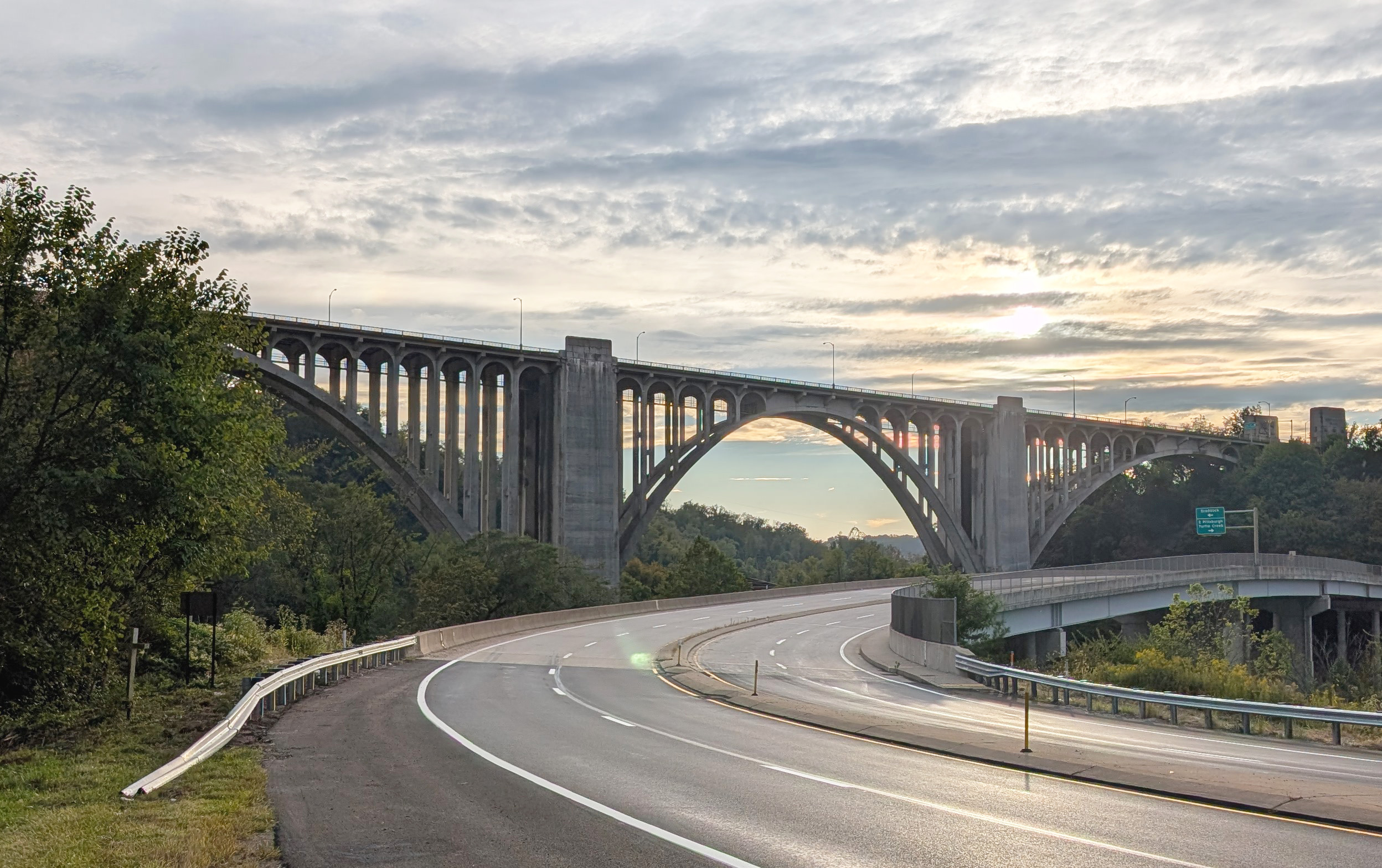
Come around the bend on the ramp below East Pittsburgh at sunrise and the George Westinghouse Bridge fills the windshield like a stage set. Five concrete arches step across the Turtle Creek valley, the big one in the middle framing a slice of sky and the hills beyond. Down at road level, a modern steel flyover curves off toward Braddock on hammerhead piers, doing its job with all the poetry of a filing cabinet. Above it, a structure from 1932 shows how a road over a valley used to get built when somebody cared what it looked like from underneath.
Allegheny County put it up between 1929 and 1932 to carry the Lincoln Highway, US 30, over the mouth of the valley. Before that, the highway dropped down the valley wall into the town of Turtle Creek, ran past the Westinghouse Electric works and climbed back out the other side. Picture a Model A grinding up that grade behind a coal truck and you understand why the county spent $1.75 million to go over the top instead.
The engineers were George S. Richardson and Vernon Covell. Richardson spent about half a century designing bridges for the county, and architectural historians call this one his masterpiece. The center arch spans 460 feet and rises 153.5 feet. When it opened, it was billed as the longest concrete arch in America, and for a stretch it held the world title for its type. The deck sits a couple hundred feet above the railroad tracks in the valley floor.
Here’s what makes the shape more than decoration. Concrete is a weightlifter with bad knees. Stack load on it and it holds all day; try to bend or stretch it and it cracks like a stale cracker. An arch is the shape that turns the weight of the road into pure squeeze, pressing down and outward along the curve into the footings. Richardson’s arches are parabolic, which means the curve follows the path the load wants to take anyway. The beauty in that line comes straight out of the math.
Then look at the space between the arch and the road. Older stone bridges filled that wedge solid, the spandrel, which adds tons of dead weight the arch has to carry for no reason except habit. This bridge leaves it open. Slender columns stand on the arch ribs and hold up the deck, and the tops of those columns are joined by little arches of their own, a row of small curves riding a big one. From the ramp below they look like a colonnade on a Roman aqueduct. They also cut the load on the main ribs, which let the main ribs reach farther.
Where the arches meet, the piers rise as tall rectangular towers that punch up past the deck line. They give the eye a resting place between spans, the way a fence post gives rhythm to a split-rail fence. Up at the ends of the bridge, four entrance pylons carry Art Deco granite reliefs by Frank Vittor, each panel ten feet by eighteen, carved between 1934 and 1936 after the bridge itself was done. The scenes tell the valley’s story: General Braddock’s defeat in 1755, the steel industry, electricity and the man the bridge is named for. Architect Stanley Roush designed the pylons.
The setting earns the art. Andrew Carnegie’s Edgar Thomson Works sits just west of the bridge, on the ground where Braddock’s army was routed. George Westinghouse’s electric works spreads up the valley to the east, right below the span. Stand on that deck and you can see two of the engines that built Pittsburgh from one spot. At the dedication on September 10, 1932, Herman Westinghouse, the inventor’s brother, cut the ribbon a little before four in the afternoon, and the factory whistles down in the valley answered.
The bridge has been worked on since. An $11.3 million renovation in 1982 and 1983 widened the roadway and added Jersey barriers, and the concrete wears the streaks and weather stains of ninety-odd Pennsylvania winters. The bones look sound. There’s even a catwalk running the length of the underside, which local bridge enthusiasts mention with a wink and a warning.
That steel flyover in the foreground will carry its share of traffic for a few decades and then get replaced by another one like it, and few drivers will notice the swap. The Westinghouse Bridge was built in the depths of the Depression by a county that could have thrown a plain beam bridge across the gap and called it a day. They hired a sculptor instead. They let the engineering show its work, and the work turned out to be beautiful.
Sources:
- Wikipedia, George Westinghouse Bridge
- pghbridges.com, George Westinghouse Memorial Bridge and field notes
- Historic American Engineering Record PA-446 (via pghbridges.com)
- Historic Pittsburgh, George Westinghouse Memorial Bridge photo record
- SAH Archipedia, Westinghouse Memorial Bridge
- Pittsburgh Post-Gazette, The Digs: “The George Westinghouse Bridge, Pittsburgh’s engineering marvel”