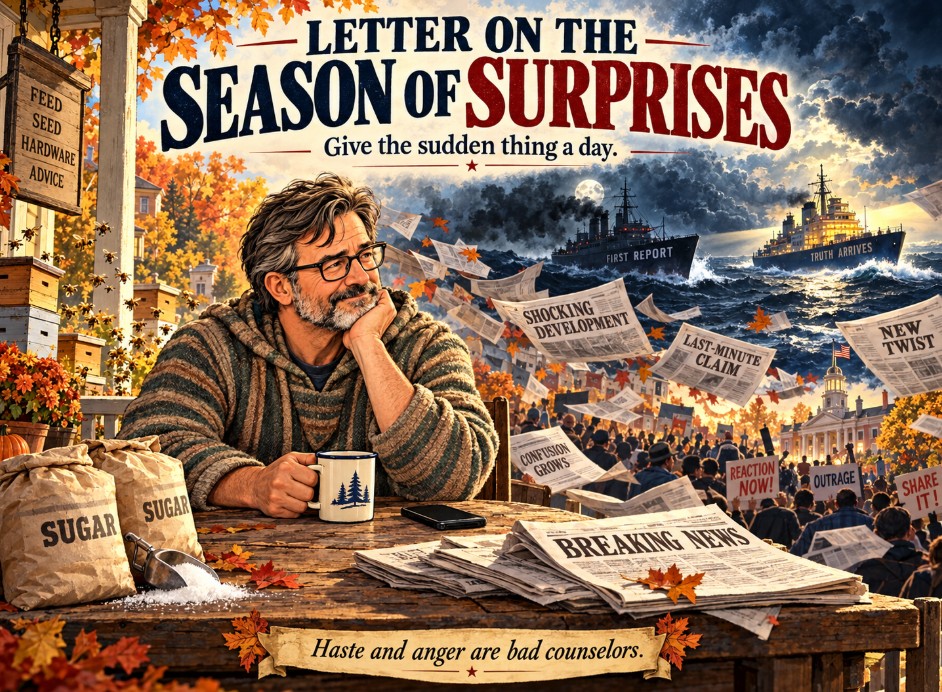
Dale at the feed store rang up two sacks of sugar this morning and asked whether the bees were done for the year. Close to it, I told him. On these first cold mornings they cluster tight in the box and wait for the sun to climb high enough to make flying worth the fuel. A keeper who pries the lid off at forty degrees because he’s curious will learn what he wanted to know and lose a frame of brood paying for it. Dale nodded like a man who has heard that lesson in other forms.
While he was making change, both our phones gave the small shiver they give when somebody somewhere has decided we need to feel something right now. Dale looked at his. Mine stayed in my hoodie pocket. I’d like to call that discipline; mostly my hands were full of sugar.
“Here we go,” Dale said, and laid his phone face down on the counter. He didn’t say what it was, and I didn’t ask. It’s October in an election year. October surprises come in season the way woolly bears cross the road: you can’t say which one or where, but a man who expects none hasn’t been watching the road.
Driving home with the sacks sliding around the truck bed, I kept turning over the question under Dale’s three words. A sudden announcement, a fresh grief or a well-timed anger can move a nation further in an afternoon than ten years of argument, while the facts trot along behind like a dog that missed the truck. So why do we keep handing the wheel to the fastest thing in the room?
The phrase is only a few years younger than I am. William Casey is usually credited with it. In 1980 he was running Ronald Reagan’s campaign and fretting that the Carter White House might get the hostages out of Iran on the eve of the vote. The thing it names is much older. In 1844 an abolitionist paper printed a passage from the travel memoir of one Baron Roorback, who described a coffle of slaves branded with James K. Polk’s initials. There was no Baron Roorback. Someone had lifted a passage from another man’s book and sewn a forgery into the seam. For a generation afterward, a “roorback” meant a lie timed to land before the truth could get its boots on. In 1880 a forged letter had James Garfield warming to Chinese immigration, a poison measured out for Western voters. In 1884 a Presbyterian minister stood near James Blaine and called the Democrats the party of “Rum, Romanism, and Rebellion.” Blaine let it pass, and New York’s Irish Catholics remembered it in the voting booth.
Grammina made me read Thucydides in Greek the summer I turned fourteen, which I resented until about forty. The passage she cared about was a small one. In 427 BC the city of Mytilene revolted against Athens and was put down. The Athenian assembly, still hot about it, voted to kill the men of the city and sell the women and children, and sent a trireme off that same day to carry the order. Overnight, Thucydides says, the Athenians began to think the decree cruel and out of proportion. They met again. Cleon argued that changing course was weakness. A man named Diodotus answered him, and his line is the one Grammina underlined in pencil: haste and anger are the two great enemies of good counsel.
The vote flipped, narrowly. A second ship went out a full day behind the first. The Mytilenean envoys promised the rowers a fortune if they won the race, so the crew ate barley soaked in wine and oil at the oars and slept in shifts. The first ship, Thucydides notes, had sailed without hurry, since none of its crew relished the errand. The second came in just after the Athenian general had read the decree and was making ready to carry it out. It arrived in time to stop him.
Grammina’s version, delivered over a sink full of dishes: “Hurry and mad are the two worst counselors, Nate, and they like to carpool.”
Since then I’ve noticed how often history sends the first ship and no second.
Consider the King of Prussia, taking the waters at Bad Ems in July 1870. He had a polite, firm conversation with the French ambassador and telegraphed Bismarck an account of it. Bismarck was at dinner with Moltke and Roon, both of them gloomy at the prospect of peace. He took a pencil to the telegram and trimmed it until a courteous refusal read like a door shut in the ambassador’s face, then gave it to the press. He expected it to work on France like a red rag on a bull. It did. France declared war within the week, and six months later the German Empire was proclaimed in the Hall of Mirrors at Versailles. A few deleted clauses set grievances that outlived everyone at that dinner. What happened at Ems was mild. What the newspapers said happened at Ems was hot, and the newspapers carried the day.
Consider the battleship Maine, which blew up in Havana harbor in February 1898 and took 260 American sailors with her. The papers had convicted Spain before the divers got wet. “Remember the Maine, to hell with Spain” sold a great deal of newsprint, a naval court of inquiry blamed a mine, and war came that spring. In 1976 Admiral Hyman Rickover, a man with little patience for sentiment, had the evidence reexamined. His team concluded the likelier cause was a fire in a coal bunker beside a magazine. The Navy’s own historians still say we may not know for certain. We fought a war over a question we haven’t finished answering.
Consider Sarajevo, June 1914. The archduke had already survived one bomb that morning. His hosts changed the route, and the driver didn’t get word. He turned where the old plan said to turn, someone shouted that he’d gone wrong, he braked to back up, and the car stalled a few steps from a nineteen-year-old named Gavrilo Princip, who by several accounts had given up for the day. A wrong turn and a balky gearbox. Then came July: a month of telegrams, ultimatums and railway timetables, in which men with weeks to think let the momentum of the moment do their thinking for them.
Consider the Gulf of Tonkin, August 1964: a stormy night, jumpy sonar operators, radar ghosts, and destroyers reporting a second torpedo-boat attack. The commander on the scene cabled his doubts within hours. Three days later Congress passed the Tonkin Gulf Resolution, 416 to 0 in the House and 88 to 2 in the Senate. In 2005 the National Security Agency released its own historian’s study concluding the second attack almost certainly didn’t happen. Fifty-eight thousand American names on a black granite wall, and a far longer list of Vietnamese dead that no wall holds, rode on those three days.
Consider October 26, 1972, twelve days before an election Richard Nixon was already winning, when Henry Kissinger told reporters that “peace is at hand.” The accords came in January. Saigon fell two years later. The phrase outlived the peace by a good margin.
To be fair to the accidents, some of them break toward the light. On November 9, 1989, an East German Politburo spokesman named Günter Schabowski was handed a note about relaxed travel rules shortly before a televised press conference. Nobody told him when the rules took effect. A reporter asked. Schabowski shuffled his papers and said that, as far as he knew, it was immediately, without delay. By late evening East Berliners were packed against the checkpoints, the guards had no orders, and at Bornholmer Strasse the officer in charge decided the gate wasn’t worth a massacre. The Wall came down on a misread memo. I’ll take that accident gladly. I’d still rather a people choose their freedom than stumble into it, because a stumble can go the other way.
And sometimes one man rows the second ship alone. On October 27, 1962, at the worst hour of the Cuban Missile Crisis, American destroyers were dropping practice depth charges on the Soviet submarine B-59 to force her to the surface. She was out of contact with Moscow, the air was foul and the heat brutal. By the account of a man aboard, her captain concluded the war might have started and wanted to fire a nuclear torpedo. Launch required the agreement of the senior officers aboard. Vasili Arkhipov said no, talked the captain down, and the boat surfaced. The surprise arrived on schedule, and one man declined to be surprised by it.
Jefferson argued with himself about this in public for twenty years, which is one of the things I like about him. In 1787 he wrote that if he had to choose between a government without newspapers and newspapers without a government, he would “not hesitate a moment to prefer the latter.” Twenty years later, after a presidency’s worth of being lied about in print, he told a young correspondent that “the man who never looks into a newspaper is better informed than he who reads them.” Both letters are true, and the distance between them is the distance between a press that informs citizens and one that only stirs them. Tocqueville, touring the country in the 1830s, saw the stirring side and admired its power: “Nothing but a newspaper can drop the same thought into a thousand minds at the same moment.” He meant it as praise for how Americans organized. He couldn’t have pictured the same thought landing in a hundred million minds before breakfast.
Here’s where I put on my market hat. A surprise is a product, and our information market prices it well. The yield goes to whoever lands first. The first ship’s crew gets paid by the click. The second ship’s crew rows a day late, for free, to a harbor where the crowd has already gone home. Correction is a public good, and public goods go underfunded in a market that pays only for attention. No cabal designed it that way. It grew the way a pasture goes to thistle when the only thing anybody pays for is speed of growth.
The midterms are a month off, and early ballots are already in the mail in a good many states. Whatever lands between now and then, whether a leaked memo, an indictment, a video, a crisis overseas or a rumor in a convincing font, will come with a clock attached. An October surprise is built to arrive after there’s time to feel it and before there’s time to check it. In Polk’s day a roorback needed a printing press and a week of stagecoaches. Ours travel faster than any Athenian trireme, and the first ship leaves the moment the screen lights up.
Madison saw this coming in his own vocabulary. In Federalist 63 he defended the Senate as a guard for the people “against their own temporary errors and delusions,” a body meant to hold the line until “reason, justice, and truth can regain their authority over the public mind.” The framework of a republic, with its staggered terms, its two chambers and its courts that move like glaciers, is a second ship built in the harbor ahead of time. The framers trusted the people. They also knew the people, which meant knowing themselves.
I’ve been aboard the first ship. There was a morning in my twenties when I was certain about a war before the dust had settled, and I said so at Grammina’s table with the confidence of a man who had read one newspaper. She listened, buttered her roll, and asked what I’d think in a month. I didn’t care for the question then. I’ve grown fond of it.
I won’t guess which party sends the first ship this fall. The record above has names from both parties on it, as targets and as senders, and the shipyard is open to anyone with a grievance and a phone. The guardrails Madison built still stand, but they were built for the Senate, and the Senate doesn’t vote in your precinct. The last stretch of guardrail is the citizen.
So here’s the virtue I’m reaching for, and it’s a small, unglamorous one: give the sudden thing a day. A surprise that shows up with a deadline attached has earned a little suspicion for the deadline alone. Read the second story as well as the first. Ask who profits from your hurry. “Strike while the iron is hot” is sound counsel for a blacksmith; a voter does better work on cooled iron. Let your anger cool to working temperature before you hand it a ballot. A day’s wait is how a citizen learns to tell weather from climate.
The bees will fly once the sun clears the ridge, and the sugar can wait in the shed until evening. I’ll turn the phone over after lunch.
Grammina, misquoting Diodotus by way of the kitchen: “Truth keeps, Nate. It’s the lies that spoil if you don’t serve them fast.”