Man Made | Ambridge–Aliquippa Bridge, Beaver County, Pennsylvania
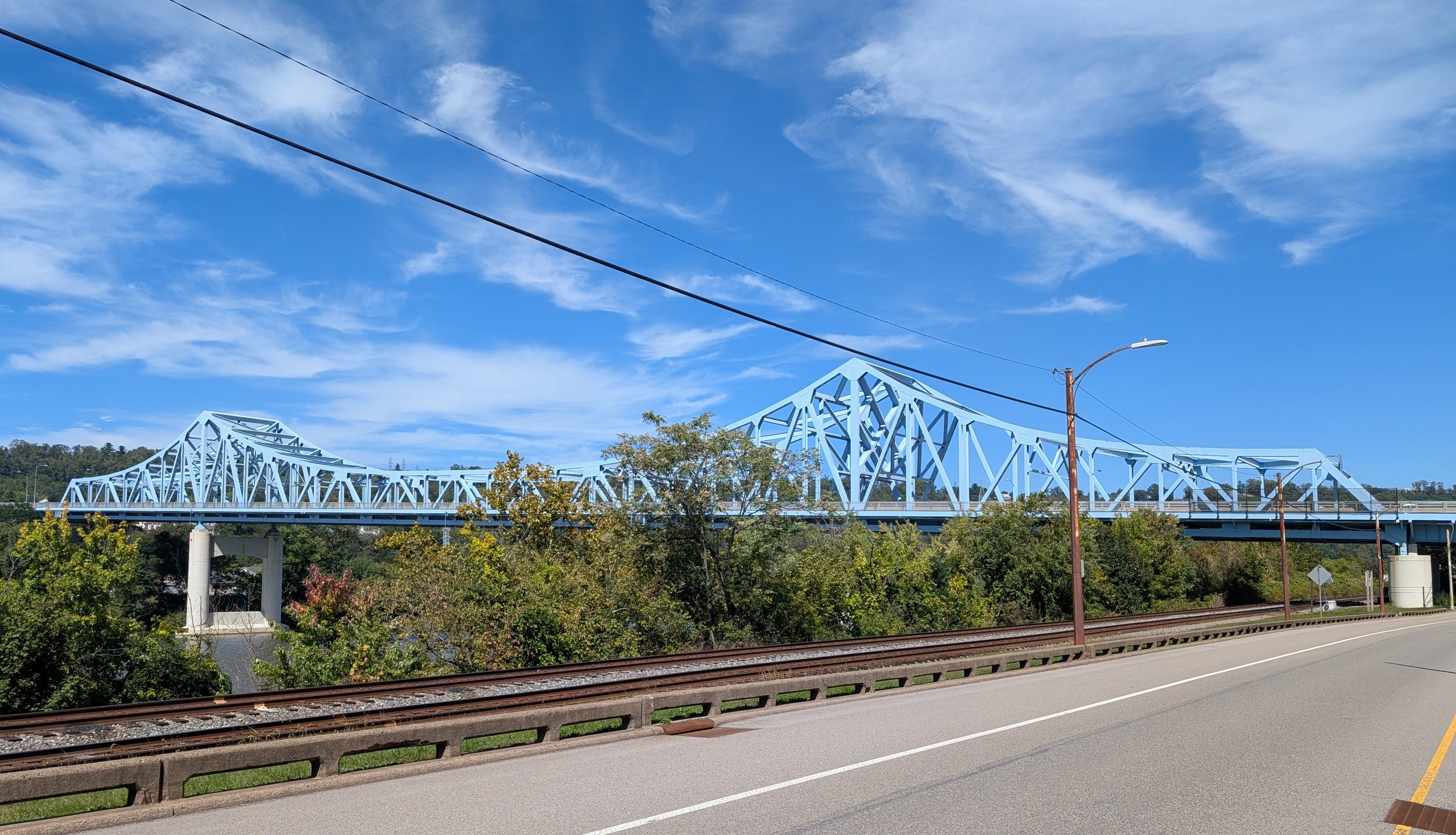
Follow Route 51 along the west bank of the Ohio at Aliquippa and the trees part long enough to show you a pale blue lattice hanging over the river. It reads from the road like lacework stretched between two hills, with pinnacled towers rising out of the truss the way church spires rise out of a town. The architectural historians at SAH Archipedia place it among Beaver County’s finest crossings, ranking it second only to the P&LE railroad bridge for sheer impact.
It earns that spot with its looks. The reasons it looks that way say a good deal about the two towns it ties together.
Two Towns Facing Each Other
Ambridge took its name from the American Bridge Company, the U.S. Steel subsidiary that set up its fabrication works on the east bank and incorporated the borough in 1910. Across the water sat Woodlawn, soon absorbed into the sprawl of Jones & Laughlin’s Aliquippa Works. At the turn of the century each town counted its people in the hundreds. By the late 1920s the two together held more than 40,000.
That many workers on two banks of one river made a bridge an obvious need. Plans had been drawn up in 1917, then shelved when the country went to war. They came back in September 1924, and this time they held.
Built From Its Own Ground
The bridge came together out of local stock to a degree few public works can claim. T. J. Wilkerson, a Beaver County engineer, designed it. J&L’s Aliquippa Works rolled the steel, a $609,000 order. American Bridge fabricated and raised the superstructure for $337,500. Even the sand and gravel for the piers and abutments came up out of the riverbed beneath it.
J&L and U.S. Steel competed hard in those years, and here they split the job down the middle like neighbors raising a barn. One end of the bridge sat beside a steel mill; the other sat beside the yard that fabricated it. Its trip from shop to site may have been the shortest haul of any bridge American Bridge built that year.
It opened on December 11, 1927, as the Ambridge–Woodlawn Bridge, with ceremonies, commemorations, and what the local paper called an “aerial bombardment.” Within a few years Woodlawn’s name had faded under Aliquippa’s, and the bridge took the new name with it.
The Purpose Behind the Shape
The engineering choice suited a working river. A cantilever truss builds outward from its piers, arm reaching toward arm, so crews can close the span without crowding the channel with temporary supports while barges keep moving. Riveted steel cantilevers like this one were the standard answer from the 1920s into the 1970s for crossings with main spans between 600 and 1,400 feet. Including the extension that carries it over the rail lines on the west bank, the Ambridge structure stretches 1,907 feet.
A plain truss would have carried the traffic. What Wilkerson and the builders delivered instead culminates in four pinnacled towers, the steel worked into a filigree of thin struts and layered bracing. Those towers do structural work, gathering load over the piers, and they also give the bridge a profile you can pick out from a mile downstream.
American Bridge once raised a sign proclaiming itself and Ambridge the “Largest Bridge and Structural Steel Center in the World.” A company with that sign over its gate was building a bridge from its own front yard to a steel mill’s front door, in full view of both towns’ workforces and every boat on the Ohio. Read that way, the ornament works like a craftsman’s sample piece hung in the shop window, a standing answer to anyone who wanted to know what Ambridge could make.
It also gave the people who made it something to look at on the way to work. Ambridge’s millworkers bought homes quickly by company-town standards, enough that the Commonwealth recognized the borough for its thrift. A town that invested in itself got a bridge that looked like an investment.
Keeping It Up
Among the first highway bridges to cross the wide Ohio, it has needed more than its share of repairs. In 1953 a water main went along its length, carrying supply from a reservoir six miles away to the Ambridge water softening plant. Approach spans came in the late 1950s with the construction of Routes 51 and 65. A $16.6 million rehabilitation by Trumbull Corporation, begun in December 2011, replaced the deck and sidewalk, repaired and repainted the steel, and added new parapets. The sidewalk railing stayed: it’s the original 1927 iron. Age has held the bridge to a posted 17-ton limit.
American Bridge closed its Ambridge works in 1983, worn down by the oil shocks and imported steel. The bridge it built from its own yard is still carrying cars across the river, a sample piece that outlasted the shop.