A Wasteland Bought Back
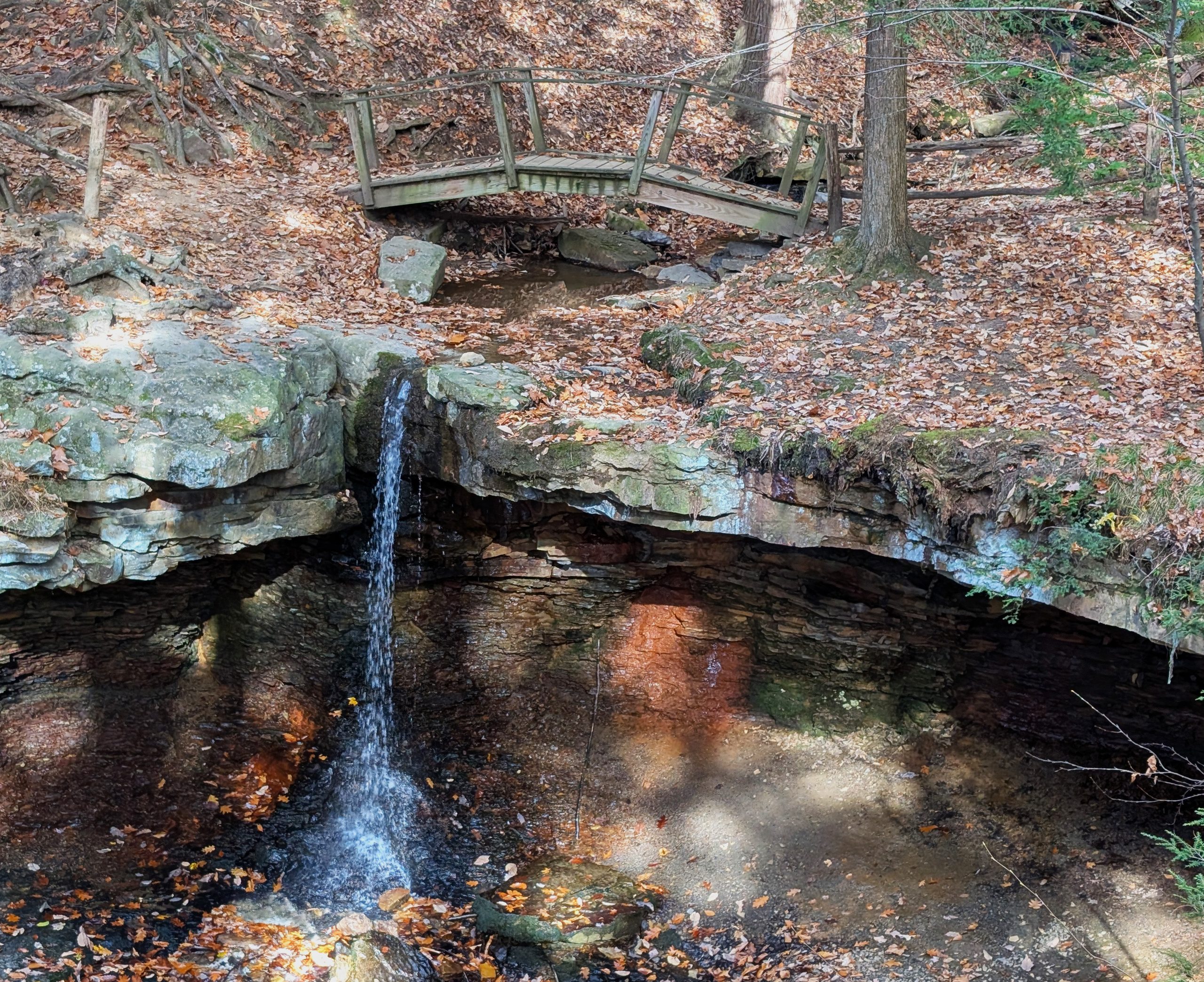
By late October the creek above Adams Falls is barely moving. It slides out from under a small arched footbridge, pools around a few squared-off blocks of stone, and spills over the lip of the ledge in one thin rope of water. The pool below is dark and full of fallen oak and maple leaves. Behind the falls, the rock face is streaked rust-orange, and the ledge hangs out over the pool like the brim of a hat.
Adams Falls sits in Linn Run State Park, a 612-acre park in Cook and Ligonier Townships, Westmoreland County, just off Route 381 near the village of Rector. Two mountain streams, Grove Run and Rock Run, join inside the park to form Linn Run, and the falls is the park’s centerpiece. The drop is modest, around fifteen feet, and the trail to it is a rocky one-mile loop through hemlock and rhododendron. Forbes State Forest surrounds the park on the mountain side and adds roughly 50,000 more acres of woods.
The Rock
The falls is a lesson in two kinds of stone stacked on top of each other. The ledge the water pours off is thick gray sandstone, mossy on top and blocky at the edges. Under it sits a stack of thin, dark shale beds layered like a pile of old newspapers. Sandstone holds up well against water and frost. Shale does not. Splash and seep work the shale loose a flake at a time, and the soft layers retreat while the hard cap stays put. Over thousands of years the falls has dug a room under itself, and you can see the result in the overhang and the shallow grotto behind the water. When the cap loses enough support, it breaks off in slabs, and the angular blocks in the streambed have the look of earlier pieces of the ledge.
The orange on the back wall is iron. Water moving through the shale picks up dissolved iron, and when it reaches open air the iron oxidizes and settles out as a rusty coating. Anyone who has looked at a creek near an old mine around Johnstown knows the color. Here it’s the natural version, in a small dose.
Pull back far enough and the falls belongs to a much bigger structure. Linn Run drains the western flank of Laurel Hill, a long upward fold in the rock called an anticline. Laurel Ridge and Chestnut Ridge are the two major folds on this part of the Allegheny Plateau, and the Conemaugh River cuts a water gap through the same Laurel Hill fold at Johnstown. The sandstones and shales in this country were laid down as river sand and swamp mud in the coal age, roughly 300 million years ago, then buckled when Africa pushed into ancient North America and raised the Appalachians. Streams like Linn Run have been cutting back down through those layers ever since, and Adams Falls marks one spot where a hard bed is slowing the cut.
The Wasteland
The woods around the falls look old. They aren’t. In the 1890s the Byers and Allen Lumber Company clearcut the old-growth forest that covered this ground. Saw logs went to market as lumber. Smaller logs went into nearby coal mines as roof props. Hemlock bark was stripped, bundled, and shipped to tanneries for its tannin. The Pittsburgh, Westmoreland and Somerset Railroad hauled it out, running from Rector up toward Somerset, switching back and forth across Linn Run to manage its heavy loads. Sparks from the locomotives set fires that burned through the leftover treetops and slash.
In 1909 the Commonwealth bought most of the land from Byers and Allen for $42,662. It was the first major public purchase of cut-over forest land in the Ohio River Basin, and plenty of people at the time questioned spending money on what they considered wasteland. The state’s first forester on the tract, John R. Williams, reported that about three-fifths of it had burned since the logging and that parts of it held little more than ferns and blackberry. The wildlife was gone along with the trees. In 1910 the new Pennsylvania Game Commission and the Department of Forestry began restocking white-tailed deer, bringing animals in from New York and Michigan.
During the Depression, the Civilian Conservation Corps went to work here. Starting in 1933, crews built the park’s ten cabins, along with stone fireplaces, bridges, roads, and utilities, in the log-and-stone style known as WPA Rustic. The cabin area is now listed on the National Register of Historic Places as the Linn Run State Park Family Cabin District. One of the park’s trails follows the original Linn Run Road that early visitors used to reach the Adams Falls picnic grounds, and hikers in the surrounding state forest still walk on the old railroad grade without knowing it. Scars from the post-logging fires can still be found on the land, if you know what to look for.
Back at the Ledge
Standing over the pool, the hemlocks are what bring the history home. A little over a century ago, hemlock bark from these slopes was loaded onto rail cars and sent off to be boiled for leather tanning. Now hemlocks shade the falls again, rooted along the rim and leaning over the gorge, and the rhododendron fills in beneath them. The forest that grew back has had about 130 years. The rock it stands on has had 300 million. The water keeps working at both.
Sources
- Pennsylvania DCNR, History of Linn Run State Park: https://www.pa.gov/agencies/dcnr/recreation/where-to-go/state-parks/find-a-park/linn-run-state-park/history
- Pennsylvania DCNR, Linn Run State Park hiking: https://www.pa.gov/agencies/dcnr/recreation/where-to-go/state-parks/find-a-park/linn-run-state-park/hiking
- Pennsylvania DCNR, Forbes State Forest history: https://www.dcnr.pa.gov/StateForests/FindAForest/Forbes/Pages/History.aspx
- Wikipedia, Linn Run State Park (citing the NRHP cabin district nomination): https://en.wikipedia.org/wiki/Linn_Run_State_Park
- Pittsburgh Geological Society, 1985 Johnstown field guide (Laurel Hill anticline): https://www.pittsburghgeologicalsociety.org/uploads/pubs/1985_Johnstown.pdf
- PA Bucket List, Adams Falls at Linn Run State Park: https://pabucketlist.com/?p=4055