The Original Graffiti Artist With a Social Message
Somewhere in the Tiantai mountains of eastern China, around twelve hundred years ago, a scruffy old man went around writing poems on rocks. He wrote them on the trunks of trees and on bamboo, and on the walls of farmhouses when the farmers weren’t looking. He made fun of rich men and stuffy officials, and of the monks down the hill who shaved their heads and kept their hands out. Then he walked back up the mountain and laughed about it.
He called himself Hanshan, which means Cold Mountain. It was the name of the cliff he lived on, and after enough years it was hard to say where the man left off and the mountain began.
I met him at nineteen, in the pages of Jack Kerouac’s The Dharma Bums. Kerouac’s hero, Japhy Ryder, was based on the poet Gary Snyder, who was translating Hanshan at the time, and Japhy hands Hanshan to the narrator like a buddy passing a joint. Kerouac dedicated the whole book to him. The narrator’s name is Ray Smith, so that’s two Smiths who’ve been handed Cold Mountain by now. I didn’t know what I was looking at back then. I knew I liked the guy.
The Man in the Bark Hat
Most of what we know about Hanshan comes from a preface that somebody stuck on the front of his poems, supposedly written by a local official named Lüqiu Yin. Scholars doubt Lüqiu ever existed. The story is too good to leave out, though, so here it is.
Hanshan was thin and ragged. He wore a hat made of birch bark and a pair of wooden clogs, and he hung around Guoqing Temple without ever joining it. His best friend was Shide, whose name means “picked up.” A wandering monk had found Shide as an abandoned baby by the side of the road and brought him to the temple, where he grew up washing dishes. Shide saved the leftover rice in a bamboo tube, and Hanshan came down the mountain to eat it. The two of them would pace the temple halls laughing, shouting at the sky, and talking nonsense. When the monks got fed up, they chased Hanshan out with sticks. He clapped his hands, laughed, and went.
The poems hint at how he got there. He seems to have started out as a farmer with a wife, a son, and an older brother. He studied for the civil service exams, the road to respectability in Tang China, and he doesn’t seem to have made it.
When I was young I hoed with a book tucked in my belt,
and lived on the farm with my older brother.
Then people started blaming me,
and my own wife turned cold.
So I threw over the world of red dust
to wander, and read what I please.
Who’ll lend me a dipper of water
for a fish stuck in a wagon rut?
That fish in the wagon rut is an old joke from Zhuangzi. It’s a fish flopping in a puddle in the road, begging for a bucket of water while some fancy lord promises to divert a whole river for it next month. Hanshan read the classics and then aimed them at the people who claimed to own them.
The Walls Were His Paper
This is the part that gets me. Hanshan didn’t take his poems to a publisher, he didn’t send them to the court, and he didn’t present them at a fancy poetry party. He wrote them where people would walk past them, on rocks beside the trail, on the trees, and on the walls of village houses. He was tagging the countryside. A farmer would come out in the morning and find a poem on the side of his barn about how the rich men in town were going to die and rot like everybody else.
I see the people of this world
each one scrambling to come out on top.
Then one morning they up and die,
and all they get is a patch of dirt
four feet wide and twelve feet long.
If you can climb back out of there and keep on scrambling,
I’ll put up a stone in your honor.
He had plenty to say about the monks too. He took aim at the ones who went into the temple to dodge taxes or work, and at the ones who chanted for donations and ate well on them. He wasn’t a monk himself, and as near as anyone can tell he never shaved his head or took a vow. He lived next door to the monastery the way a stray dog lives next to a butcher shop, close enough to eat and far enough to bark.
I’ll admit that’s a big part of the attraction for me. When I picture a holy man, I picture Hanshan in a bark hat, getting run off temple grounds with a stick and cackling about it, not a solemn figure in robes. He took the whole tradition seriously enough to make fun of it, and there’s a wisdom in that you won’t get from the pulpit.
He was proud of his work too, in a cocky, wink-at-you way:
Five-word poems, five hundred.
Seven-word poems, seventy-nine.
Three-word poems, twenty-one.
Six hundred in all.
I wrote every one on the rocks,
and I’ll brag I’ve got a good hand.
Anybody who can understand my poems
is the mother of the Buddha herself.
That’s a graffiti artist talking about his body of work.
The Road Up
When he wasn’t needling the neighbors, Hanshan wrote about the mountain. His landscape poems are full of clouds, pines, frozen creeks, and moonlight. Again and again, he comes back to the road up there and how you can’t get to Cold Mountain by any road a person can follow.
People ask the way to Cold Mountain.
There’s no road that gets you there.
In summer the ice still hasn’t melted,
and when the sun comes up, the fog hangs on.
How did somebody like me make it?
My mind isn’t the same as yours.
If your mind were like mine,
you’d be here already.
Cold Mountain is a place, and it’s also a state of mind, and he never bothers to tell you which one he means. Sometimes he lets the joke drop and just tells you what it’s like up there:
My mind is the autumn moon
shining clean in a clear green pool.
There’s no comparing it to anything.
Tell me how I’m supposed to explain it.
Vanishing Into the Rock
According to the preface, the official Lüqiu heard these two kitchen bums were holy men in disguise and went to the temple to pay his respects. When he bowed to them, Hanshan and Shide burst out laughing, took each other by the hand, and ran. Lüqiu sent gifts of clothing and medicine up the mountain after them. Hanshan yelled at the messengers to run for it, ducked into a crack in Cold Cliff, and the rock closed behind him. That was the last anyone saw of him.
Lüqiu then had the monks go around and collect the poems off the rocks, the trees, and the farmhouse walls. They came back with a little over three hundred. Given what Hanshan bragged about, that means half of them weathered off the rocks before anyone thought to write them down.
The scholars have their own version. The language in the poems points to the 700s and 800s, later than the preface claims, and some of them think more than one hand wrote the collection over that stretch. “Hanshan” may have been one man, or a few men sharing a name and a mountain. Hanshan would have found that hilarious, I suspect.
Twelve Hundred Years of Strangers
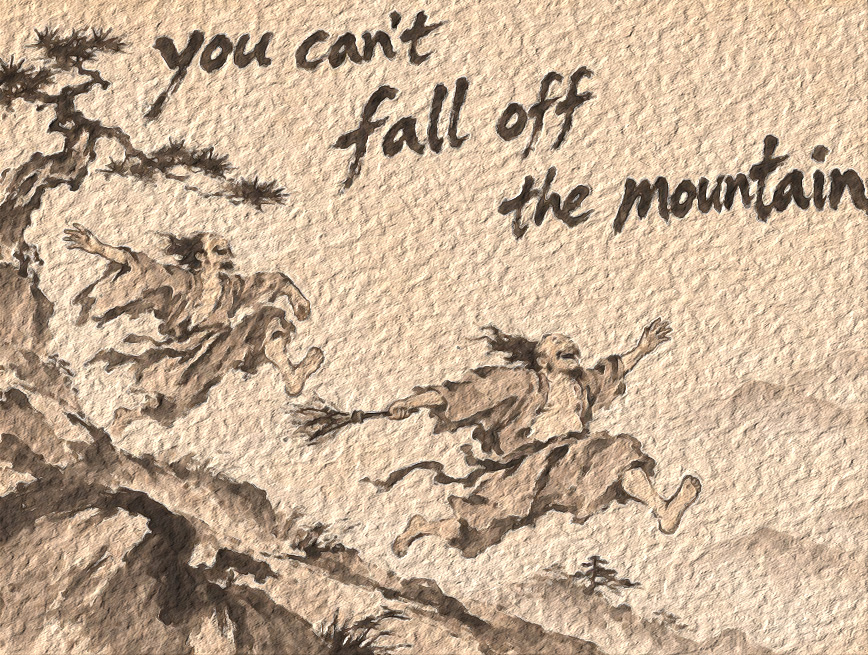
China didn’t make a big fuss over him for a long time. Japan picked him up as Kanzan, and the Zen painters loved him and Shide, two grinning, shaggy men, one with a scroll and one with a broom. In the 1950s Snyder put him into English, Kerouac put him in a novel, and a generation of young Americans who had no business reading Tang poetry started reading Tang poetry. Charles Frazier opened his novel Cold Mountain with one of Hanshan’s poems and borrowed the title from it.
That’s a long chain of strangers for a guy who wrote on rocks. He saw it coming, too:
Some folks laugh at my poems.
My poems are proper enough.
They don’t need Master Zheng’s commentary
or Master Mao’s notes to explain them.
I don’t mind that few people get them.
Real listeners are scarce, is all.
But let them run into somebody with clear eyes,
and they’ll travel the whole world on their own.
Somebody with clear eyes found them, and then somebody else did, and then a nineteen-year-old in Indiana did. Hanshan wrote his poems on the walls for whoever walked by. You just walked by.
Sources
- Red Pine (trans.), The Collected Songs of Cold Mountain (Copper Canyon Press, 1983; rev. 2000)
- Paul Rouzer (trans.), The Poetry of Hanshan (Cold Mountain), Shide, and Fenggan (De Gruyter, 2017)
- Kazuaki Tanahashi and Peter Levitt (trans.), The Complete Cold Mountain (Shambhala, 2018)
- Gary Snyder, Riprap and Cold Mountain Poems (1958/1965)
- Burton Watson (trans.), Cold Mountain: 100 Poems by the T’ang Poet Han-shan (1962)
- Edwin G. Pulleyblank, “Linguistic Evidence for the Date of Han-shan” (1978)
- Jack Kerouac, The Dharma Bums (1958)
- Zhuangzi, chapter 26 (the fish in the wagon rut)