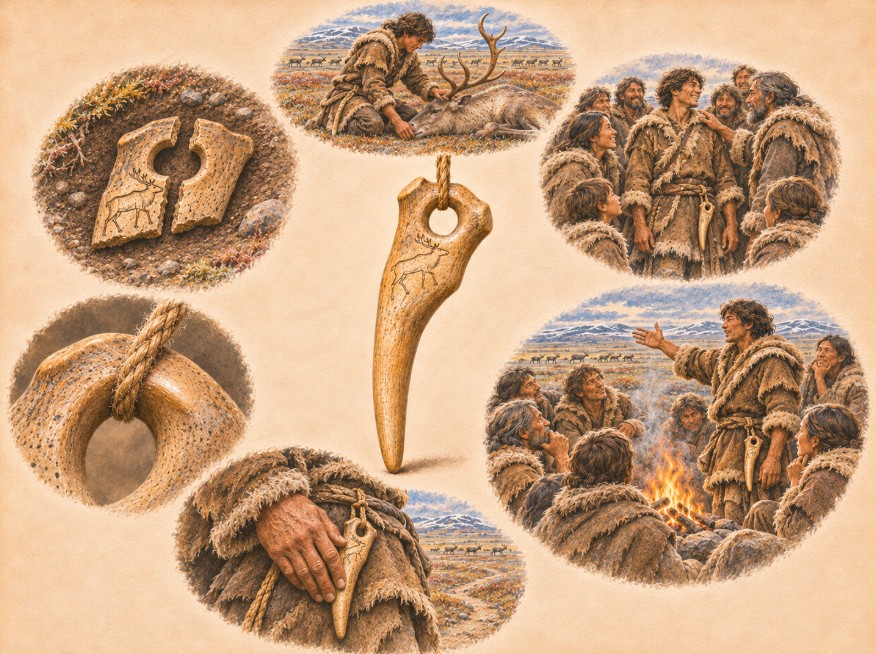
A Bright Meadow Group ODI reading of the bâton percé
Archaeologists keep a drawer for objects that refuse to explain themselves. The carved stone balls of Neolithic Scotland sit in it. So do the bronze dodecahedra of Roman Gaul. One of the oldest residents of that drawer is a rod of reindeer antler with a hole bored through one end, and it has been waiting there since the 1860s.
The French call it the bâton percé, the pierced baton. Édouard Lartet, digging Ice Age caves in southwestern France, gave it a grander name: bâton de commandement, a commander’s staff. He pictured a chief raising it before his people. The name outlasted his reasoning, and in the century and a half since, the baton has been reassigned as a spear straightener, a rope-making tool, a thong softener, a spear-thrower part, and a few things in between.
We think Lartet was closer than he gets credit for. He just put the wrong man behind it.
Observe
Start with what the objects show.
- They’re antler, usually reindeer, running from about hand length to forearm length.
- The hole sits where a tine once branched from the main beam. That fork is the densest, toughest part of an antler, and the makers chose it on purpose.
- The tines themselves are gone, cut or broken down to stubs.
- Many holes carry wear polish on one side of the opening. Something pulled through that hole in one direction, under load, for a long time.
- Plenty of them are broken straight across the hole.
- Many are carved with animals, lines, or spirals. Others are plain.
- People made them in much the same form from roughly 35,000 years ago down to about 12,000 years ago, across Ice Age Europe.
That last observation covers twenty-three thousand years. Tools change over a stretch like that as people find better ways to do a job; stone blade-making went through several overhauls in the same period. Customs tied to who a person is within the group hold their shape far longer. A wedding ring today looks much like one from Rome.
Design
Ask what the object was built to do, and the clues line up behind one answer: it was built to hang.
A cord through the hole at the fork puts the load on the strongest point of the antler. Hang that rod from a belt or a neck for years and the cord rubs the top inside edge of the hole, one direction, day after day. There’s the one-sided polish. Snag the cord on brush, catch it in a fall, roll over on it in your sleep a few hundred times, and the antler finally gives way right where the cord pulls. The breaks across the hole look like a worn-out keychain ring.
The missing tines fit the same picture. A full antler fork hanging at your hip would jab you each time you sat, knelt, or pushed through brush, so the tines came off. They wouldn’t have gone to waste. Antler tips are the classic flintknapper’s tools, used as pressure flakers to sharpen an edge and as punches to strike blades from a core. One animal supplied the hunter’s badge from the beam and his knapping kit from the points.
The carving follows from the carrying. Anything a person keeps on them day in and day out picks up their mark. Soldiers scratch names and dates into lighters. Truckers cover a cap in pins. A man who wore his baton for thirty years had plenty of firelit evenings to cut his reindeer into it, and the plain ones may belong to hunters who hadn’t gotten around to it or didn’t care to brag.
Daily carry also explains the side jobs. Whatever you have on you gets pressed into service. A sturdy antler rod with a smooth hole would work as a lever, a shaft straightener, a drill bow, or a handhold for a fire drill when the moment called for it, and the experiments showing those jobs can be done sit comfortably with this reading. A pocketknife opens plenty of bottles without anyone calling it a bottle opener. The four-holed ivory piece from Hohle Fels in Germany, with spiral grooves cut into its holes, makes a strong case for rope making, and it may well be a separate tool that shares a family resemblance.
Intervene
Now put the object back into the band that made it.
Hunter-gatherer groups ran on standing. Whoever had proven himself had a say when the group decided where to move, when to hunt, and how to settle a quarrel. A large kill, a reindeer taken by a young man on his own effort, is the kind of threshold a band would mark. The beam of that animal’s antler, cut at the fork and hung at his body for the rest of his life, told anyone in camp at a glance: this one has killed, this one speaks as a man of the band.
That’s the job of a torc. The Celtic neck ring signaled rank to anyone who saw it, and many men could hold that rank at once. A colored sash, a lapel pin, a ribbon rack on a dress uniform, a patch on a club vest do the same work. The bâton percé stands at the head of that line.
Here’s where Lartet comes back in. He saw authority in the object and pictured a single commander. The count argues against him; batons turn up in quantity, site after site. A badge that each proven hunter earned fits those numbers. Lartet had the right category, a staff of standing, at the wrong scale.
The broken ones finish the story. A baton worn through by decades of life might land on the camp midden. A whole one might go into the ground with the man who earned it.
The BMG question for a mystery object is what it did for the person carrying it. Sometimes the answer is a tool. For the bâton percé, the answer was a voice at the fire.
Sources
- Lartet, Édouard, and Henry Christy. Reliquiae Aquitanicae. London, 1865–1875.
- Conard, Nicholas J., and Maria Malina. Report on the Hohle Fels mammoth-ivory rope-making tool, University of Tübingen, 2016.