A historic opportunity for a historic governor in a historic moment
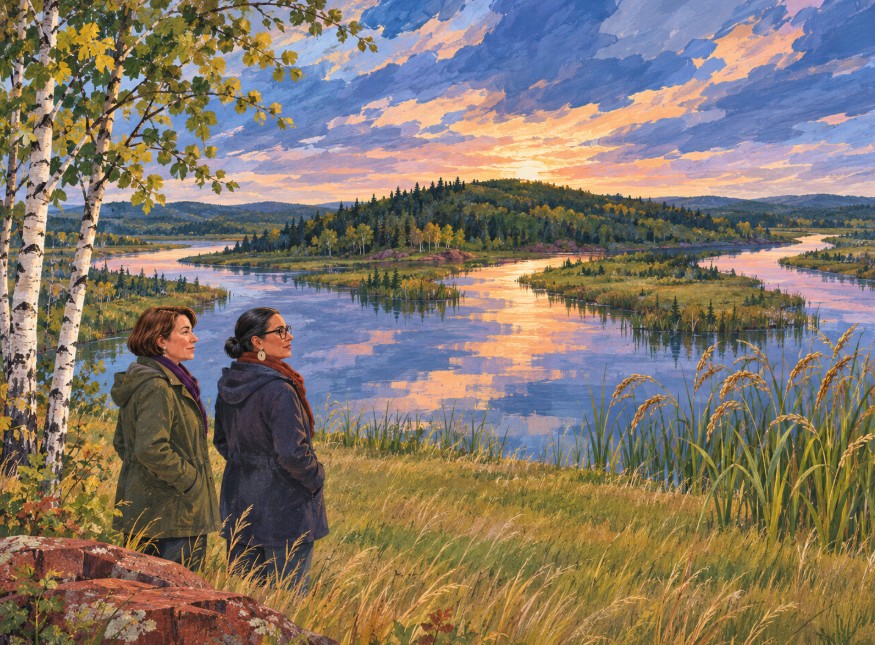
On the Iron Range near Hibbing there is a low rise of ground called the Hill of Three Waters. Rain that lands on it has three ways to go. Some runs north toward Hudson Bay. Some runs east through Lake Superior and the St. Lawrence to the Atlantic. Some runs south into the Mississippi and on to the Gulf of Mexico. A single hill sends its water to three coasts and two countries.
Minnesota sits at the heartland of the divide in the plainest sense a map can offer. The state’s name comes from the Dakota Mni Sota, often rendered as water that reflects the sky. John Muir wrote that when we try to pick out anything by itself, we find it hitched to everything else in the universe. Minnesota’s watersheds were hitched to a continent long before anyone drew a border across them, and so were the peoples who lived along them.
The Moment
On November 3, Minnesota elected Amy Klobuchar its first woman governor. The same day, voters sent Peggy Flanagan, a citizen of the White Earth Nation, to the United States Senate, in a race the Associated Press has called for her. She will be the first Native American woman to serve there.
That second result is a statement from the electorate. A state that has carried the country’s arguments over who belongs, and who gets to be safe, onto the streets of Minneapolis twice in six years has now chosen an Ojibwe woman to speak for it in Washington.
Governor-elect Klobuchar takes the oath on January 4. One of her first acts may be to fill the Senate seat she is leaving. Whoever she appoints will hold it until a special election in November 2027. Few governors get to choose their own successor, and fewer get to do it in a year when the voters have just shown them which way the water is running.
The Ground
The Ojibwe and the Dakota fought over the land that became Minnesota for generations. Anishinaabe expansion pressed west and south from the Great Lakes, and the Dakota drew back toward the prairie and the river valleys. That rivalry is old, and it is real, and it is part of the ground under the Capitol in St. Paul.
So is 1862. After the U.S.–Dakota War, the state hanged 38 Dakota men at Mankato on December 26. Through that winter, about 1,600 Dakota people, most of them women, children and elders, were held in a fenced camp below Fort Snelling at Bdote, the meeting of the Minnesota and Mississippi rivers that the Dakota hold as their place of origin. Many did not live to see spring. In 1863 Congress voided the Dakota treaties and ordered the Dakota out of Minnesota. Families were shipped west to Crow Creek, and others fled north into Canada.
The Dakota came home anyway, a few families at a time, over the decades that followed. Today there are four Dakota communities in Minnesota: Shakopee Mdewakanton, Prairie Island, Lower Sioux and Upper Sioux. Their relatives still live across the line in Manitoba and Saskatchewan, and Ojibwe relatives stretch from Ontario to Montana. The wound runs across a border, and so will the healing.
The Healing of America
When we say America here, we mean the whole continent the word once named, from Hudson Bay to the Gulf. The United States is one government on it. The nations that were here first hold kinship, ceremony and memory that run under the border the way groundwater runs under a fence line.
Healing a continent sounds too big to begin. Healing a watershed does too, until you stand at the headwaters. Restoration ecologists work by a plain rule: a stream recovers faster once the species that shaped it are back in the water. Stopping the poison starts the work. Returning the mussels and the native fish carries it through. A Congress that once ordered the Dakota removed from Minnesota is a stream that has been missing one of the species that shaped it.
The Invitation
Governor-elect Klobuchar, the name is yours to choose, and The Cernunnos Foundation leaves it with you. We offer a direction.
Appoint a Dakota leader to sit beside an Ojibwe senator. Let two nations that once fought over this ground carry it together into the chamber that ordered one of them gone. Minnesota would send the Senate a picture it has not seen: old rivals now representing one shared home, and a people expelled by Congress returning to it by appointment, with voters waiting in 2027 to confirm or correct the choice.
The politics are there. Minnesotans have just shown they will vote statewide for a Native leader. The history is there, with the 164th anniversary of Mankato falling the day after Christmas. The moment is there too: a new governor, a vacant seat, and a country hungry for evidence that old divides can be crossed by people who choose to cross them.
The rain on the Hill of Three Waters reaches three coasts and two countries, and it carries the same water to each. The healing of America can begin the same way, from one rise of ground in the middle of the continent, flowing outward. Minnesota has already sent one river toward Washington. Governor, you hold the next.
Sources
- KTTC, “Amy Klobuchar is the new governor-elect, what happens to her U.S. Senate seat?” (Nov. 4, 2026)
- MPR News, “Amy Klobuchar is Minnesota’s next governor. What happens to her Senate seat?” (Nov. 3, 2026)
- FOX 9, “What happens to Amy Klobuchar’s US Senate seat once she is elected governor?” (Nov. 2026)
- Minnesota Reformer, “Sen. Amy Klobuchar needs to tell us who she would name as her successor” (Aug. 13, 2026)
- NOTUS, “Progressive Peggy Flanagan Wins Minnesota’s Democratic Senate Primary” (Aug. 2026)
- AP / Ahram Online, “Progressive Democrats get another win in Minnesota US Senate primary” (Aug. 12, 2026)
- Associated Press election results, Minnesota U.S. Senate, as of Nov. 5, 2026, 7:39pm ET
- John Muir, My First Summer in the Sierra (1911)