Thermal Articulation and Multi-Phase Vapor Recovery in HTL
A Bright Meadow Group Systems Note on Designing REALcycling Infrastructure
Bright Meadow Group
Systems Analysis and Solutions Consulting
A division of the Cernunnos Foundation
Modern waste streams are chemically rich and systemically neglected.
We routinely describe material as “trash” when what we mean is poorly organized carbon, nitrogen, minerals, and stored energy. The issue is not scarcity. It is process design.
At Bright Meadow Group, we approach REALcycling as a thermodynamic and control problem:
How do we convert heterogeneous waste into defined commodity streams with precision, repeatability, and minimal loss?
Hydrothermal liquefaction (HTL) remains one of the most promising tools in that space. Yet most conventional HTL configurations treat heat as a background utility rather than an active control variable.
That is a design limitation.
Moving Beyond Isothermal Thinking
Traditional HTL reactors are typically operated under a steady thermal hold at elevated temperature and pressure. The objective is bulk conversion of wet biomass into biocrude, aqueous phase, solids, and off-gas.
In practice, vapor evolution during HTL is not uniform. Gas fractions evolve in stages, influenced by:
- Temperature bands
- Pressure conditions
- Reaction kinetics
- Feedstock composition
- Residence time
When the system is operated as a single, long isothermal hold, vapor fractions blend. Separation opportunities diminish. Recovery value decreases.
A more disciplined approach treats HTL as a sequence of defined thermal-pressure phases engineered to create discrete vapor recovery windows.
That requires precise thermal articulation.
Induction Heating as a Process Control Instrument
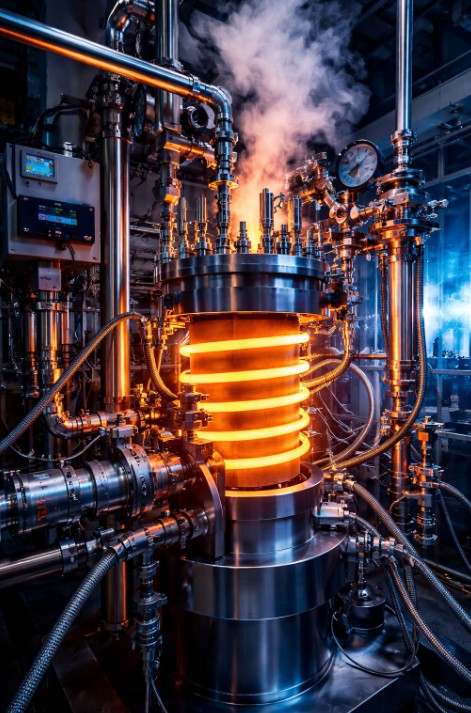
Induction heating converts the reactor wall into a controllable heat source via electromagnetic coupling. Unlike fired systems or thermal oil jackets, induction systems adjust power input rapidly and with minimal lag.
In a staged HTL architecture, induction becomes a dynamic thermal actuator capable of:
- Rapid ramping through pre-reaction temperature bands
- Tight stabilization within primary reaction zones
- Controlled thermal perturbations synchronized with pressure modulation
- Repeatable multi-cycle vapor release windows
In this configuration, temperature is not merely maintained — it is sequenced.
Heat becomes part of the control logic.
Multi-Phase Vapor Recovery Architecture
A staged HTL process under Precision Thermal Cycling (PTC) may include:
1. Rapid Pre-Activation Ramp
Minimize residence time in intermediate bands to reduce uncontrolled devolatilization.
2. Primary Reaction Hold
Maintain a defined reaction envelope for depolymerization and liquefaction.
3. Targeted Thermal Transition
Apply a controlled temperature shift to initiate preferential vapor evolution.
4. Pressure-Managed Release Window
Route evolved gases to fraction-specific recovery paths.
5. Re-Stabilization Phase
Return to the reaction band and repeat as required.
By sharply defining these transitions, the system improves:
- Off-gas compositional segmentation
- Recovery efficiency of valuable fractions
- Reduction of blended low-value streams
- Process repeatability across heterogeneous feedstocks
This becomes particularly relevant in municipal or agricultural waste streams, where variability is the rule rather than the exception.
System-Level Implications for REALcycling
Induction-based thermal control can reduce balance-of-plant complexity by eliminating or downsizing:
- Thermal oil circulation loops
- Combustion systems and associated permitting
- Pump and valve maintenance infrastructure
For modular, distributed REALcycling units, simplification has direct economic value.
Electrified heating integrates cleanly with:
- Renewable generation
- Battery buffering
- Load scheduling
- PLC-based process sequencing
This is not merely a heater substitution. It is an architectural shift.
Designing for Commodity Recovery
The deeper systems question remains:
How do you have trash when everything is a commodity?
Waste exists where systems fail to extract value efficiently. When heat delivery, pressure control, and vapor routing are treated as blunt instruments, material value is lost in blended outputs.
By tightening thermal control and deliberately sequencing vapor recovery, HTL shifts from waste destruction to controlled commodity separation.
- Carbon becomes oil fraction
- Volatiles become fuel gas
- Aqueous streams become nutrient recovery inputs
- Minerals become soil amendments
REALcycling is not disposal.
It is disciplined separation under thermodynamic control.
Bright Meadow Group Perspective
At Bright Meadow Group, our role is not to sell a single technology. It is to design coherent systems.
In waste-to-resource infrastructure, the question is rarely whether one component functions. The question is whether the architecture supports:
- Precision
- Modularity
- Scalability
- Maintainability
- Economic clarity
Induction heating within a staged HTL framework — Precision Thermal Cycling — is one example of reframing a utility as a control instrument.
When every phase is intentionally managed and every stream is treated as feedstock, “trash” becomes a classification error rather than a material condition.