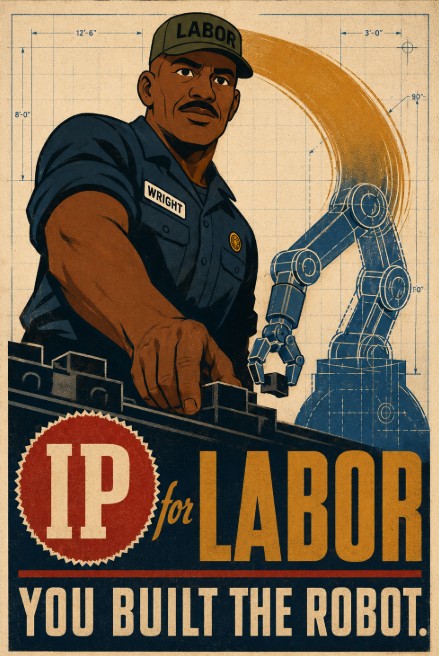
You Built the Robot. You Just Didn’t Know It.
There is a conversation this country never had. It should have. It would have been uncomfortable, and expensive, and about forty years overdue — which is precisely why nobody ever called the meeting.
So I’ll call it. I’ve been calling meetings to order on shop floors my whole life. This one’s no different, except the grievance is bigger than any I ever filed.
Here is the conversation.
When the robots came for the line, somebody should have written a check.
Not a severance check. Not a retraining stipend. Not a handshake and a thank-you and a pension that gets renegotiated every five years until there’s nothing left to renegotiate. A royalty check. The kind you write when you’ve used a man’s work to build something valuable and sold it to the world.
Because that is what happened. That is exactly what happened. And we have been too polite, or too tired, or too worn down to say it plain.
Let me tell you what the autoworker actually did.
He showed up. Thirty years, he showed up. He learned the line — not from a manual, not from a simulation, but from his hands and his back and the man next to him, who learned it from the man before him. He found the sequence. He refined the motion. He filed the grievance when the pace was wrong and bargained the work rule that set it right. He stood in the time-motion study and let them clock him and time him and write down everything he knew about how to build a thing well and fast.
He generated intellectual property.
He just never got to call it that.
The engineers called it that. The efficiency men called it that. The robotics designers who took those documented workflows and built them into servo motors and sensor arrays and automated assembly lines — they surely called it that. Proprietary process knowledge. Competitive advantage. The foundation of the next-generation plant.
They just forgot to mention whose foundation it was.
I want to be precise, because precision is the whole job. Measure twice, act once — that’s the rule. You don’t get careless with a man’s labor and then act surprised when the cut comes out crooked. So let me measure this twice before I say it once: this is a legal argument. Make no mistake about that.
Intellectual property law in this country runs on a plain principle. If you make something of value, you’re entitled to benefit when it’s used. If somebody takes what you made and builds a paying enterprise on top of it, they owe you. We call it a royalty. We call it a licensing fee. In the language of the courts we call it unjust enrichment — the rule that says you cannot profit off another man’s knowledge and labor without paying for it, just because you were clever enough not to call it theft while you were doing it.
The automakers documented labor’s knowledge for decades. Every time-motion study. Every efficiency fight. Every work-rule grievance that forced management to put down on paper exactly how the job was supposed to be done. That paper became the blueprint. The blueprint became the robot. And the robot replaced the man who drew the blueprint with his own two hands — except he never got to sign it.
And nobody wrote a check.
The autoworkers’ union has the funds. It has the lawyers. And it has thirty years of documented grievance history that amounts to the most detailed record of manufacturing know-how ever assembled in the American economy. That record sits in filing cabinets and arbitration binders and contract transcripts.
It’s a library. It’s a vein of ore. And by any honest reading of the law, it is intellectual property.
It was taken without compensation.
Now, I’ve heard the objection. I’ve heard it my whole life, in one form or another, and it always comes down to the same line: you were paid for your labor, not your knowledge. The wage covered it. The benefits covered it. You sold your time and your back, and whatever came out of that belonged to the company.
I want you to sit with that one a minute. Sit with it the way I had to.
What it says is that a man who spent thirty years perfecting the knowledge of how to build something — knowledge so valuable they engineered a machine on purpose to copy it — that man’s knowledge was worth his hourly rate and not one cent past it. That when the company took everything he knew and poured it into a machine that runs three shifts without a pension or a health plan or a contract, they owed him nothing extra, because they’d already paid him Tuesday.
That is the argument. That labor’s knowledge has no value of its own. That the worker is an input, not a maker. That thirty years of hard-won skill, poured into a billion-dollar automation system, amounts to no contribution worth paying for.
Say it again. Slower. I want to be sure everybody in the room caught it.
The auto unions are the right ones to bring this. They have the paper, the lawyers, the memory of exactly how the transfer happened and what it was worth. But this was never only an auto story.
Every industry that automated on the back of documented worker knowledge owes this same conversation. Warehousing. Meatpacking. Textiles. Every place a time-motion study came before a robot, every place a grievance produced a workflow document that later turned up as a design spec — that is a place where the ledger was never squared.
We didn’t just lose the jobs. We lost the credit. We lost the royalty. We lost the plain acknowledgment that what we knew was worth something past what they paid us to show up and use it.
That account is still open.
I’m no lawyer. I’m a steward. Forty years I’ve read the blueprints and read the room, and I’ll tell you the two don’t always agree. But I know what theft looks like even when it shows up in a clean shirt with a press release about innovation.
My father was a Pullman porter. Carried other men’s bags up and down this country his whole working life. He told me once, “We carried other folks’ baggage, son — but we never carried their shame.” I’ve held onto that. Because the last thing they handed the working man on his way out the door wasn’t just the pink slip. It was the shame. Told him he was obsolete. Told him the machine was simply progress, and progress doesn’t owe anybody anything. Made him feel he’d built nothing worth keeping — when the truth is he built the thing that replaced him, by hand, and then was sent home and told to be grateful for the chance to retrain.
I won’t carry that shame, and neither should you. You built the robot. You just didn’t know you were building it. And the men who did know — they never said a word, because saying it would have cost them something.
It still would.
So let’s send the bill.
Now you know, Jack.
— Philip Randolph Wright