Why Machiavelli wanted us to study failure By Nathaniel Leery | republican Virtue
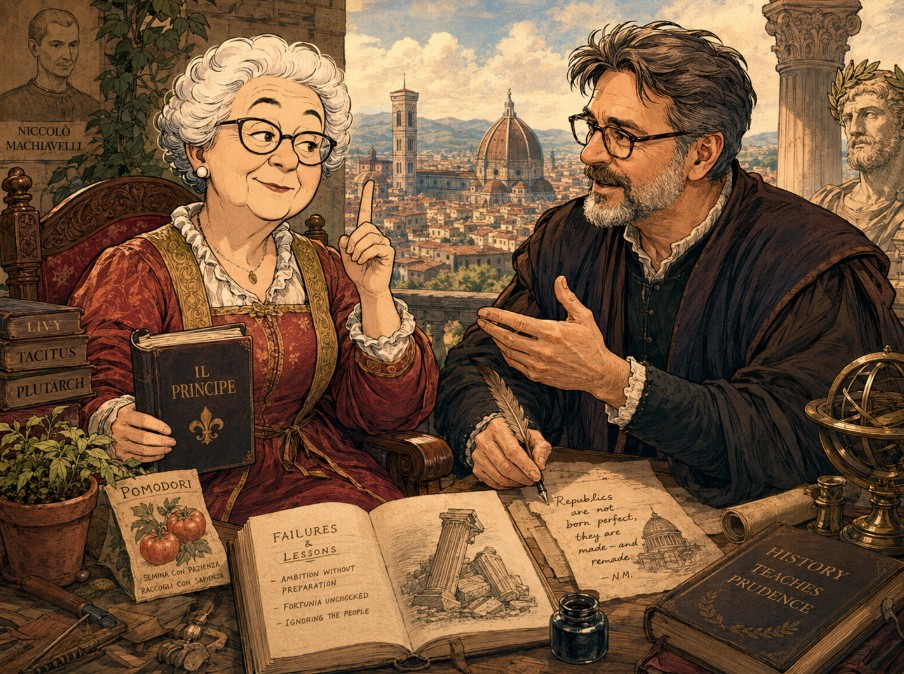
Grammina kept her copy of The Prince on the same shelf as the seed catalogs, which tells you most of what you need to know about how she read it. “Folks treat that little book like a knife,” she said once, “when the man was really just keeping a ledger of other people’s mistakes.” She was wrong about the date, wrong about the publisher, and exactly right about the man.
There is a Machiavelli almost everyone meets first, and it is the cynical one — the advisor at the prince’s elbow, the connoisseur of deceit, the author boiled down to a handful of provocative lines and handed to teenagers as proof that politics is nothing but cunning dressed for dinner. That Machiavelli is real enough; he simply isn’t the whole man. The fuller one was doing something harder and far more useful than teaching rulers to lie. He was teaching citizens how to read their own history without flinching.
The trouble with admiring only heroes
Most histories flatter us. They gather up the victories and the virtuous founders and the generals who never seem to sweat, and they hand us a civilization built entirely by people better than ourselves. The effect is predictable and a little corrosive: we come to believe that greatness is the property of rare men, that error is an accident rather than a habit, and — most dangerous of all — that our own republic is somehow exempt from the failures that buried the others. Machiavelli thought that was precisely backward. If you mean to preserve a free state, he argued, you must study its diseases as carefully as its health; and if you have only so much attention to spend, spend more of it on the diseases.
The instruction of bad examples
In the Discourses on Livy he kept circling one unglamorous idea: bad examples teach better than good ones. A triumph invites admiration, which is a pleasant feeling and a poor teacher. A catastrophe invites understanding. The corrupt magistrate, the swollen ruling class, the republic congratulating itself on the eve of its own decline — these show you where the joints of a political system actually are, and how they give way. Citizens who can see that pattern can act against it. Citizens fed nothing but their own mythology will mistake the warmth of self-regard for the strength of the thing itself, and mythology, as Grammina would say, “never once stopped a leak.”
The slow slide
He understood something about us that the centuries have only confirmed: success breeds forgetting. A people grows prosperous and steady, then misplaces the discipline that bought the prosperity in the first place. Standards soften. Institutions grow comfortable in their chairs. Ambition turns from the common good toward the private account. Nothing collapses on a Tuesday; instead the whole thing slides, and the slide begins so modestly that no one bothers to name it — a little corruption here, a little arrogance there, a small disregard for the public good that everyone agrees to overlook. But small excesses compound like interest, and the system that held for generations begins to fail in ways its beneficiaries never see coming. Rome, which he studied more closely than any living court, slid exactly so. It was not the last republic to do it.
A republic is a moral system, or it is nothing
We remember Machiavelli as the friend of hard rulers, but he admired republics far more than princes, and he was honest about what one costs. A republic runs on civic virtue — not the Sunday-school kind, but the older, plainer kind: a shared willingness among citizens to put the health of the whole above the appetite of the moment. Republics flourish where people still prize responsibility, learning, historical memory, and the patient balance of institutions against one another. Where those weaken, republics rot. And the uncomfortable part of the lesson is that the rot is rarely the enemy’s doing. Free states seldom fall because someone knocks them down; they fall because their own citizens stop tending them — and a republic, like a field, returns to weeds the season you decide it can mind itself.
The king we stopped imagining
There is an older possibility our politics has set aside, older than Machiavelli and older than Rome. Plato called it the philosopher-king: not a flawless ruler, but a thoughtful one, governed by understanding rather than appetite, schooled in history and human nature before being trusted with power. For a long stretch of Western thought, the highest aim of education was held to be the making of such people — leaders who had read enough of the past to be humbled by it. We treat the phrase as a fairy tale now, and assume that public life must be cynical and self-dealing by its very nature. But that assumption is not wisdom. It is amnesia wearing the costume of realism.
Rich in information, poor in memory
The great flowerings of our civilization shared one unfashionable habit: they valued learning. The Renaissance arrived when scholars went back to the old texts and read them as if their lives depended on it. The Enlightenment followed when inquiry and education became things a society was willing to spend money on. Universities grew; cities widened; art and architecture stood up straight — not by accident, but because people believed that understanding what had already happened might help them shape what came next.
We have inherited the opposite arrangement. We carry whole libraries in our pockets; every manuscript and treatise and chronicle sits a few keystrokes away — and our historical literacy feels thinner than it has in living memory. Our public argument rarely pauses to ask what an earlier society learned at great cost. It prefers the immediate: the immediate outrage, the immediate advantage, the immediate quarrel that will be forgotten by Friday. The long view has gone out of fashion, which means we have arranged, without quite noticing, to repeat mistakes we already know how to avoid.
Machiavelli’s real warning
His lesson was never that politics must be ruthless. It was that politics must be informed. Good intentions do not keep a republic standing; citizens who understand the forces working on it do. And that understanding has only one source — the study of what came before, the noble examples and the disastrous ones together, the long cycle of rising and softening and falling that repeats across the centuries with depressing punctuality. I count myself among those who need the reminder. I am as quick as anyone to mistake my own certainty for judgment, and as slow as anyone to look up the part of the record that might embarrass me. A man who lectures on memory ought to confess how easily he forgets.
The return of republican virtue
If we want our societies sound, we will have to revive something older than any of our modern ideologies: republican virtue in the classical sense, not the moralizing one. It is the plain capacity of a citizen to set the long welfare of his community above his own short reckoning. It asks for education, for historical memory, for a sense of responsibility toward institutions one did not build and will not outlive — and for the nerve to learn from a past that does not always flatter us. None of that comes free, and none of it comes easy. It never did.
Civilizations forget; that is the oldest story there is. They forget the dangers that ruined the ones before them, and they forget the hard-won wisdom that kept them upright for a while, and when the forgetting is complete the wheel comes round again. But the record is still here. The examples — the heroes and the fools alike — are still on the shelf where Grammina left them. We only have to take them down.
She put it better than I could, the way she always did. “A republic,” she told me once, getting the philosopher wrong and the point exactly right, “isn’t kept by the smart ones remembering. It’s kept by the rest of us not forgetting on purpose.”