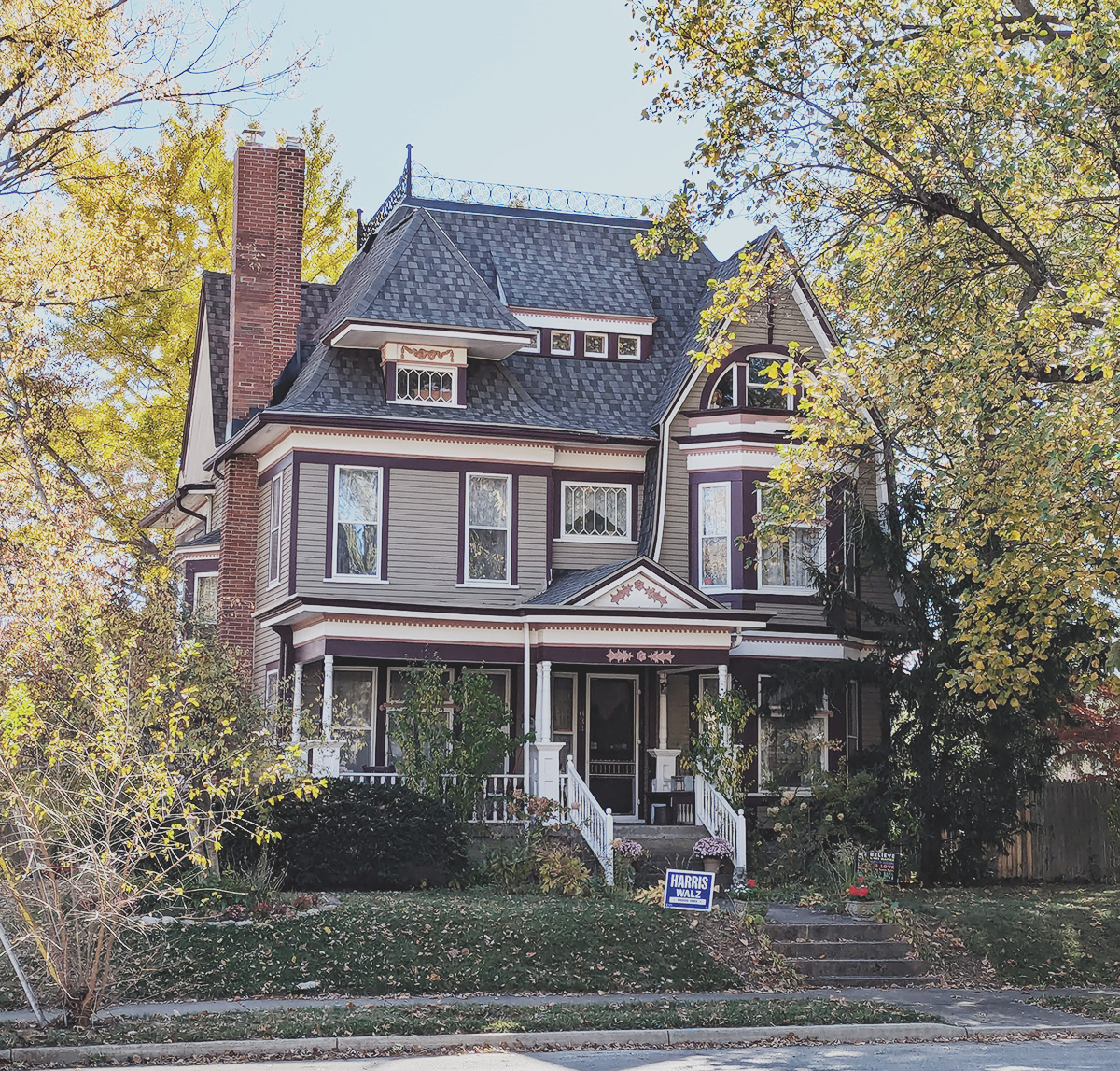
Most houses you pass and forget by the next mailbox. This one makes you stop on the sidewalk like a rubbernecker, crane your neck, and lose the thread of wherever you were headed. Fine. It earned it.
Start with the obvious, because the obvious here is the entire show: that roof. It’s a deep mansard, the steep near-vertical kind the Second Empire builders used to turn an attic into a whole inhabited upper floor instead of a hat on a box. But this is not the stiff Parisian mansard sitting square and humorless over a formal block. Look at the eaves — they flare. That concave, bell-cast curve at the bottom of the slope is the detail that separates a good mansard from a billboard, and whoever framed this one knew it. Then run your eye up to the ridge, where there’s a line of wrought-iron cresting doing nothing structural whatsoever and being absolutely correct about it. That ironwork is the kind of thing the first owner paid extra for and the third owner usually rips off because it’s “a maintenance issue.” This one kept it. Good for them.
What keeps the mansard from reading as a heavy dark lid is that it refuses to behave like one. It breaks. It folds. It throws up crossed gables that shoulder past each other, a dormer punched in under the slope here, a steep front-facing gable rising over there with a neat round-arched window tucked into its peak. The deep planes give the house real mass — sculptural mass, the kind that holds a shadow — and then the gables come out of that mass like the house was thinking out loud and changed its mind twice. That’s the Queen Anne talking. The Second Empire built the gravity; the Queen Anne spent it on movement.
Here’s the part the casual eye misses: the house is not symmetrical, and it does not need to be, because it’s balanced. The tall brick chimney on the left — corbeled cap, honest red brick, no nonsense — drops a plumb line down the whole left side and anchors the thing to the ground. The broad porch pins the bottom floor in place. Everything between those two fixed points is allowed to misbehave: the bay pushing forward, the band of small windows slipping across under the roofline, the right side climbing into its sharp gable. You get the prized Queen Anne illusion that the house accumulated over decades, grew the way a family grows, rather than getting assembled in one go from a single drawing.
And here’s the distinction that matters: the richness comes from form, not from fuss. Plenty of big Victorians try to buy your attention with surface — every shingle a different shape, every board a different color, spindlework stapled onto every available inch until the house looks nervous. This one has its ornament, and good ornament too — those carved scroll-and-medallion panels over the porch entry and under the bay are straight out of the pattern-book vocabulary, the Palliser-and-Shoppell catalog grammar that built half the good houses in America. But the real wealth is in the roof and the massing. Take every panel off and it’s still a handsome house. That’s the test, and it passes.
The color carries it. Olive-sage body, deep burgundy trim, white porch, red brick — an autumn palette that doesn’t reach for your collar. The dark trim outlines the windows and the roof edges like a confident hand inking a drawing, and the white columns and rails keep the entrance legible so you actually know where the front door is, which is more than I can say for a depressing number of newer houses. The diamond-paned and leaded glass scattered through the windows is exactly the right note of delicacy against all that heavy roof — a little jewelry on a house that mostly wears tweed.
And then the porch, because a Queen Anne without a decent porch is a Queen Anne that’s only half-awake. This is where the house stops performing and starts being livable. The upper stories can be grand and restless all they like; the porch is at eye level, it’s got steps and rails and a shadowed doorway and a couple of pots, and it says the only thing a porch ever needs to say, which is: sit down. It pulls the whole theatrical pile back down to human size. That’s the difference between a house and a monument, and the people who built these knew it cold.
What I like most is that it’s eclectic in the honest sense, not the indecisive one. It is not auditioning to be a textbook anything. The mansard says Second Empire, the crossed gables and asymmetry say Queen Anne, the chimney says practical, the cresting and the carved panels say somebody had money and taste in roughly equal measure — and all of it adds up to a single coherent house that knows exactly what it is. That’s the late-19th-century American move: borrow from every shelf and still end up with something particular. Nobody builds like this now. Nobody’s allowed to. You’d never get the cresting past a budget meeting.
A good house doesn’t have to be perfect. The great old ones almost never are. They’re better than perfect — they’re particular, and this one is particular in all the right places: a deeply roofed, many-gabled Queen Anne with just enough Second Empire weight to keep its exuberance from floating off down the street. It stands there under the turning trees looking settled, complicated, and entirely satisfied with itself.
Which, frankly, is the correct attitude for a house that good.