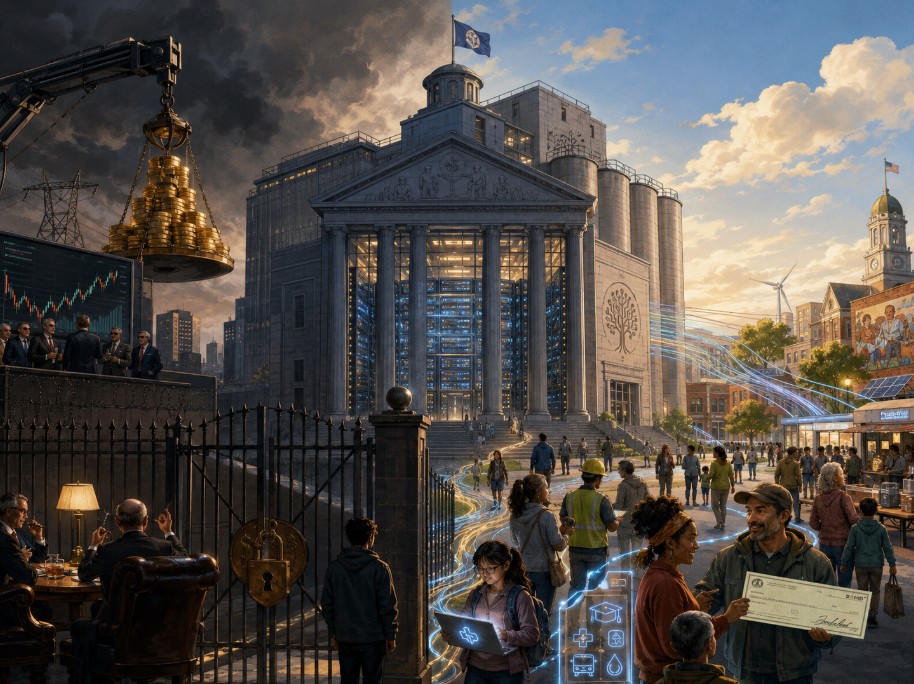
Data is not a commodity. It is a common venue.
And a common venue cannot be privately held.
Every argument about data currently underway is conducted in the wrong grammar.
We debate it as property. Who owns it, who may sell it, who profits, who consents, what it is worth. The metaphor of choice for a decade has been oil — a resource in the ground, extracted, refined, monetized. That metaphor governs privacy law, antitrust theory, the entire “data dividend” discourse, and most of what gets said in a state legislature on the subject.
The metaphor is wrong at the root, and being wrong at the root, it produces remedies that cannot work.
Data at the scale that matters is closer in kind to a courtroom than to a commodity. It is the venue in which claims are established, contested, and honored. Property, contract, citizenship, eligibility, guilt, innocence, title, debt, identity — none of these exist independently of a record asserting them. The record is where they live. Which means the record is not one more thing to be allocated among competing owners. It is the place where all allocation happens.
You cannot privatize a courtroom and then guarantee its litigants a fair hearing by regulating the ticket price.
This essay makes one argument: the register — the substrate on which governance, finance, and recordkeeping operate — must remain in public hands, publicly auditable, and subject to mandatory transparency in both directions. The case rests on a pattern visible across the whole span of recorded history, on a natural experiment already run at a scale of trillions, and on a line of American doctrine that is a century and a half old and has simply stopped being pointed at the layer where it now matters.
I. The record and the enclosure arrived together
The oldest substantial body of writing we possess is a pile of receipts.
The administrative tablets from Uruk, pressed into clay around 3300 BCE, are inventories. Sacks of barley, head of livestock, jars of oil, allotments of beer, the names of those owed and those owing. Before literature, before law, before a surviving line of poetry, there is a count. Writing appears to have emerged from accounting rather than the reverse — from tokens sealed in clay envelopes to marks on the envelope’s surface to the marks alone.
The temple complex that held the grain and the scribal apparatus that recorded it were one institution. To someone standing outside with a claim, the record and the granary were indistinguishable, because a claim the record does not reflect is not a claim. It is a grievance.
This is the founding condition, and it has never been undone. The ledger and the enclosure entered human history as a single technology. Every subsequent attempt to separate them has succeeded only in relocating the ledger into someone’s private custody.
We are in the middle of such an attempt now. It is being conducted in daylight, through ordinary commercial and administrative law, and almost nobody is attending.
II. Everything gets gated
Read history at sufficient depth and a pattern surfaces with almost embarrassing consistency: every resource gets gated, and every gate becomes the leverage on the next resource.
The Han court debated a state salt monopoly in 81 BCE and the transcript survives as the Discourses on Salt and Iron — an argument about whether the state or private merchants should hold the chokepoint on a substance no one can live without. France ran the gabelle for four centuries, structured so punitively that households were compelled to buy a minimum quota whether they needed it or not. Two millennia after the Han debate, Gandhi surveyed the entire apparatus of British administration in India, selected the salt law, and walked to the sea.
England enclosed its commons across four centuries and something over five thousand acts of Parliament. The standard reading is that this was a land grab, which it was. The consequential reading is that it manufactured a labor force by removing the alternative to wages. A person with access to common pasture, fuel, and gleaning can decline an offer. A person without it cannot. No whips were required. The gate did the work.
Amartya Sen won a Nobel for the sharpest version. His finding in Poverty and Famines was that major famines have occurred where food was physically present and in some cases increasing, and what collapsed was not supply but entitlement — the capacity to command food through the prevailing structure of claims. Bengal in 1943 did not run out of rice. People ran out of standing to obtain it. Starvation administered through the claim structure, with the granary full.
Fernand Braudel, working at the scale of centuries, drew the distinction that organizes all of it. Below, the market: transparent, competitive, small transactions, thin margins, the zone of actual exchange. Above it, a second layer he called the anti-market, where the large players operate, where competition is precisely what is absent, and where returns are accordingly enormous. The upper layer is profitable because it is not a market. It is a position.
The position is almost never the resource itself. This is the refinement that matters here. American railroads held power through rate-setting and through what sat at the terminus, rather than through steel. The gate is the bottleneck adjacent to the thing — the counter where the claim is honored or refused.
Data is now that counter for essentially everything.
III. Three registers, one machine
We treat finance, regulation, and recordkeeping as three separate policy domains. Different agencies, different bodies of law, different reporters, different advocacy constituencies. That separation is the single most useful fact available to anyone enclosing the whole.
They are one function.
Money is a register of claims. This is neither metaphor nor heterodoxy; it is the credit theory of money running from Mitchell Innes through Geoffrey Ingham through Graeber, and Narayana Kocherlakota gave it formal treatment in a paper titled, with admirable economy, Money Is Memory. What a dollar records is that the system generally owes you something. The token is an artifact of the accounting.
Regulation is a register of permissions. Who may operate, issue, practice, build, dispense, transport. A license is an entry in a book.
The record proper is a register of facts — title, identity, vital records, liens, court files — which is to say a register of which claims and permissions are held to exist at all.
One machine, three faces. And its operative property is this: it does not much matter who holds a claim if the party maintaining the record disagrees. Money can be present and unavailable. Title can be held and unprovable. A permission can exist in law and be absent from the file. Ask anyone who has tried to prove residency without a document, or contest a debt that appeared in a system with no visible author.
The count is the sovereignty. Everything else is downstream.
The consequence: these three cannot be enclosed separately without the whole being enclosed. And separately is exactly how it is happening.
IV. The experiment already ran
Here is the part that should settle the argument, and generally would if it were better known.
In the mid-1990s the American mortgage industry built a private electronic registry to route around the county recorder. Recording assignments at the courthouse was slow and carried a fee per transfer, and an industry that had begun slicing and reselling loans at high velocity found both intolerable. So it stood up MERS: a private book-entry system holding nominal title while beneficial interest moved as often as the secondary market required. The public register would show one unchanging name. The real chain would live inside a private database.
It worked precisely as designed for roughly a decade.
Then 2008 arrived, foreclosures entered the courts by the million, and judges began asking the question courts exist to ask — who holds the note. In a substantial and never fully quantified number of cases, no one could answer. Assignments were executed after the fact, backdated, or signed in industrial volume by people with no knowledge of the underlying files, a practice that entered the language as robo-signing. State courts split on whether MERS could foreclose at all. Chain of title was clouded across an enormous number of American properties, and portions of that clouding were never cleaned up.
No one conspired. The MERS story has no villain and requires none. The incentive was a recording fee of a few dollars per assignment. A private register substituted for a public one because it was cheaper; the public one atrophied from disuse; and when the moment arrived that the count had to be produced against an adverse party in a courtroom, the count did not exist.
That is this entire essay, executed as a completed natural experiment, in the most boring possible asset class, at a scale of trillions of dollars and millions of households.
V. When the register is run against a person
Michigan deployed an automated system called MiDAS to adjudicate unemployment insurance fraud beginning in 2013. It operated with minimal human review and carried authority to garnish wages and impose penalties at multiples of the alleged overpayment. It issued fraud determinations against tens of thousands of people. Subsequent state review of the auto-adjudicated cases found error rates that can only be called catastrophic — the overwhelming majority were wrong. Litigation ran for years.
Australia ran the same play at national scale. The scheme that became known as Robodebt averaged annual tax data across fortnightly reporting periods, generated debts from the resulting arithmetic mismatch, and — the decisive design choice — reversed the burden of proof, requiring recipients to disprove a debt the state had never established. A Royal Commission concluded in 2023 that the scheme had been unlawful. The government had already settled for roughly $1.8 billion AUD. The Commission’s report addresses, at length, people who died.
In both cases a government handed adjudication to a system it did not fully control, could not fully explain, and would not halt when told it was wrong. The accusation was manufactured inside the register, and the register had no answerable keeper.
Note what neither case involved: hacking, theft, malice, or any breach of privacy in the sense privacy law recognizes. Every data protection statute on the books would have been satisfied. The harm came from the register’s operation, not from its exposure — which is exactly the harm the commodity framing cannot see.
VI. The due process cut
This is the hinge, and it deserves plain statement.
When the register is privately owned, the method of counting is a trade secret. Which means the person the count is run against cannot examine it.
Eric Loomis was sentenced in Wisconsin with the assistance of a proprietary risk score. He was not permitted to inspect how it was produced; the vendor’s method was a protected commercial asset. He challenged on due process grounds. The Wisconsin Supreme Court upheld the sentence in 2016 with cautionary language attached, and the U.S. Supreme Court declined review. Note carefully: Loomis lost. The system operated as designed, and as designed it permits a citizen to be sentenced on evidence he is forbidden to see.
Houston’s teachers went the other way. Evaluated and in some cases terminated on a vendor’s value-added model whose outputs the district itself could not replicate or explain, they sued, and a federal court in 2017 found a plausible procedural due process violation on exactly that ground. Scores that cannot be verified cannot support adverse action. The district settled and abandoned the system.
Due process, reduced to its irreducible core, requires that the record be contestable. You must be able to see the evidence and argue with it. Private ownership of the register renders the evidence unexaminable, and it does so through routine commercial law, with no bad actor required.
Trade secret protection eats the right to confront. That is the mechanism, and it operates automatically.
Which is why this layer cannot be allocated by preference, individual or institutional. You do not opt into the county recorder. You do not opt into the settlement rail. The venue in which claims are adjudicated is not itself a claim, and it cannot be distributed by choice for the same reason a courtroom cannot.
VII. What is already private, and what is being made private now
Americans believe they own their stocks. Nearly all U.S. equities are held in street name through a single nominee, Cede & Co., under the Depository Trust & Clearing Corporation. What a retail holder possesses is a claim against an intermediary inside a private book-entry system. This is neither scandal nor secret; it is the plumbing, dating to the paperwork crisis of the late 1960s. It is simply invisible, which is the point. When brokerages abruptly restricted purchases in specific securities in early 2021, the proximate cause sat in clearing and settlement margin, and the entire public argument was conducted about brokerages and message boards, because the layer where the decision actually lived has no civic vocabulary attached to it.
That architecture is now being extended to money itself. A chartered list of permitted issuers is being assembled through the GENIUS Act framework, OCC approvals of digital asset firms, and FDIC rules for bank-issued payment stablecoins. JPMorgan has issued a deposit token on a public blockchain; Citi has integrated token services into round-the-clock cross-border clearing. Analysts expect final FDIC stablecoin rules by July 2026, with implementation by 2027. The public rail already exists — FedNow has been live since 2023. Whether settlement runs on the public rail or on licensed private rails is being decided right now, in rulemaking, in a room with no gallery.
Observe the mechanism, because it is not the one people expect. No stealth acquisition is required. No majority is accumulated. There is a list of who may issue, and the contest is over membership. The enclosure happens at the licensing counter, on the record, in public documents no one reads.
VIII. The instructive failure
Blockchain belongs here as demonstration rather than threat.
The founding premise was trustlessness — a register requiring no one to be trusted, arithmetic substituting for authority. Take the ambition seriously; it was serious, and it was pursued by serious people.
It did not survive contact with money.
In the open networks, custody concentrated regardless: a handful of mining pools, a staking layer dominated by a few operators, a majority of nodes running on a small number of cloud providers. The distribution was social and economic, and it re-centralized the way distributions do.
And in every deployment touching regulated money or public records, permissionlessness is the first property discarded. Tokenized deposits, chartered stablecoins, CBDC architectures, and — to take the least sinister available example, the World Bank’s FundsChain tool for tracing project disbursements, scaling to roughly 250 projects — are permissioned systems. Someone decides who may validate, who may issue, who may write. The sovereignty question was relocated to the charter counter rather than dissolved. The stated trajectory is toward blockchain as the foundation of a new financial market infrastructure — infrastructure being the operative word, and infrastructure always having an owner.
There is a further design property, discussed openly in the literature as a benefit: programmability. A token can carry conditions — expiry, merchant category restriction, geographic limit, velocity cap. The keeper need not disagree with your claim after the fact. The instrument can be built to refuse in advance.
So the most ambitious attempt in history to build a register requiring no sovereign has chiefly demonstrated that registers require sovereigns. Cryptography can make a record tamper-evident. It cannot make a record legitimate. Legitimacy is a political property; it derives from the keeper being answerable, and no cryptographic substitute for answerability exists.
There is no technological exit from the governance question. The register always has a keeper. The only live question is whether the keeper can be reached.
IX. The doctrine is already built
Nothing here requires legal invention. American law contains the instrument and has for a hundred and fifty years; it has merely stopped being aimed at the layer that now matters.
The root is the common carrier duty, inherited from English law and older than the republic: innkeepers, ferrymen, wharfingers, and carriers were bound to serve all comers on reasonable terms. The obligation attached to the function performed, indifferent to who held title.
Munn v. Illinois carried it into American constitutional law in 1877 over grain elevators at Chicago — the terminus, the actual gate on the American grain trade. Property devoted to a public use, the Court held, borrowing from Lord Hale, is clothed with a public interest and becomes subject to public control. Ownership did not exempt the elevator from the obligations attaching to where it stood.
Marsh v. Alabama, 1946, maps most cleanly onto the present. A corporation owned an entire town, sidewalks included, and tried to exclude someone distributing literature on the theory that the streets were private property. The Court held that a street performing a public function carries public obligations regardless of the deed. Private title did not extinguish public character.
The register is the wharf, the elevator, and the sidewalk. The doctrine is sitting there.
X. Scope
State this precisely or an opponent will inflate it for you.
This is not a proposal to nationalize graphics processors or socialize frontier model development. Compute hardware is mass-produced, fungible, and depreciating on a three-to-five-year clock — close to the worst imaginable asset to enclose. Nor is it a claim that the state should build everything, operate everything, or hold everything.
It is five things.
The register of record. Title, identity, vital records, liens, court files, licenses. Public by default, publicly maintained, publicly auditable, with no private substitute permitted to displace it. The MERS lesson is that a private register allowed to stand in for a public one will hollow it out and then fail at the exact moment it is needed.
The settlement rail. A public payment and settlement layer available on common-carrier terms, so that access to the means of transacting is not a licensed privilege revocable under someone’s terms of service.
Any model used in an adverse determination against a person. If it can garnish wages, deny a benefit, revoke a license, or lengthen a sentence, it is evidence, and evidence must be examinable by the party it is used against. No trade secret exemption. This is a due process floor rather than an ownership question, and it may be the most immediately winnable item on the list.
A public option in general capacity. On the public power authority model — a floor rather than a monopoly. Sufficient publicly held storage and compute that governments are not captive tenants negotiating from zero leverage over their own records.
Bidirectional transparency, which is the subject of the next section and the load-bearing element of the whole design.
XI. Objections
“This builds a surveillance state.”
The strongest counter, and it should be raised by proponents before opponents get to it.
The concentration exists under either arrangement. Nobody is choosing between a concentrated register and a diffuse one; the register is concentrated because that is what registers are. The choice is between a register with remedies attached and a register with the remedies stripped off.
Public ownership is the condition under which open records law applies, due process attaches, judicial review is available, an inspector general has jurisdiction, and an election can eventually reach the thing. Every one of those handles exists because the function is public. Privatization does not decentralize the register. It removes the handles and leaves the concentration standing. MERS was not less centralized than a county recorder’s office. It was equally centralized and unreachable.
But “the alternative is worse” is a weak place to finish, so finish somewhere else: mandatory transparency running both directions, built into the architecture rather than promised in policy.
Every register already keeps a record of what it holds. A public register must additionally keep a record of its own use, and that second record must be as available to the subject as the first.
Concretely, four requirements:
Access logging as a public function. Every query against a person’s record generates an immutable entry: who looked, when, under what authority, for what stated purpose. Not a policy commitment. A structural property, where lookups cannot execute without writing the log.
Subject notification by default. The person whose record was accessed can see who accessed it, on the model of the medical record disclosure accounting, with narrow, judicially supervised, time-limited exceptions for active investigation — exceptions that expire and then notify.
Published aggregate statistics. Volume of queries by agency, by purpose, by outcome, published on a fixed cycle. This is the layer that catches patterns no individual subject can see from inside their own file.
Adversarial audit standing. A named entity with the resources and legal standing to interrogate the system on the public’s behalf, structurally independent of the agencies operating it. Something with actual subpoena power and a budget.
The point of this design is that it is available only under public ownership. You cannot log a private system you cannot inspect. You cannot audit a trade secret. You cannot notify a subject about a query executed inside a vendor’s black box, because you do not know the query occurred. Every one of these mechanisms presupposes the thing being defended.
Which reverses the objection. Mandatory transparency is not a mitigation bolted onto public ownership to make it tolerable. It is the reason public ownership is the safer arrangement.
“Government cannot run technology.”
Sometimes true, and the failures cited here — MiDAS, Robodebt — were government systems, which is worth conceding directly.
Two responses. First, both were vendor-built, procured under contracts that transferred neither the source nor the operational understanding, which is a version of the disease rather than a counterexample. Second, the argument is about ownership and auditability, which is separable from operation. Municipal water authorities contract out construction and retain the asset and the accountability. The demand is that the register, the logs, and the method remain publicly held and publicly examinable — not that a state IT department write all the code.
“Hardware cycles are five years and municipal bonds are thirty.”
Correct, and it is the reason the scope above excludes hardware. The durable public asset is the register, the schema, the audit trail, and the legal right of access. Those outlast any machine they sit on. Data portability and format neutrality do the work here; the obligation is that the record can always be lifted off whatever it currently runs on, which is also the anti-lock-in provision.
“Public ownership just relocates capture.”
Partly true, and the honest answer is that public ownership converts capture from a private-law problem into a political one. Political problems are ugly, slow, and sometimes lost. They are also contestable, which is the entire distinction. A captured agency can be sued, investigated, defunded, reorganized, and voted at. A vendor contract with an integration clause and a trade secret assertion offers none of those surfaces.
“This is a taking.”
It is a regulation of function, which is what Munn established over the same objection, raised by the same kind of party, and rejected. Grain elevator operators argued that public control of their rates confiscated their property. The Court held that property devoted to a public use accepts the obligations of that use. Nobody proposes seizing anyone’s servers.
XII. Where the gate actually is
A tactical note, because the fight is not being held where the signage says.
The visible battle is over data centers, conducted as an argument about compute, water, land, and neighborhood impact. Those are real concerns. They are also not the position.
The scarce good is grid interconnection and firm power. Average grid-connection wait times in primary data center markets now exceed four years, which means the binding constraint is administered through public process — interconnection queues, utility commissions, transmission planning, siting authority, tariff design. That is the elevator at the terminus. It is publicly owned, publicly governed, and being negotiated away in increments through abatement, preemption, and rate design, in dockets with no gallery. Pennsylvania has spent three decades demonstrating what results when public subsidy and private control are packaged together and the ownership question is never put; the KOZ statute is one instance among many.
The five largest hyperscalers are spending on the order of $725 billion in capital expenditure this year, with projections of roughly 100 GW of new capacity between 2026 and 2030 — effectively doubling global capacity. That spending is overwhelmingly about AI, and the demand behind it is genuine. Which is exactly why it functions as cover. The loud infrastructure story absorbs the entire available supply of civic attention while the register question rides underneath, unexamined, decided in rulemaking, with the public comment period spent on cooling towers.
Two indicators are worth watching, both more honest than anything anyone says. Watch what capital is willing to lose money on, because sustained losses mean someone is buying position rather than return. And watch where the lobbying goes, because policy spend marks where the players believe the gate is.
XIII.
Return to Uruk.
The scribe pressing barley allotments into wet clay was performing the oldest continuous function of organized human life, and the reason that function produced writing before it produced poetry is that a settlement requires an agreed count before it requires anything else. Who is owed. Who owes. What exists. The register is the substrate on which every subsequent claim — property, contract, citizenship, guilt, innocence — is inscribed.
That substrate is now being moved onto privately chartered infrastructure, financed substantially by public subsidy and public grid capacity, through three separate policy conversations that never reference one another, on rulemaking timelines measured in months.
The motives are ordinary. Nothing occult is required and nothing novel is being attempted. Every resource gets gated, and every gate becomes the leverage on the next. This one happens to be the gate all the other gates run through.
A register that cannot be examined is not a record. It is an assertion with an enforcement mechanism attached. The distinction between those two things is most of what separates a citizen from a subject, and it is being decided this year, in dockets, by default.